CM Himanta's Assam Rolls Out Employee Welfare Roadmap
Synopsis
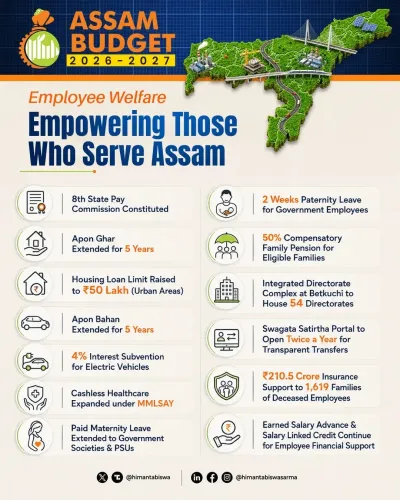
The Chief Minister's Office of Assam announced an Employee Welfare Roadmap on 23 May 2026, promising comprehensive insurance and welfare measures for state government employees under CM Dr. Himanta Biswa Sarma, framing it as a sustained commitment to workforce dignity, security, and growth.
Key Takeaways
The Chief Minister's Office of Assam announced the 'Employee Welfare Roadmap' on 23 May 2026 .
The roadmap promises comprehensive insurance covers and robust welfare initiatives for state government employees.
Himanta Biswa Sarma is credited as leading this sustained commitment to workforce welfare.
The initiative aims to guarantee dignity, security, and growth for Assam state personnel.
State budget allocations and formal government orders will determine the operational scope of the roadmap.
The move fits a broader pattern of Indian state governments expanding public sector employee welfare to improve retention and governance efficiency.
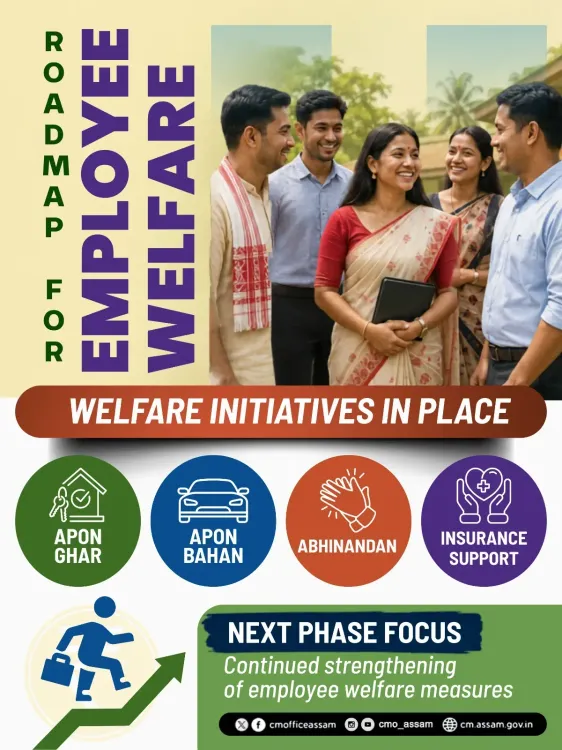
The Chief Minister's Office of Assam on Saturday, 23 May 2026 announced the state's 'Employee Welfare Roadmap', describing it as a framework designed to guarantee security, dignity, and growth for the Assam state government workforce through welfare initiatives and comprehensive insurance covers.
Context
The announcement, posted on the official CMO Assam account, frames the roadmap as a sustained commitment under Chief Minister Dr. Himanta Biswa Sarma. The post states the initiative 'ensures absolute security for the state workforce through robust welfare initiatives and comprehensive insurance covers,' positioning it as a cornerstone of the administration's personnel policy.
The language of the post — emphasising 'dignity, security and growth' — signals that the roadmap is intended to cover not just financial protection but also the broader professional well-being of state employees powering Assam's developmental agenda.
Policy Backdrop
Dr. Himanta Biswa Sarma has led the Assam government since May 2021, with administrative reforms and workforce management forming a stated priority of his tenure. Expanding insurance and welfare covers for public sector employees is a pattern seen across Indian state governments, typically aimed at improving retention and administrative efficiency.
In Assam's case, such measures are situated within the broader Northeast development framework, where attracting and retaining a capable state workforce is viewed as foundational to sustained governance. State budget allocations for welfare and insurance schemes are the key instrument through which such roadmaps are operationalised.
Stakeholders and Impact
The primary beneficiaries of the Employee Welfare Roadmap are Assam state government employees — a large constituency that spans departments ranging from health and education to revenue and police. Comprehensive insurance cover, if implemented robustly, directly reduces financial vulnerability for government personnel and their families.
For the state administration, a well-protected and financially secure workforce is also a governance efficiency argument: reduced attrition, higher morale, and stronger institutional continuity. The announcement is therefore as much a signal to serving employees as it is a statement of administrative intent.
What's Next
Observers will watch for formal government orders detailing the specific insurance schemes, coverage amounts, and eligibility criteria that constitute the roadmap. Assam's state budget allocations for employee welfare in the current fiscal year will be a key indicator of the financial commitment behind the announcement.
As Indian states compete to modernise their public administration, Assam's formalisation of a named welfare roadmap for employees could set a template for other Northeast states looking to strengthen workforce security within tighter fiscal envelopes.
Point of View
A constituency that matters electorally and administratively. Framing employee welfare in terms of 'dignity and security' borrows from the language of rights-based governance, which has gained traction across Indian states seeking to differentiate their administrative identity. The announcement also fits a Northeast-specific pattern where state governments must work harder to retain skilled personnel against the pull of opportunities elsewhere. The real test will lie in the specifics: the coverage amounts, the range of schemes, and the budget backing that translate a roadmap into measurable outcomes.
NationPress
7 Oct 2026
Frequently Asked Questions
What is the Assam Employee Welfare Roadmap?
The Assam Employee Welfare Roadmap is a policy framework announced by the Chief Minister's Office of Assam on 23 May 2026, aimed at providing comprehensive insurance covers and welfare initiatives to secure the dignity, security, and growth of state government employees.
Who announced the Assam Employee Welfare Roadmap?
The announcement was made by the official Chief Minister's Office of Assam on X, attributing the initiative to Chief Minister Dr. Himanta Biswa Sarma.
Who benefits from the Assam Employee Welfare Roadmap?
The roadmap is designed for Assam state government employees across all departments, offering them welfare initiatives and insurance coverage.
What does the Assam government employee welfare scheme include?
Based on the announcement, the scheme includes robust welfare initiatives and comprehensive insurance covers, though the specific details of coverage and eligibility are expected to be outlined in formal government orders.
How does Assam's employee welfare initiative compare to other Indian states?
Expanding insurance and welfare covers for public sector employees is a broader trend across Indian states, aimed at improving workforce retention and administrative efficiency; Assam's formalised roadmap places it among states proactively structuring such measures within the Northeast development framework.