CM Himanta Launches Cashless Health Cover for Assam Govt Staff
Synopsis
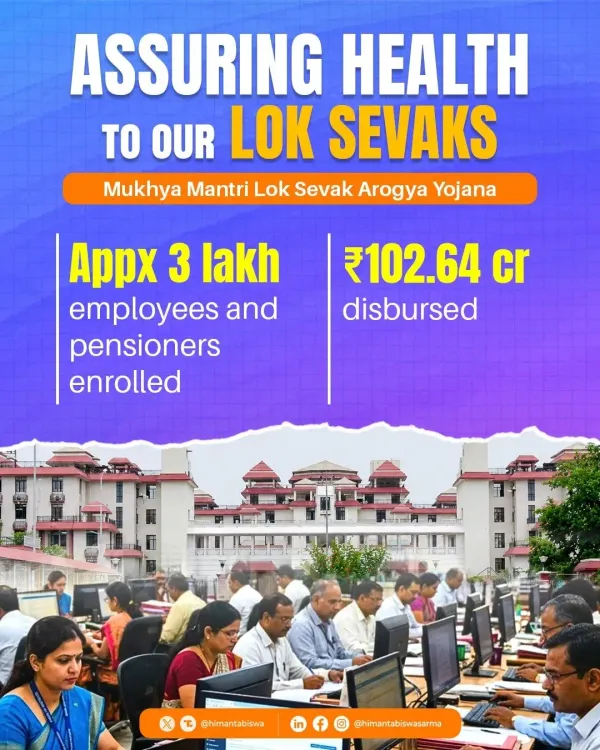
Assam Chief Minister Himanta Biswa Sarma announced that the Mukhya Mantri Loksevak Arogya Yojana has disbursed over ₹100 crore in cashless health claims to state government employees, addressing a long-standing gap in their medical coverage.
Key Takeaways
Assam CM Himanta Biswa Sarma confirmed the Mukhya Mantri Loksevak Arogya Yojana has crossed ₹100 crore in health claims disbursed to state government employees.
The scheme provides cashless health insurance — a benefit state government employees in Assam previously lacked.
Sarma acknowledged the gap had persisted 'for years' before the current administration acted.
The cashless design eliminates the need for upfront hospital payments, reducing financial burden during medical emergencies.
Future expansions to contractual staff or pensioners have not been announced but remain a logical next step to watch.
For years, the men and women running Assam's government machinery had no reliable cashless health cover — a gap that quietly eroded both their welfare and the state's ability to retain talent. Assam Chief Minister Himanta Biswa Sarma announced on Monday, August 3, 2026, that the Mukhya Mantri Loksevak Arogya Yojana has now delivered over ₹100 crore in health claims to state government employees, closing a long-standing institutional blind spot.
The gap that ₹100 crore is now filling
State government employees are the backbone of public service delivery — from district collectors to frontline health workers — yet they lacked what most formal-sector workers take for granted: a structured, cashless medical safety net. The Mukhya Mantri Loksevak Arogya Yojana was designed specifically to fix that. Sarma's post frames the milestone plainly: 'Our State Govt employees have been at the forefront of building a resilient Assam but for years lacked a proper cashless health insurance scheme.'
The ₹100 crore figure represents actual claims disbursed — not allocations on paper — signalling that the scheme has moved beyond launch-day optics into operational scale.
Employee welfare as a governance lever in Assam
The Sarma administration, in office since 2021, has positioned employee welfare alongside broader health reforms as a pillar of its governance pitch in the Northeast. Across India, state governments have used targeted employee health schemes as tools for both retention and morale — particularly in states competing with the private sector for skilled administrators. Assam's move follows that pattern, but the explicit acknowledgment that the gap existed 'for years' is a pointed political signal: the current dispensation is framing itself as the government that finally acted.
The scheme's cashless design matters in practice. In medical emergencies, upfront payment requirements at hospitals have historically forced employees to dip into savings or take loans — a burden the Yojana is built to eliminate at the point of care.
What the ₹100 crore milestone signals going forward
Crossing ₹100 crore in claims is a utilisation benchmark, not a ceiling. The figure suggests significant uptake among the beneficiary pool of state government employees — and raises the question of whether the scheme will be extended to contractual staff, pensioners, or other categories currently outside its ambit. Future government reports on claim volumes and possible scope expansions will be the real measure of the scheme's ambition.
For now, the number does the work: a hundred crore rupees in health claims processed is a hundred crore reasons why the scheme's critics will find it hard to argue the gap was never real.
Point of View
And putting a rupee figure on the fix. In the Northeast, where state capacity and employee morale are perennial governance challenges, anchoring a health scheme to actual claims data rather than budgetary allocations is a sharper accountability move than most state governments attempt. The broader pattern across India shows employee health schemes doubling as retention tools; Assam's version fits that arc but arrives with a distinctly electoral framing ahead of future cycles in the region.
NationPress
17 Sept 2026
Frequently Asked Questions
What is the Mukhya Mantri Loksevak Arogya Yojana?
The Mukhya Mantri Loksevak Arogya Yojana is a cashless health insurance scheme launched by the Assam state government specifically for its employees, designed to cover medical expenses without requiring upfront payments at hospitals.
How much has Assam paid out under the Loksevak Arogya Yojana?
Assam CM Himanta Biswa Sarma announced that the scheme has delivered over ₹100 crore in health claims to state government employees as of August 2026.
Who benefits from the Mukhya Mantri Loksevak Arogya Yojana in Assam?
The scheme covers Assam state government employees, providing them cashless medical insurance that was previously unavailable to this group.
Why did Assam launch a separate health scheme for government employees?
State government employees in Assam lacked a structured cashless health insurance scheme for years. The Mukhya Mantri Loksevak Arogya Yojana was introduced by the Sarma administration to fill that gap and reduce the financial burden on employees during medical emergencies.
Will the Assam government health scheme be extended to other workers?
As of August 2026, no official announcement has been made about expanding the scheme beyond state government employees, but future utilisation reports and scope expansions remain a key development to watch.