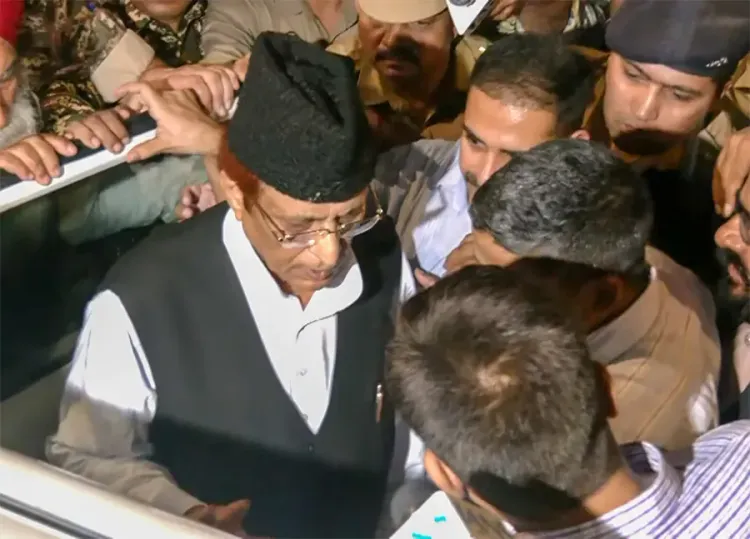
Azam Khan sent to 14-day judicial custody in Jauhar University money laundering case
Synopsis
A day after the Enforcement Directorate arrested him, SP's Azam Khan has been remanded to 14-day judicial custody — his legal team immediately challenged the arrest's procedural basis. With ₹1,170 crore in university assets already attached and 26 FIRs underlying the probe, this is among the most serious legal challenges yet to a sitting opposition leader in Uttar Pradesh.
Key Takeaways
Mohammad Azam Khan was sent to 14 days of judicial custody by the Ghaziabad MP-MLA Court on 1 November 2026 .
He was arrested by the Enforcement Directorate (ED) on Saturday in a money laundering case linked to Maulana Mohammad Ali Jauhar University , Rampur.
The ED has attached university assets with an estimated market value of ₹1,170 crore ; the latest provisional attachment was valued at ₹426.46 crore .
The case is rooted in 26 FIRs alleging forcible acquisition of farmers' land and illegal occupation of 34 acres of enemy property.
Khan's lawyer Danish Ali challenged the arrest's procedural validity, citing a violation of Section 19 and arguing a B-Warrant should have been used.
Khan will remain in custody until 13 November , when the court is scheduled to review the matter.
Samajwadi Party (SP) leader Mohammad Azam Khan was on Sunday, 1 November 2026, sent to 14 days of judicial custody by the Ghaziabad MP-MLA Court, a day after his arrest by the Enforcement Directorate (ED) in connection with a money laundering case linked to Maulana Mohammad Ali Jauhar University in Rampur, Uttar Pradesh. The court directed that Khan will remain in judicial custody until 13 November.
What the Court Ordered
The Ghaziabad MP-MLA Court passed the remand order following the ED's request for further interrogation. Khan's lawyer, Danish Ali, told reporters: 'Today, Azam Khan has been remanded to judicial custody. We argued that since this is a 2019 case, the authorities could have taken action through a B-Warrant when he was already in custody. There has also been a violation of Section 19.'
Ali added: 'The ED has sought his custody to further interrogate him.' The defence's challenge signals that a legal battle over the arrest's procedural validity is likely to intensify in the days ahead.
The Money Laundering Probe and Asset Attachments
Khan's arrest came shortly after the ED provisionally attached land and buildings belonging to Mohammad Ali Jauhar University in Rampur district, valued at ₹426.46 crore. In total, the agency has attached university assets with a current estimated market value of approximately ₹1,170 crore in connection with this money laundering investigation involving the Maulana Mohammad Ali Jauhar Trust, Khan, and others.
The university campus, situated at Jauhar Nagar in Rampur's Singhankhera village, is owned by the Maulana Mohammad Ali Jauhar Trust — an institution founded and controlled by Khan, who also serves as its honorary Chancellor, according to the ED.
Origin of the Case: Land Acquisition Allegations
The investigation traces back to 26 FIRs registered at Azeem Nagar police station in Rampur, alleging that agricultural land belonging to farmers was forcibly acquired to build the university. According to the ED, enquiries by the district administration further found that nearly 34 acres of enemy property at Singhankhera village had allegedly been occupied for the university despite the cancellation of a land lease. That land has since been recovered by the Custodian of Enemy Property through the district administration.
The Political and Legal Backdrop
The arrest comes at a significant moment for Khan. Just days earlier, the Allahabad High Court had offered him and his son Abdullah Khan a short-lived reprieve — suspending their sentence in the dual PAN card case and granting them bail on Thursday. The ED's move effectively offset that relief, placing the veteran SP leader back in custody under a separate and considerably more serious set of charges.
This is not Khan's first brush with incarceration; he previously spent over two years in Sitapur Jail following convictions in multiple cases before securing bail. The latest development is likely to deepen divisions within the SP's political calculus ahead of upcoming state-level contests.
What Happens Next
Khan will remain in judicial custody until 13 November, when the court is expected to review the matter. The ED may seek further custody extensions depending on the progress of its interrogation. Legal challenges to the arrest's procedural basis, flagged by the defence team, are expected to be argued before higher courts in the coming days.
Point of View
Effectively neutralising that relief. The ₹1,170 crore attachment figure is substantial enough to threaten the operational future of Jauhar University itself, not just its founder's liberty. The defence's procedural challenge — invoking Section 19 and a B-Warrant argument — suggests the legal fight will move well beyond the trial court. For the Samajwadi Party, the episode underscores a recurring vulnerability: its most prominent Muslim face remains enmeshed in legal proceedings that constrain his political effectiveness at precisely the moment UP's opposition needs consolidation.
NationPress
1 Nov 2026
Frequently Asked Questions
Why was Azam Khan sent to judicial custody?
Azam Khan was sent to 14-day judicial custody by the Ghaziabad MP-MLA Court on 1 November 2026, a day after the Enforcement Directorate arrested him in connection with a money laundering case linked to Maulana Mohammad Ali Jauhar University in Rampur. The ED sought further custody to interrogate him regarding the alleged laundering of proceeds derived from forcible land acquisition.
What is the Jauhar University money laundering case?
The case stems from 26 FIRs at Azeem Nagar police station in Rampur, alleging that agricultural land belonging to farmers was forcibly acquired to build Mohammad Ali Jauhar University. The ED has linked the proceeds of this alleged crime to money laundering by the Maulana Mohammad Ali Jauhar Trust, Azam Khan, and others, attaching assets worth approximately ₹1,170 crore in total.
How much property has the ED attached in this case?
The ED has attached university assets with a total estimated market value of approximately ₹1,170 crore. The most recent provisional attachment, made just before Khan's arrest, covered land and buildings valued at ₹426.46 crore.
What is Azam Khan's lawyer arguing?
Khan's lawyer Danish Ali argued that since this is a 2019 case, the authorities could have used a B-Warrant while Khan was already in custody instead of making a fresh arrest. He also alleged a violation of Section 19 of the Prevention of Money Laundering Act, signalling that the defence plans to challenge the arrest's procedural validity in higher courts.
What happens next in the case?
Azam Khan will remain in judicial custody until 13 November 2026, when the court is expected to review the remand. The ED may apply for a custody extension to continue interrogation, while the defence is expected to challenge the arrest before higher courts on procedural grounds.