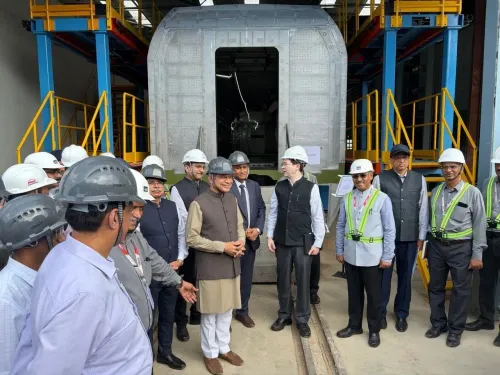
Giriraj Singh: Made-in-India Bullet Train Taking Shape at BEML
Synopsis
Union Textiles Minister Giriraj Singh highlighted the construction of India's first 'Made in India' bullet train at BEML's Bengaluru plant, framing it as a milestone for Atmanirbhar Bharat and PM Modi's vision for self-reliant, high-technology domestic manufacturing.
Key Takeaways
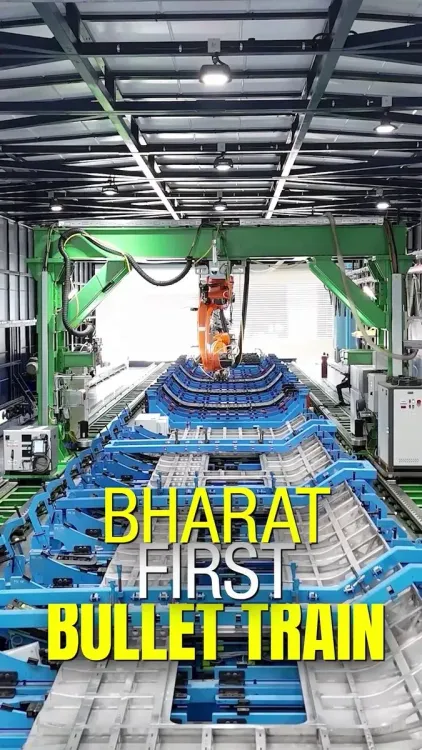
Union Textiles Minister Giriraj Singh posted a video on 1 November 2026 showing bullet train construction at BEML, Bengaluru .
He described it as India's first 'Made in India' bullet train, built in alignment with PM Narendra Modi 's Atmanirbhar Bharat vision.
BEML (Bharat Earth Movers Limited) is a Bengaluru-based public sector undertaking with an established track record in rail coaches and metro rolling stock.
India's Mumbai–Ahmedabad High Speed Rail corridor, approved in 2015 with Japanese assistance, is the flagship project driving demand for indigenous high-speed rolling stock.
The development follows the indigenisation arc seen earlier with the Vande Bharat Express under the Make in India initiative launched in 2014 .
Key milestones to watch include prototype testing, local-content certification, and railway budget allocations for high-speed rolling stock procurement.
A new chapter in India's high-speed rail ambitions is being written on the factory floor in Bengaluru — and Union Textiles Minister Giriraj Singh wants the country to know it. On Sunday, 1 November 2026, Singh posted a video on X showcasing what he described as the construction of India's first 'Made in India' bullet train at the facilities of BEML (Bharat Earth Movers Limited), calling it a symbol of the new India's capabilities aligned with Prime Minister Narendra Modi's vision.
Posting in Hindi, Singh wrote: 'Aatmanirbhar Bharat ki nayi raftaar!' ('A new speed for self-reliant India!'), adding that the construction work at the Bengaluru-based BEML facility is 'progressing rapidly' and represents 'a confluence of cutting-edge technology and Indian skill — a powerful symbol of new India's capability.'
BEML's Role in India's High-Speed Rail Push
Bharat Earth Movers Limited, headquartered in Bengaluru, Karnataka, is a central public sector undertaking with a decades-long track record in rail coaches, metro cars, and heavy earth-moving equipment. The company has previously supplied coaches for Indian Railways and rolling stock for multiple urban metro systems across the country. A pivot toward high-speed rail manufacturing would mark a significant escalation of BEML's technological footprint.
India's flagship high-speed rail project — the Mumbai–Ahmedabad High Speed Rail corridor — was approved in 2015 with Japanese technical and financial assistance under the Shinkansen framework. Over the years, a central question has been how much of the rolling stock and infrastructure would eventually be manufactured domestically. Singh's post suggests that indigenisation is now actively under way, not merely planned.
Make in India, Atmanirbhar Bharat — and the Rail Sector's Evolving Blueprint
The political and policy framing here is deliberate. Make in India, launched in 2014, set the broad ambition of turning India into a global manufacturing hub. Atmanirbhar Bharat, announced in 2020, sharpened that focus toward strategic self-reliance — railways being one of the most symbolically loaded sectors. The domestic success of the Vande Bharat Express, indigenously designed and produced, gave the government a proof-of-concept it has leaned into politically and practically.
Bullet train manufacturing is a steeper climb: the technology envelope, precision engineering requirements, and quality certifications involved are of a different order than conventional express trains. That is precisely why the BEML facility's reported progress — if it moves from assembly toward full indigenous production — would represent a qualitative leap, not just a quantitative one.
What the Milestone Watch Looks Like From Here
The next concrete markers to track are prototype testing timelines, local-content certification thresholds set by Indian Railways, and railway budget allocations for indigenous high-speed rolling stock. Tender outcomes for future procurement will also signal how seriously the government intends to back domestic manufacturers with actual orders, rather than aspirational announcements.
India has done it before with metro coaches and Vande Bharat. The question now is whether bullet trains follow the same arc — from dependence to indigenisation, one factory floor at a time.
Point of View
A public-sector undertaking, as the manufacturing site is also pointed: it frames state-led industrialisation, not just private-sector FDI, as the engine of self-reliance. If the bullet train project delivers on indigenisation benchmarks, it will substantially strengthen the government's 'Make in India works at the frontier' argument ahead of future elections. The open question — how much of the supply chain is truly domestic versus assembled from imported sub-systems — will determine whether this becomes a durable policy achievement or a headline that outpaces the engineering reality.
NationPress
1 Nov 2026
Frequently Asked Questions
Where is India's first Made-in-India bullet train being built?
According to Union Textiles Minister Giriraj Singh's post, construction is under way at BEML (Bharat Earth Movers Limited) 's facility in Bengaluru, Karnataka .
What is BEML and why is it significant for bullet trains?
BEML (Bharat Earth Movers Limited) is a Bengaluru-based central public sector undertaking with a long history of manufacturing rail coaches, metro cars, and heavy equipment. Its involvement in bullet train production would mark a major step up in India's high-speed rail indigenisation.
What is India's bullet train project?
India's flagship high-speed rail project is the Mumbai–Ahmedabad High Speed Rail corridor , approved in 2015 with Japanese technical and financial support. It is designed to run trains at speeds comparable to Japan's Shinkansen.
What is Atmanirbhar Bharat and how does it relate to railways?
Atmanirbhar Bharat , launched in 2020 , is India's policy campaign for self-reliance in strategic sectors. In railways, it has driven domestic manufacturing of rolling stock — most visibly with the Vande Bharat Express — and now potentially extends to bullet trains.
Why did Giriraj Singh post about a bullet train when he is the Textiles Minister?
As a senior BJP leader and Union Cabinet minister, Singh regularly amplifies government-wide achievements aligned with PM Modi 's Atmanirbhar Bharat and Make in India narratives, even those outside his direct portfolio of Textiles.