CPI(M)-Mamata bonhomie at INDIA bloc rally unsettles Bengal Left workers
Synopsis
A single photograph from an INDIA bloc rally — showing CPI(M) chief M. A. Baby whispering into Mamata Banerjee's ear — has exposed a widening fault line inside the Left: can it fight the BJP nationally while remaining a credible opposition to Trinamool in Bengal? The answer is splitting the party between pragmatic uniters and ideological hardliners, with real consequences for Left revival in West Bengal.
Key Takeaways
An unverified photograph from Sunday's INDIA bloc rally in New Delhi showing CPI(M) General Secretary M.
Baby and Mamata Banerjee in apparent camaraderie has sparked internal Left unease.
The core dispute: whether fighting the BJP nationally requires softening the Left's opposition to Trinamool Congress in West Bengal .
One Left faction backs 'anti-BJP unity'; hardliners warn it blurs political identity and echoes a failed Congress alliance strategy in Bengal.
Baby's approach is being described within party circles as 'Baby steps' away from the independent-Left framework championed by former General Secretary Prakash Karat .
Bengal Left workers, many of whom faced Trinamool's alleged crackdowns post- 2011 , view the leadership's proximity to Mamata with deep suspicion.
The CPI(M) 's parliamentary strength is a fraction of its historic peak, making the unity debate both urgent and fraught.
CPI(M) General Secretary M. A. Baby's visible warmth toward All India Trinamool Congress (TMC) chief Mamata Banerjee at a recent INDIA bloc rally in New Delhi has reportedly triggered a sharp internal debate within sections of the Left Front, raising uncomfortable questions about whether national Opposition unity can coexist with an uncompromising fight against Trinamool in West Bengal. The unease, observers say, risks fracturing the relationship between the party's top leadership and its grassroots cadre.
The Image That Ignited the Debate
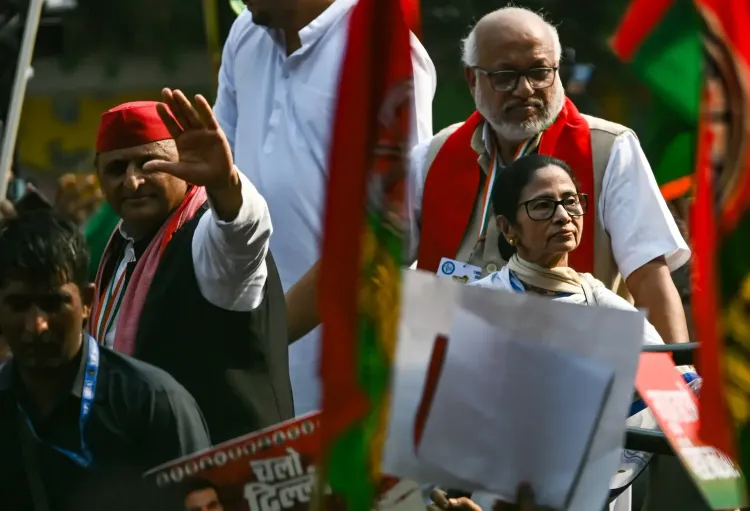
An unverified photograph from Sunday's INDIA bloc rally in New Delhi — circulating widely — reportedly shows Baby leaning in to whisper into Mamata's ear as she listens attentively, with a smile. The optics alone, according to Left insiders, would have been 'unbelievable' and 'abhorred' even in the recent past. Mamata's defining political project over the last decade-and-a-half has been dismantling West Bengal's Left Front bastion — a goal she accomplished in 2011, roughly 13 years after breaking away from the Indian National Congress (Congress).
The Fault Line Inside the Left
At the heart of the controversy is a strategic question: can the Left fight the Bharatiya Janata Party (BJP) nationally while simultaneously maintaining an adversarial posture against Trinamool in Bengal? Two schools of thought have emerged.
One camp argues that confronting the 'larger enemy' — the BJP — requires the Left to treat the 'enemy's enemy' as a temporary ally, even when that ally has historically been a regional opponent. Proponents point to how the CPI(M)'s central decision-making body previously sanctioned support to Congress in its fight against 'communal forces', suggesting ideological flexibility is not unprecedented. They further argue that withdrawing support from the Congress-led United Progressive Alliance (UPA) marked the beginning of the Left's sustained electoral erosion.
The opposing camp is equally vocal. It points to the failure of the Left-Congress alliance in West Bengal to mount a credible challenge against Trinamool during Mamata's heydays, as evidence that tactical alliances with ideologically inconvenient partners yield diminishing returns. This group also flags the structural contradiction: the Left coalition remains in direct electoral contest against a Congress-led alliance in Kerala, making a fully unified national posture difficult to sustain at the state level.
Baby's Line vs Karat's Legacy
Observers note that since taking charge of the CPI(M), Baby has placed considerable emphasis on 'anti-BJP unity', and his interactions with Mamata within the INDIA bloc framework have been characterised as 'cordial'. Within party circles, media reports suggest a section is already describing the new political direction as 'Baby steps' away from the strategic framework associated with veteran Marxist leader and former General Secretary Prakash Karat — who had long insisted on maintaining the Left's independent political identity, separate from both the BJP and the Congress.
For years, the Bengal Left maintained publicly that the BJP and Trinamool represented 'two sides of the same coin'. Senior Left leaders had argued that any political understanding with Mamata Banerjee would weaken their independent political space and confuse their cadre base — particularly in a state where the party alleges sustained atrocities on its supporters under her administration.
Grassroots Anxiety in Bengal
In West Bengal, Left workers who confronted Trinamool at the ground level during Mamata's tenure reportedly view the leadership's growing proximity with deep suspicion. Their concern is twofold: that blurred political messaging could further erode the Left's already diminished independent support base, and that it reinforces the perception that the party has accepted a secondary, support role in state politics rather than mounting a genuine revival.
The CPI(M)'s parliamentary presence today is a fraction of what it was at its peak, which many within the party acknowledge has made Opposition unity a strategic necessity rather than merely a tactical option. Whether that necessity can be communicated convincingly to workers on the ground in Bengal — where the wounds of post-2011 political violence remain fresh — will be the defining challenge for Baby's leadership in the months ahead.
Point of View
Which is precisely the problem. Baby's dilemma is structural — the CPI(M) cannot be simultaneously the anti-BJP glue nationally and Trinamool's principal challenger in Bengal without one project cannibalising the other. The Left's post-2011 collapse in Bengal was not purely electoral; it was a crisis of political identity, and no amount of INDIA bloc optics can paper over the fact that Mamata Banerjee built her career on dismantling exactly what Baby is now shaking hands with her to protect.
NationPress
4 Nov 2026
Frequently Asked Questions
What triggered the debate inside the Left Front about Mamata Banerjee?
An unverified photograph from Sunday's INDIA bloc rally in New Delhi, reportedly showing CPI(M) General Secretary M. A. Baby whispering into Mamata Banerjee's ear as she smiled, has triggered discomfort within sections of the Left. The image has reignited a long-running internal debate about whether the party can pursue national anti-BJP unity while maintaining an adversarial stance against Trinamool Congress in West Bengal.
What are the two positions within CPI(M) on working with Mamata Banerjee?
One faction argues that fighting the BJP — described internally as the 'larger enemy' — requires treating regional adversaries like Trinamool as tactical allies. The opposing camp warns that such proximity blurs the Left's political identity, citing the failure of past Left-Congress alliances in Bengal to challenge Mamata and the Left's ongoing electoral contest against Congress in Kerala.
How does M. A. Baby's approach differ from Prakash Karat's political line?
Former CPI(M) General Secretary Prakash Karat championed the Left's independent political identity, separate from both the BJP and the Congress bloc. Baby has emphasised 'anti-BJP unity' and maintained reportedly cordial interactions with Mamata within the INDIA bloc framework — a shift that some party members are describing as 'Baby steps' away from the Karat framework.
Why are Bengal Left workers specifically concerned about closeness with Trinamool?
Left workers in West Bengal who confronted Trinamool Congress on the ground after the party's 2011 defeat allege sustained atrocities against Left supporters under Mamata Banerjee's administration. They fear that leadership-level bonhomie sends a confusing signal to the cadre base and further erodes the Left's already diminished independent political standing in the state.
What is the INDIA bloc and why is CPI(M) part of it?
The INDIA bloc is a pan-Opposition coalition formed to contest the ruling BJP at the national level, bringing together parties including Congress, TMC, CPI(M), and others. With its parliamentary presence sharply reduced from historic highs, the CPI(M) has joined the alliance viewing Opposition unity as a strategic necessity — though this alignment creates friction with its state-level rivalries, particularly in West Bengal and Kerala.