Bhupender Yadav Highlights Mission LiFE Goals Set by PM Modi
Synopsis
Union Environment Minister Bhupender Yadav on 24 June 2026 spotlighted PM Modi's Mission LiFE targets, reinforcing India's push to embed sustainable lifestyle choices within its broader Panchamrit climate commitments and net-zero 2070 roadmap.
Key Takeaways
Union Environment Minister Bhupender Yadav publicly highlighted PM Modi 's targets under Mission LiFE on 24 June 2026 .
Mission LiFE (Lifestyle for Environment) was launched by PM Modi in October 2022 , following its announcement at COP26, Glasgow in November 2021 .
The initiative forms part of India's Panchamrit climate commitments, including a net-zero by 2070 goal.
Primary stakeholders include Indian households and state environment departments mobilised through a 'Pro-Planet People' movement.
The government frames Mission LiFE as a demand-side complement to technology and finance-based climate solutions.
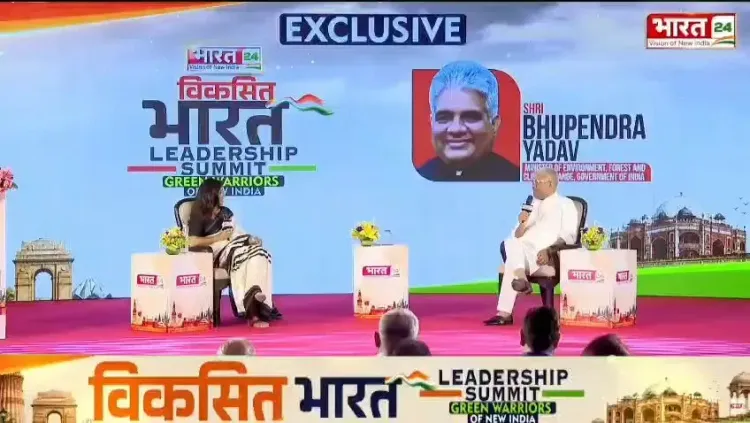
Union Environment Minister Bhupender Yadav on Wednesday, 24 June 2026 invoked Prime Minister Narendra Modi's vision for Mission LiFE — the Lifestyle for Environment initiative — underscoring the government's commitment to embedding sustainable living at the heart of India's climate strategy.
In his post on X, the Minister referred to the targets set by the Prime Minister under Mission LiFE, stating: 'प्रधानमंत्री जी ने जो Mission Life का जो लक्ष्य दिया है…' ('The goal that the Prime Minister has set for Mission LiFE…'), signalling continued political momentum behind the behavioural-change campaign.
Context
Mission LiFE — short for Lifestyle for Environment — was formally launched by Prime Minister Narendra Modi in October 2022, building on a concept he first introduced to the world at COP26 in Glasgow in November 2021. The initiative calls on individuals and communities to adopt mindful, resource-conscious habits as a complement to large-scale regulatory and technological climate interventions. Its central argument is that demand-side behavioural shifts can meaningfully reduce emissions alongside supply-side decarbonisation.
Policy Backdrop
Mission LiFE sits within India's broader Panchamrit climate commitments announced at COP26, which include reaching net-zero emissions by 2070 and meeting 50 per cent of energy requirements from non-fossil fuel sources by 2030. The initiative also supports India's updated Nationally Determined Contributions (NDCs) submitted under the Paris Agreement. By framing lifestyle choices as a climate tool, the government positions Indian households — not just industries — as active participants in the country's decarbonisation journey.
Bhupender Yadav, who has helmed the Ministry of Environment, Forest and Climate Change since July 2021, has consistently championed Mission LiFE in domestic and international forums, presenting it as a culturally rooted alternative to what the government describes as a 'use-and-dispose' consumption model.
Stakeholders and Impact
The initiative's primary targets are Indian households and state environment departments, which are expected to drive adoption of low-carbon practices — from reducing single-use plastics to conserving water and energy. The government has sought to activate a 'Pro-Planet People' movement, encouraging citizens to pledge specific lifestyle changes through a dedicated digital platform. Community-level mobilisation through local bodies and civil society organisations forms a key delivery mechanism.
For India's roughly 1.4 billion citizens, even marginal shifts in consumption patterns across sectors such as food, transport, and energy could aggregate into significant reductions in the country's carbon footprint, according to the policy's underlying rationale.
What's Next
Attention will now turn to national rollout metrics for Mission LiFE targets and any references the government makes at upcoming UNFCCC sessions or in domestic parliamentary discussions on environment policy. The Minister's renewed public emphasis on the initiative ahead of future climate negotiations suggests the government intends to project Mission LiFE as a signature Indian contribution to global climate discourse — one that foregrounds lifestyle and values alongside finance and technology.
Point of View
It democratises climate action by making every citizen a stakeholder; internationally, it allows India to project a culturally distinctive, values-based climate narrative that contrasts with Western consumption-led models. Yadav's continued amplification of the mission suggests the government views it as a durable diplomatic and electoral asset, not merely a one-cycle campaign. Whether implementation metrics match the rhetorical investment remains the central question for policy watchers.
NationPress
24 Jun 2026
Frequently Asked Questions
What is Mission LiFE in India?
Mission LiFE, or Lifestyle for Environment, is a government initiative launched by Prime Minister Narendra Modi in October 2022 that encourages individuals and communities to adopt mindful, sustainable consumption habits as part of India's climate strategy.
When did PM Modi announce Mission LiFE?
PM Modi first introduced the concept of Mission LiFE at COP26 in Glasgow in November 2021 and formally launched the initiative in October 2022.
What is India's net-zero target year?
India has committed to achieving net-zero emissions by 2070, as part of its Panchamrit climate pledges made at COP26.
Who is Bhupender Yadav?
Bhupender Yadav is a senior BJP leader from Rajasthan who has served as India's Union Minister of Environment, Forest and Climate Change since July 2021.
How does Mission LiFE relate to India's climate commitments?
Mission LiFE supports India's updated Nationally Determined Contributions under the Paris Agreement and its Panchamrit goals by promoting demand-side behavioural changes alongside regulatory and technological climate measures.