PM Modi Reaffirms Mission LiFE on World Environment Day
Synopsis
On World Environment Day 2026, Prime Minister Narendra Modi reaffirmed India's commitment to Mission LiFE, invoking the 'One Earth, One Family, One Future' principle to call for a cleaner, greener planet through individual and collective climate action.
Key Takeaways
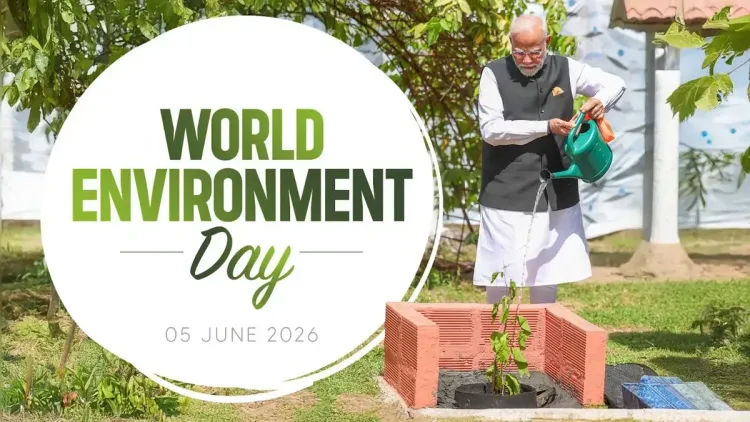
PM Modi posted on World Environment Day, 5 June 2026 , reaffirming India's commitment to Mission LiFE .
Mission LiFE (Lifestyle for Environment) was first launched by PM Modi at COP26 in Glasgow in November 2021 .
The 'One Earth, One Family, One Future' principle is rooted in the Sanskrit concept of Vasudhaiva Kutumbakam and was the theme of India's G20 presidency in 2023 .
India's climate strategy pairs Mission LiFE with a net-zero pledge by 2070 and participation in the International Solar Alliance .
The campaign targets behavioural change at the individual level, complementing national and multilateral climate policy.
Future UNFCCC and COP meetings are expected venues for new Mission LiFE targets or partnerships.
Prime Minister Narendra Modi on Friday, 5 June 2026 — World Environment Day — renewed India's commitment to sustainable living, invoking the principle of 'One Earth, One Family, One Future' and pledging continued action through Mission LiFE.
Context
In his post, Prime Minister Modi wrote: 'Guided by the principle of One Earth, One Family and One Future, we will continue working towards a cleaner, greener and more sustainable planet through the spirit of Mission LiFE.' The message, timed to World Environment Day, links India's domestic behavioural campaign directly to a globally recognised sustainability ethic.
The phrase Vasudhaiva Kutumbakam — meaning 'the world is one family' — is a Sanskrit maxim that underpins the 'One Earth, One Family, One Future' framing. India made this theme central to its G20 presidency in 2023, embedding it in the New Delhi Leaders' Declaration alongside climate and development priorities.
Policy Backdrop
Mission LiFE — short for Lifestyle for Environment — was first announced by Prime Minister Modi at the UN Climate Change Conference (COP26) in Glasgow in November 2021. The initiative calls on individuals and communities to adopt mindful consumption habits and sustainable daily practices as a complement to government-level climate policy.
India's broader climate architecture pairs Mission LiFE with a net-zero emissions pledge by 2070 and active participation in the International Solar Alliance. The approach is distinctive in that it frames climate action through cultural values rather than relying solely on regulation or technology.
Unlike conventional top-down environmental mandates, Mission LiFE targets what policymakers describe as a 'pro-planet' shift in everyday behaviour — from reducing single-use plastics to conserving water and energy — seeking to mobilise global citizens as active participants in the climate transition.
Stakeholders and Impact
The campaign's intended beneficiaries span global citizens and climate policymakers alike. By positioning individual behavioural change as a pillar of climate strategy, India has sought to build a broad coalition that includes households, civil-society groups, and multilateral partners.
The G20 platform gave Mission LiFE significant international visibility in 2023, with partner nations acknowledging the framework in joint declarations. Advocates argue that linking cultural identity to sustainability goals can drive adoption at scale in a country of more than 140 crore people.
What's Next
Observers will watch for fresh Mission LiFE targets or partnerships at upcoming UNFCCC sessions, including future COP meetings, where India has historically used high-profile moments to announce new climate commitments. Domestic rollout of LiFE-linked programmes — covering sectors from agriculture to urban infrastructure — remains a key metric of the campaign's on-ground progress.
With World Environment Day 2026 providing a fresh platform, the Prime Minister's reaffirmation signals that Mission LiFE will remain a centrepiece of India's climate diplomacy and public-communication strategy in the months ahead.
Point of View
A campaign he personally launched at COP26 and has since woven into India's multilateral identity. By invoking the G20's 'One Earth, One Family, One Future' theme, he is drawing a straight line from India's 2023 presidency to ongoing domestic climate priorities, signalling continuity rather than new policy. The cultural framing — rooted in Vasudhaiva Kutumbakam — is a recurring strategic choice that distinguishes India's climate diplomacy from purely technocratic or regulatory approaches. It also keeps India visible as a norm-setter in global sustainability discourse ahead of future UNFCCC negotiations.
NationPress
20 Oct 2026
Frequently Asked Questions
What is Mission LiFE launched by PM Modi?
Mission LiFE, or Lifestyle for Environment, is a global movement launched by Prime Minister Modi at COP26 in Glasgow in November 2021. It promotes sustainable daily habits and mindful consumption as individual contributions to climate action, complementing government-level policy.
What does 'One Earth, One Family, One Future' mean?
'One Earth, One Family, One Future' is the theme India adopted for its G20 presidency in 2023, drawn from the Sanskrit principle of Vasudhaiva Kutumbakam, which means 'the world is one family'. It frames climate and development discussions within a shared-humanity ethic.
Why did PM Modi post about Mission LiFE on 5 June 2026?
5 June is observed globally as World Environment Day, making it a natural occasion for leaders to reaffirm climate commitments. PM Modi used the day to renew India's pledge to Mission LiFE and sustainable development.
What is India's net-zero target?
India has committed to achieving net-zero carbon emissions by 2070, a pledge made alongside the Mission LiFE announcement and other climate goals under the Paris Agreement framework.
How does Mission LiFE connect to India's G20 presidency?
During India's G20 presidency in 2023, Mission LiFE was promoted as a key climate initiative and the 'One Earth, One Family, One Future' theme aligned the summit's agenda with the campaign's philosophy, giving it significant international visibility.