Bhupender Yadav: India's rise benefits all of humanity
Synopsis
Union Environment Minister Bhupender Yadav declared on 9 July 2026 that India's growing strength benefits all of humanity — reaffirming the Modi government's consistent framing of national capability as a global public good, rooted in the Panchamrit climate plan and the G20 'Vasudhaiva Kutumbakam' theme.
Key Takeaways
Bhupender Yadav posted on 9 July 2026 that India's rising capabilities benefit all of humanity.
The statement is in line with the Modi government 's long-standing framing of India's growth as serving global welfare, not narrow national interest.
India's Panchamrit climate plan, announced at COP26 in 2021 , linked national targets — including net-zero by 2070 — to global climate outcomes.
India's G20 presidency in 2023 used the theme 'Vasudhaiva Kutumbakam' to position the country's rise as a service to the Global South .
Yadav, as Union Minister of Environment, Forest and Climate Change , has been a key Indian voice at UNFCCC and G20 forums.
Upcoming COP sessions and climate finance negotiations will test whether the philosophy translates into concrete multilateral commitments.
Union Environment Minister Bhupender Yadav posted a pointed statement on X on 9 July 2026, asserting that as India's capabilities grow, the entire world stands to gain. The remark, shared in Hindi, distils a foreign-policy and climate-diplomacy philosophy that the BJP-led government has consistently advanced on global platforms.
Context
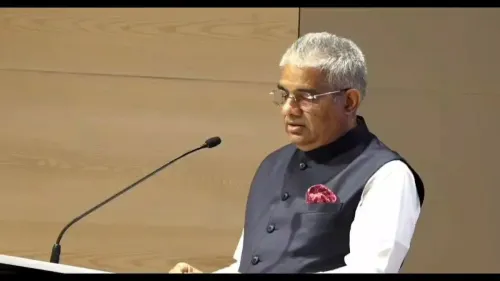
Yadav's post reads: 'Bharat ka saamarthya jitna badhta hai, uska faayda poori manavta ko hota hai' — 'The more India's capability grows, the more all of humanity benefits.' The formulation is deliberate: it frames national strength not as an end in itself but as a vehicle for collective global good. The post was accompanied by a video, the contents of which could not be independently verified at the time of publication.
As Union Minister of Environment, Forest and Climate Change since July 2021, Yadav has been one of India's principal voices at multilateral climate forums, making the sentiment particularly resonant in the context of sustainable development and climate justice.
Policy Backdrop
The idea that India's rise is inseparable from global welfare has been a recurring theme in Prime Minister Narendra Modi's government since 2014. At the COP26 summit in Glasgow in 2021, India unveiled its Panchamrit climate action plan — five commitments including reaching 500 GW of non-fossil energy capacity and achieving net-zero emissions by 2070 — explicitly linking India's national ambitions to global climate outcomes.
During India's G20 presidency in 2023, the government adopted 'Vasudhaiva Kutumbakam' ('The world is one family') as the summit's guiding theme, positioning India's economic and diplomatic ascent as a service to the Global South. Yadav's latest post echoes that same philosophical thread, extending it into the current moment.
Stakeholders and Impact
Developing nations and Global South partners have been the primary audience for this framing. India has used its growing clout at bodies such as the UNFCCC and the G20 to push for climate finance commitments from wealthy nations, equitable technology transfer, and a louder voice for emerging economies in setting global rules.
For domestic audiences, the statement reinforces a narrative of purposeful national growth — that India's economic and technological gains are not pursued at the expense of others but in service of a broader human interest. Environmental advocates and multilateral partners will watch closely to see whether the sentiment is matched by fresh policy deliverables on climate finance or renewable technology sharing.
What's Next
India's positions at upcoming COP sessions and any new announcements on climate finance, renewable energy technology transfer, or Global South partnerships will be the clearest test of the principle Yadav has articulated. If New Delhi translates this philosophy into concrete multilateral commitments — on green hydrogen, solar deployment, or loss-and-damage funding — the statement will carry lasting policy weight beyond its rhetorical appeal.
Point of View
He signals that the government intends to keep this framing central as India heads into the next round of global climate negotiations. The statement also pre-empts any critique that India's development priorities conflict with climate commitments, turning the argument on its head. For the Global South, it is a reminder that India sees itself as a spokesperson for developing nations, not merely a participant in forums designed by wealthier countries.
NationPress
9 Jul 2026
Frequently Asked Questions
What did Bhupender Yadav say on X on 9 July 2026?
Yadav posted in Hindi that 'the more India's capability grows, the more all of humanity benefits,' reaffirming the government's view that India's national rise serves a global purpose.
What is Bhupender Yadav's role in the Indian government?
Bhupender Yadav is the Union Minister of Environment, Forest and Climate Change and a senior BJP leader representing Rajasthan in the Rajya Sabha. He has held the portfolio since July 2021.
What is India's Panchamrit climate plan?
Panchamrit is India's five-point climate action strategy announced at COP26 in Glasgow in 2021, which includes targets such as achieving 500 GW of non-fossil energy capacity and reaching net-zero emissions by 2070.
How does India link its national growth to global benefit?
The Modi government has consistently argued that a stronger India can contribute more to global climate goals, technology sharing, and advocacy for developing nations, a position most prominently expressed through the G20 theme 'Vasudhaiva Kutumbakam' in 2023.
What should we watch after Yadav's statement?
Analysts will track India's positions at upcoming COP climate summits and any new commitments on climate finance, renewable energy technology transfer, or Global South partnerships as a measure of whether the philosophy translates into policy action.