Bhupender Yadav on India Day: We Find Solutions

Synopsis
On Independence Day 2026, Union Environment Minister Bhupender Yadav declared that while the world debates global warming, India focuses on delivering real solutions — a pointed assertion of India's action-first climate identity ahead of upcoming COP negotiations.
Key Takeaways
Union Environment Minister Bhupender Yadav posted an Independence Day climate message on 15 August 2026 , contrasting global debate with India's solution-oriented approach.
India's updated Nationally Determined Contributions target 50% electric power from non-fossil sources by 2030 under the Paris Agreement.
Mission LiFE , launched by PM Modi in 2022 , promotes individual and community pro-planet actions as part of India's domestic climate strategy.
India's climate diplomacy rests on the principle of common but differentiated responsibilities , distinguishing its position from early-industrialising nations.
India's Panchamrit climate commitments and upcoming COP rounds will be the next test of the action-first posture Yadav articulated.
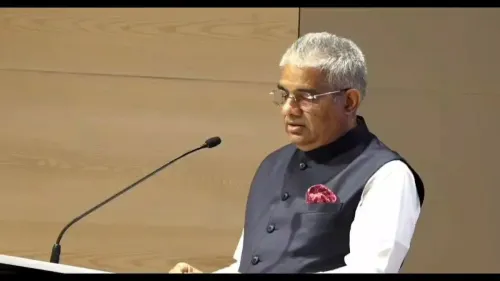
While the world debates, India builds. On Independence Day, 15 August 2026, Union Environment Minister Bhupender Yadav drew a sharp line between global climate conversation and India's on-ground action, posting a pointed message that captured the government's long-held posture on the world stage.
Posting in Hindi on the occasion of Independence Day, Yadav wrote: 'दुनिया जब ग्लोबल वार्मिंग की चर्चा करती रहती है, हम रास्ते खोजते रहते हैं। हम समस्याओं का समाधान दे रहे हैं।' — 'While the world keeps talking about global warming, we keep finding ways. We are providing solutions to problems.'
India's 'Doer, Not Talker' Climate Identity
The framing is deliberate and familiar. India has spent years positioning itself not as a polluter seeking exemptions but as a developing nation actively building answers — from its updated Nationally Determined Contributions under the Paris Agreement, which target 50% cumulative electric power from non-fossil sources by 2030, to Prime Minister Modi's Mission LiFE (Lifestyle for Environment), launched in 2022 to embed pro-planet choices into everyday Indian life.
The Independence Day timing is pointed. Climate messaging on 15 August from the Environment Ministry has become a recurring signal — linking national sovereignty with environmental agency, and reminding both domestic and global audiences that India intends to define its own climate trajectory.
The Principle Behind the Post
India's consistent anchor in climate diplomacy is the doctrine of common but differentiated responsibilities — the argument that nations that industrialised early bear greater historical culpability for warming, and that emerging economies must not be penalised for development they are still completing. Yadav's post compresses that argument into two sentences: others talk, we solve.
With the next round of Conference of Parties (COP) negotiations on the horizon, and progress reviews on India's Panchamrit climate commitments due, the minister's Independence Day framing sets the rhetorical tone India is likely to carry into those rooms.
The message is simple and the ambition is large: India will not wait for the world to agree before it acts.
Point of View
Sovereignty over external pressure. Timed to Independence Day, it links national identity with environmental agency, a pairing the BJP has cultivated consistently since Mission LiFE. The sharpness of the contrast ('the world talks, we find ways') signals the register India intends to carry into the next COP cycle. Whether the on-ground numbers — renewable capacity, emissions intensity, forest cover — continue to back that claim will determine how durable the framing remains.
NationPress
15 Aug 2026
Frequently Asked Questions
What did Bhupender Yadav say on Independence Day 2026 about climate change?
Yadav posted in Hindi that while the world keeps talking about global warming, India keeps finding solutions — framing the country as a problem-solver rather than a bystander in the climate debate.
What is India's 2030 climate target under the Paris Agreement?
India's updated Nationally Determined Contributions commit to achieving 50% of cumulative electric power capacity from non-fossil fuel sources by 2030.
What is Mission LiFE and who launched it?
Mission LiFE (Lifestyle for Environment) was launched by Prime Minister Narendra Modi in 2022 to encourage individuals and communities to adopt pro-planet behaviours as part of India's domestic climate strategy.
What are India's Panchamrit climate commitments?
The Panchamrit are India's five climate goals announced at COP26, including reaching 500 GW of non-fossil energy capacity, generating 50% of energy from renewables, reducing carbon emissions by one billion tonnes, cutting the carbon intensity of the economy by 45%, and achieving net zero by 2070.
Why does India emphasise 'common but differentiated responsibilities' in climate talks?
India argues that nations that industrialised earlier bear greater historical responsibility for cumulative greenhouse gas emissions, and that developing countries like India should not face the same obligations as wealthy, early-industrialising nations.