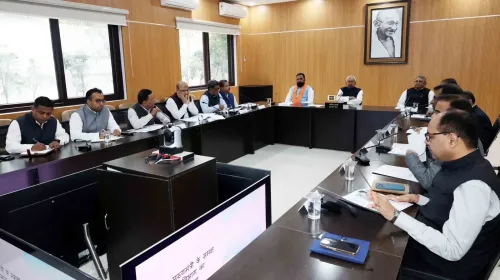
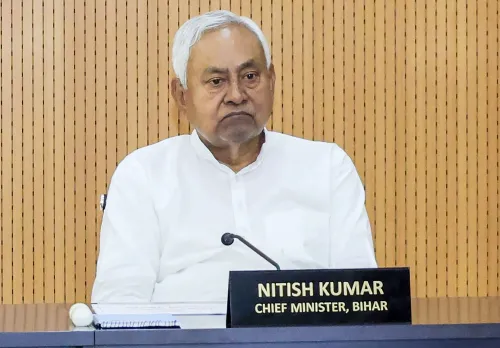
CM Nitish Sets 1,000 MW Data Centre Target for Bihar
Synopsis
Chief Minister Nitish Kumar has announced a five-year target to build at least 1,000 megawatts of data centre capacity in Bihar, positioning the eastern state as a new player in India's rapidly expanding digital infrastructure landscape.
Key Takeaways
Chief Minister Nitish Kumar has set a target of at least 1,000 megawatts of data centre capacity for Bihar over the next five years .
The announcement was made by the Chief Minister's Office of Bihar on October 13, 2026 .
India's 2020 digital economy framework has driven states to compete for data centre investment through localisation requirements and rising digital demand.
Bihar's existing IT footprint is limited compared to established hubs like Mumbai, Chennai, and Hyderabad , making this a significant strategic pivot.
Key details including incentives, land policy, and power allocation framework are yet to be announced and will determine investor response.
Eastern India remains largely untapped for data centre development, giving Bihar a first-mover opportunity in the region.
Bihar is staking its claim in India's digital infrastructure race. Chief Minister Nitish Kumar, through the Chief Minister's Office of Bihar, announced on Tuesday, October 13, 2026, a bold target to establish data centres with a combined capacity of at least 1,000 megawatts in the state over the next five years.
The post, in Hindi, stated: 'Mananiya Mukhyamantri ji ne agle paanch varshon mein Bihar mein kam se kam 1,000 megawatt kshamata ke data centre sthapit karne ka lakshya niradharit kiya' — 'The Honourable Chief Minister has set a target of establishing data centres with a minimum capacity of 1,000 megawatts in Bihar in the next five years.'
Why 1,000 MW Is a Serious Number
To put that figure in perspective: 1,000 megawatts of data centre capacity is not incremental — it is the kind of target that would place Bihar among the significant players in India's fast-expanding digital infrastructure landscape. Data centres are power-hungry facilities, and committing to that scale of electricity demand signals that the government intends to back this target with real power-sector planning and land allocation.
India's central government has encouraged states to build out data centre infrastructure since its 2020 digital economy framework, which pushed data localisation requirements and created fresh demand for domestic storage and compute capacity. States like Maharashtra, Telangana, and Tamil Nadu moved early to attract hyperscale and colocation operators. Bihar's announcement signals it intends to compete — even though its existing IT footprint remains limited compared to those established hubs.
Bihar's Calculated Bet on the Digital Economy
Nitish Kumar's development record in Bihar has centred on roads, electricity, and basic governance — the unsexy but essential foundations. That groundwork now becomes an argument to tech investors: reliable power supply, land availability, and lower operational costs compared to saturated metros. Those are precisely the ingredients data centre operators weigh when selecting new sites.
The broader national pattern reinforces the logic. Rising demand for cloud services, the rollout of AI-driven applications, and India's push toward data sovereignty have collectively accelerated the search for new data centre locations beyond Mumbai and Chennai. Eastern India — with Patna as a potential anchor city — remains largely untapped, making Bihar's timing strategically credible.
What Comes Next: Incentives, Land, and Power
A capacity target is a starting gun, not a finish line. The critical details — what tax incentives the state will offer, how land parcels will be identified and allocated, which power utilities will underwrite the additional megawatt demand, and whether a formal Bihar IT or data centre policy will follow — are yet to be announced. Investors and operators will be watching for a concrete policy framework before any capital commitments are made.
Bihar has made ambitious development announcements before; the differentiator this time will be execution speed and the credibility of the power-allocation plan. A state that can guarantee uninterrupted power at scale has a genuine pitch to make to the data centre industry.
The target is set. The harder work of turning megawatts on paper into servers humming in the eastern Gangetic plains starts now.
Point of View
000 MW data centre target is best understood as an economic diversification play by a government long associated with agriculture and basic infrastructure — a deliberate signal that the state is ready for the next tier of investment. For Nitish Kumar, digital infrastructure offers a cleaner political narrative than manufacturing: lower land-acquisition friction, higher employment multipliers per rupee of investment, and alignment with New Delhi's data-sovereignty agenda. The announcement fits a broader national pattern in which tier-2 and tier-3 states are competing to absorb demand that has outgrown India's legacy data centre corridors. Whether Bihar converts this target into signed capacity depends almost entirely on what policy architecture — power guarantees, fiscal incentives, single-window clearance — follows in the coming months.
NationPress
14 Oct 2026
Frequently Asked Questions
What is Bihar's data centre capacity target announced by CM Nitish Kumar?
Chief Minister Nitish Kumar has set a target of establishing data centres with a combined capacity of at least 1,000 megawatts in Bihar over the next five years, as announced on October 13, 2026.
Why is Bihar targeting data centre development?
Bihar is seeking to diversify its economy into digital infrastructure, taking advantage of India's growing demand for data storage and cloud services, national data localisation requirements, and the availability of land and power in the state.
How does Bihar's 1,000 MW target compare to other Indian states?
States like Maharashtra, Telangana, and Tamil Nadu have already established significant data centre hubs. Bihar's 1,000 MW target represents a serious entry into this space, though the state is starting with a limited existing IT footprint.
What policy details are still awaited after Bihar's data centre announcement?
Investors are awaiting specifics on land allocation, power supply guarantees, tax incentives, and whether a formal Bihar data centre policy will be introduced to back the capacity target.
What is the significance of 1,000 MW for data centres?
1,000 megawatts is a large-scale target reflecting the power-intensive nature of data centres; committing to that level signals that the government plans to back the goal with substantial power-sector and land-use planning.