Rahul Gandhi's double standard on student protests: BJP steps up pressure
Synopsis
The BJP has turned Congress's own student-protest playbook against it. While Rahul Gandhi has led Parliament disruptions over NEET irregularities, his party's muted response to police action against students in coalition-governed Jharkhand has handed the ruling party a potent 'double standards' charge — one that BJP MPs are now pressing literally at Parliament's front door.
Key Takeaways
BJP is pressing Rahul Gandhi over Congress's contrasting responses to student protests — forceful on NEET at the Centre, restrained in Jharkhand where Congress is a coalition partner.
In Ranchi on Monday , police used batons, tear gas, and water cannons on students protesting alleged JPSC and JSSC exam irregularities; several students were reportedly injured.
Student leader Devendra Nath Mahto was reportedly hospitalised after a nine-day hunger strike .
Gandhi condemned the 'use of force' but stopped short of demanding accountability from Chief Minister Hemant Soren 's government.
Union Ministers J.P.
Nadda and Kiren Rijiju accused Congress of 'double standards'; Priyanka Gandhi Vadra hit back, saying Gandhi had already met Jharkhand students.
The Monsoon Session has seen repeated adjournments as Opposition disruptions over NEET and related issues continue.
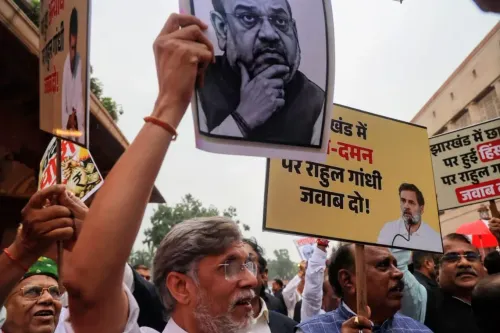
Rahul Gandhi, the Lok Sabha Leader of Opposition, is under sustained attack from the Bharatiya Janata Party (BJP) over what the ruling party describes as a glaring contradiction in the Indian National Congress's stance on student protests — aggressive against the Centre in the NEET case, but markedly restrained in Jharkhand, where Congress is a coalition partner in the Jharkhand Mukti Morcha (JMM)-led government. The political row intensified on Tuesday, 13 August, when BJP MPs staged a demonstration at the Parliament entrance, confronting Wayanad MP Priyanka Gandhi Vadra over Gandhi's silence on the Jharkhand student agitation.
The Jharkhand Flashpoint
In Ranchi on Monday, police deployed batons, tear gas, and water cannons to disperse thousands of students marching towards the state Assembly building. Several students, including women, were reportedly injured; police, in turn, claimed their personnel were hurt in stone-pelting. Student leader Devendra Nath Mahto was reportedly hospitalised after his health deteriorated during a nine-day hunger strike.
The students are protesting alleged paper leaks and recruitment irregularities in the Jharkhand Public Service Commission (JPSC) and the Jharkhand Staff Selection Commission (JSSC) recruitment examinations. Their demands include cancellation of the tainted exams, structural reforms in the recruitment process, and a probe by central investigative agencies into alleged corruption.
What Rahul Gandhi Said — and Did Not Say
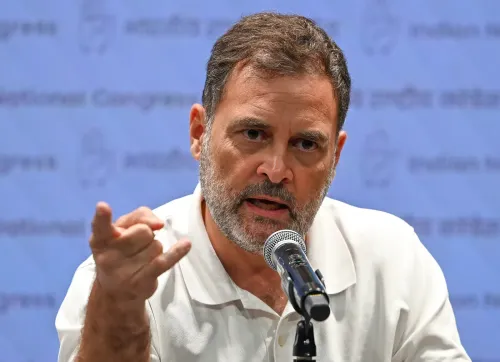
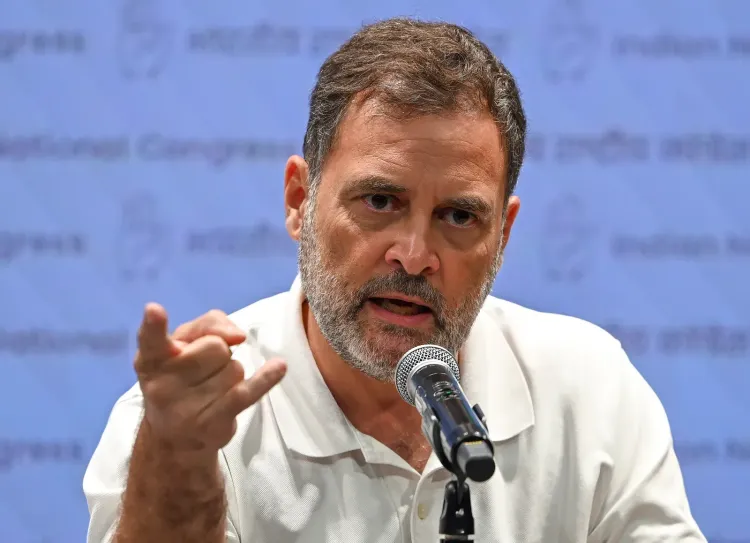
When pressed by reporters on Monday, Gandhi said Congress 'condemns any use of force against peacefully protesting students in Jharkhand' and that 'students have a right to protest and that only dialogue can resolve their grievances.' He urged Chief Minister Hemant Soren to listen to students and resolve the issues immediately.
Notably, Gandhi stopped short of directly blaming the Soren government, demanding accountability from state leadership, or calling for resignations — a sharp contrast to the Congress's posture in the NEET paper-leak controversy, where the party has relentlessly targeted the Union government and disrupted Parliament proceedings seeking ministerial accountability.
BJP Mounts the Pressure
On Monday, Union Health Minister J.P. Nadda and Parliamentary Affairs Minister Kiren Rijiju publicly criticised Gandhi and Congress for holding up Parliament while displaying what they called 'double standards' on student protests. The BJP argues that if Congress genuinely stood with agitating students, it should withdraw support from the Jharkhand coalition government.
BJP MPs carrying the protest to Parliament's entrance on Tuesday — an unusual sight — drew a sharp response from Priyanka Gandhi Vadra, who said Gandhi had already met Jharkhand students and reiterated demands that Union Home Minister Amit Shah make a statement in the House. She also remarked, pointedly, that it was the first time she had seen ruling-party MPs staging a protest at Parliament's gates.
The Political Calculus Behind the Restraint
The BJP's broader charge is that Congress, having suffered consecutive electoral setbacks, is unwilling to destabilise the few state governments it remains part of. Critics argue the party's muted response to the Jharkhand crackdown — compared to its aggressive posture on NEET irregularities and Delhi Police action — exposes a transactional approach to student welfare.
The Monsoon Session of Parliament has seen repeated adjournments of both Houses as Opposition parties, led by Congress, have raised the NEET paper leak, demanded accountability for police action against protesters, and flagged alleged irregularities in Ayodhya Ram Mandir donations. The Jharkhand episode has now handed the treasury benches a counter-narrative that threatens to dilute that momentum.
What Comes Next
With the Monsoon Session still under way, the BJP is expected to keep the Jharkhand contrast at the centre of its parliamentary strategy. Whether Congress sharpens its tone toward the Soren government — or continues to walk the coalition tightrope — will determine how effectively it can sustain the moral high ground it has claimed on student issues at the national level.
Point of View
No accountability demand — but that calculation has a cost. The NEET campaign's moral authority rests on the claim that students matter above politics; the Jharkhand contrast punctures exactly that claim. The BJP, which has been on the defensive over NEET, now has a counter-narrative that could shift the Monsoon Session's political balance. For Congress, the harder question is structural: with so few state governments left to protect, every coalition compromise chips away at the opposition identity it is trying to build.
NationPress
26 Sept 2026
Frequently Asked Questions
What is the BJP's 'double standards' charge against Rahul Gandhi?
The BJP alleges that Congress has aggressively targeted the Centre over NEET exam irregularities and Delhi Police action against protesters, while remaining conspicuously restrained in criticising the JMM-led Jharkhand government — of which Congress is a coalition partner — for similar police action against student demonstrators. The party argues that if Congress genuinely stood with students, it should withdraw support from the Jharkhand coalition.
Why are students protesting in Jharkhand?
Students in Jharkhand are protesting alleged paper leaks and recruitment irregularities in examinations conducted by the Jharkhand Public Service Commission (JPSC) and the Jharkhand Staff Selection Commission (JSSC). Their demands include cancellation of the affected exams, reforms in recruitment processes, and a central agency probe into alleged corruption.
What did Rahul Gandhi say about the Jharkhand student protests?
When asked by reporters on Monday, Gandhi said Congress condemns any use of force against peacefully protesting students in Jharkhand and that dialogue is the only way to resolve grievances. He urged Chief Minister Hemant Soren to listen to students, but stopped short of demanding accountability or resignations from the state government.
What happened at Parliament's entrance on Tuesday?
BJP MPs staged a demonstration at Parliament's entrance, confronting Wayanad MP Priyanka Gandhi Vadra over Rahul Gandhi's alleged silence on the Jharkhand agitation. Priyanka responded that Gandhi had already met Jharkhand students and reiterated her demand that Home Minister Amit Shah make a statement in the House.
How has the Monsoon Session been affected by the student protest row?
The ongoing Monsoon Session has seen repeated adjournments of both Houses as Opposition parties, led by Congress, have raised the NEET paper leak, demanded accountability for police action against protesters, and flagged alleged irregularities in Ayodhya Ram Mandir donations. The Jharkhand episode has given the BJP a counter-narrative to use against the Opposition's parliamentary strategy.