Is BJP's Remarkable Victory in Civic Bodies a Cause for Concern for Shiv Sena and NCP?

Synopsis
The BJP's recent electoral success in Maharashtra's municipal corporations has raised concerns for its allies, the Shiv Sena and NCP. With significant victories, the BJP aims for total dominance by 2029. Can its partners adapt to this shifting political landscape?
Key Takeaways
The BJP aims for total political dominance in Maharashtra.
Shiv Sena and NCP need to strengthen their political strategies .
BJP's grassroots mobilization is a key factor in its success .
Political alliances are shifting, impacting traditional strongholds .
The upcoming elections will be critical for the future of Shiv Sena and NCP .
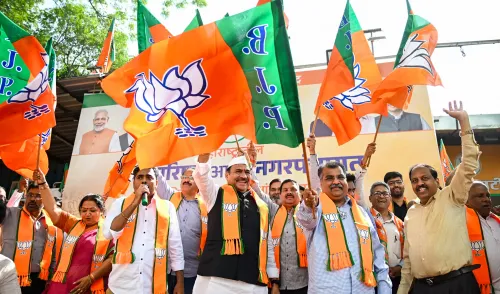
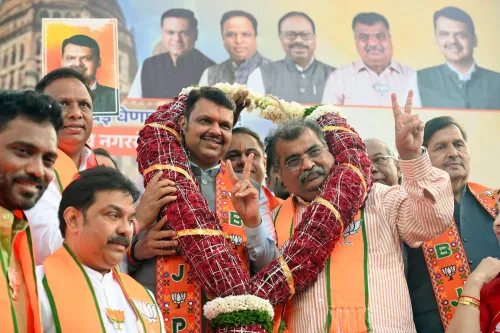
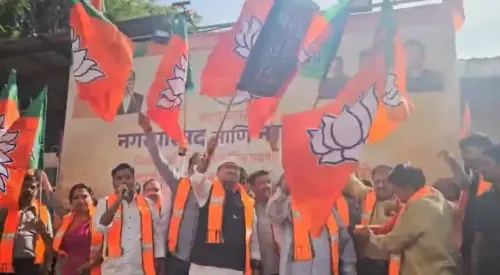
Mumbai, Jan 16 (NationPress) The election outcomes from 29 municipal corporations in Maharashtra have unequivocally indicated that the BJP is intensifying its campaign to attain its goal of “shat pratishat” (100 percent) rule in Maharashtra ahead of the upcoming Assembly elections scheduled for 2029.
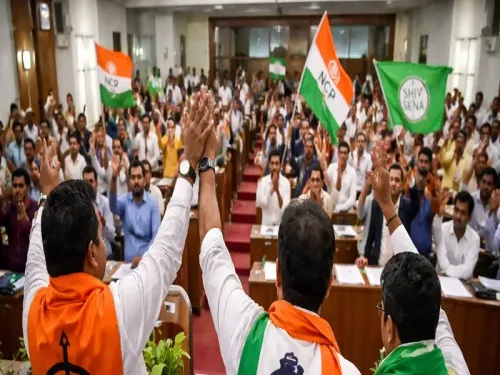
However, the BJP's achievement in securing control over more than 16 municipal corporations independently has raised significant concerns for its allies, including the Eknath Shinde-led Shiv Sena and the Ajit Pawar-led NCP, who must now step up their efforts to remain relevant and enhance their political influence.
Initially, the BJP leveraged both Eknath Shinde and Ajit Pawar to destabilize the Maha Vikas Aghadi (MVA) government by fracturing the Shiv Sena and the NCP. Recent data, however, indicates that the party is systematically asserting its dominance within the traditional strongholds of its allies.
After the establishment of the MVA government under Uddhav Thackeray, the BJP initially faced disappointment. Yet, within two and a half years, the party successfully integrated Eknath Shinde to seize power. While Shinde was content with his position as Chief Minister, the BJP's long-term vision extended beyond mere leadership changes.
Despite facing a setback in the 2024 Lok Sabha elections, the BJP preserved its momentum in the Assembly elections. By capitalizing on the support from the factions led by Shinde and Pawar, the party has greatly expanded its grassroots presence throughout the state.
The BJP has effectively transformed long-standing political dynamics. In its 25-30 year alliance with the undivided Shiv Sena, the Sena typically contested 171 seats compared to the BJP's 117.
Now, the BJP has flipped this equation, establishing a strong organizational network across all 288 constituencies, even in traditionally Shiv Sena and NCP dominated regions.
Political analysts suggest that the BJP has executed a strategic plan where ministers, MLAs, and MPs are assigned specific roles to erode the influence of Shinde and Pawar in key areas like Mumbai, Thane, Kalyan-Dombivli, Navi Mumbai, and Konkan. The party treats municipal and zilla parishad elections with the same urgency as general elections, ensuring detailed planning at the booth level.
The election results suggest that while the BJP formed coalitions in municipal corporations where it lacked confidence for a solo win, the advantages of these partnerships did not revert to the Shinde faction.
Instead, the BJP has established undisputed dominance in major urban centers such as Mumbai, Pune, Navi Mumbai, and Kalyan-Dombivli.
By dismantling the traditional strongholds of the Shiv Sena and the NCP, the BJP has made it clear that its primary aim is total political supremacy, leaving its “younger brothers” struggling to defend their territories.
The Shinde faction, which continuously asserts it is the “real Sena”, will need to work hard to maintain its position, as it has been outpaced by both the Uddhav Thackeray-led Shiv Sena in Mumbai and the BJP in other civic bodies, whether contesting together or independently.
This serves as a wake-up call for the NCP under Ajit Pawar, whose decision to confront the BJP while going solo in Pune and Pimpri Chinchwad did not yield fruitful results. The BJP, backed by its organizational strength, outmaneuvered the NCP and delivered a strong message to Ajit Pawar that remaining in the Mahayuti is his best option until the next Assembly elections.
The BJP has shown discontent towards Ajit Pawar's move to ally with his uncle Sharad Pawar-led NCP in Pune and Pimpri Chinchwad. In summary, the powerful BJP is determined to pursue its objective of gaining autonomous power, compelling both the Shiv Sena and the NCP to navigate their own paths to maintain political significance.
(Sanjay Jog can be contacted at sanjay.j@ians.in)
Point of View
It's crucial to recognize the implications of the BJP's stronghold in Maharashtra's municipal elections. The political landscape is shifting, with traditional alliances being tested. The performance of the Shiv Sena and NCP will determine their future relevance in the face of BJP's aggressive tactics.
NationPress
30 Sept 2026
Frequently Asked Questions
What does 'shat pratishat' mean?
Shat pratishat translates to '100 percent', indicating the BJP's ambition for complete political control in Maharashtra.
Who leads the Shiv Sena and NCP?
The Shiv Sena is led by Eknath Shinde, while the NCP is headed by Ajit Pawar.
What is the significance of the BJP's victory?
The BJP's victory signals its increasing influence and aims to dominate Maharashtra's political landscape ahead of the 2029 Assembly elections.
How have the political dynamics changed in Maharashtra?
The BJP has shifted traditional alliances, now asserting dominance in regions previously controlled by its allies.
What challenges do the Shiv Sena and NCP face?
Both parties must adapt to the BJP's rising power or risk losing their political relevance.