How Did MahaYuti Retain Supremacy While BJP Dominates?
Synopsis
The recent Zilla Parishad elections showcased the BJP's enduring dominance across Maharashtra, while the MahaYuti alliance continues to solidify its influence. Explore how political dynamics shifted in the wake of Ajit Pawar's passing, and the implications for future governance in the state.
Key Takeaways
BJP secured a majority in two Zilla Parishads and emerged as the largest party in four others.
Ajit Pawar's NCP made significant gains, especially in Pune.
The political landscape in Maharashtra is shifting, with coalition dynamics becoming increasingly complex.
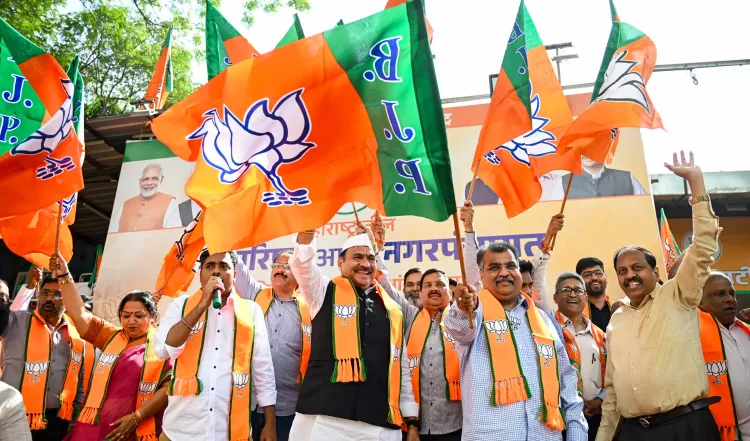
Mumbai, Feb 9 (NationPress) In the aftermath of the Legislative Assembly, Municipal Corporations, and Municipal Councils elections, the BJP has successfully upheld its dominance in the Zilla Parishad elections as well.
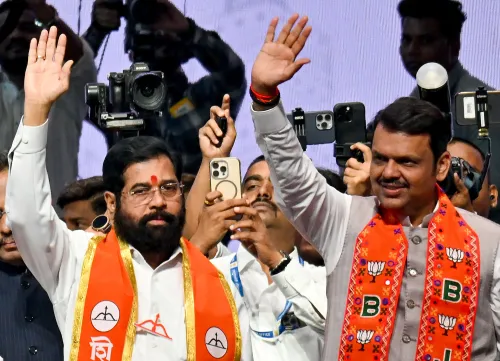
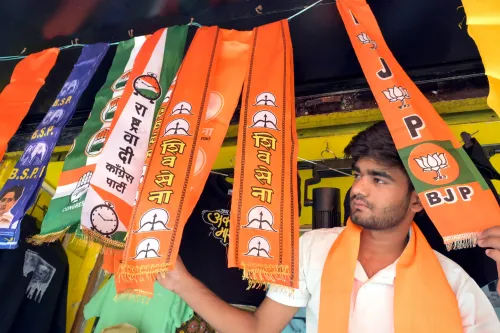
Out of 12 Zilla Parishads, the BJP achieved a majority or emerged as the dominant party in six districts. Following the BJP, Ajit Pawar's NCP decisively claimed the second position, surpassing the Shiv Sena led by Eknath Shinde. The MahaYuti alliance has effectively retained its stronghold across Zilla Parishads and Panchayat Samitis.
In the results announced for 12 Zilla Parishads and 125 Panchayat Samitis, where reservations were limited to 50 percent, the BJP has once again asserted its supremacy. The party secured a clear majority in two Zilla Parishads and was the largest party in four others.
The NCP led by Ajit Pawar and the Shiv Sena faction under Shinde each became the largest parties in two Zilla Parishads, while both the Congress and NCP led by Sharad Pawar topped one district each.
With victories in 225 seats in Zilla Parishads and 459 seats in Panchayat Samitis, the BJP emerged as the leading party. The BJP gained a majority in Sindhudurg and Solapur, while it became the largest party in Satara, Chhatrapati Sambhaji Nagar, Parbhani, and Dharashiv.
In the wake of Ajit Pawar’s unexpected passing, a surge of sympathy favored his faction of the NCP. They celebrated a landslide victory in Pune, winning 51 out of 73 seats, and emerged as the largest party in Kolhapur.
While the Shinde faction previously held the second place in other local body elections, the Ajit Pawar faction has now claimed the second position across Zilla Parishads and Panchayat Samitis. In several districts, the collaboration between both NCP factions also proved advantageous.
A notable achievement for the BJP is its success in Western Maharashtra, a region where the party has historically faced challenges. The party has now firmly established its presence in rural areas and the cooperative sector strongholds of this region.
In the Konkan region, the Shiv Sena under Shinde showcased its strength by winning Ratnagiri, striking a blow against Narayan Rane’s influence. They also emerged as the largest party in Raigad. The Congress made its presence felt in Latur with 23 seats, while Jayant Patil’s influence propelled the Sharad Pawar-led NCP to the forefront in Sangli. Despite being the largest parties in multiple districts, most will require coalitions to take control of these local bodies.
In Raigad, Sunil Tatkere (NCP-Ajit Pawar), allied with the BJP, will assume power despite the Shinde faction being the largest. In Latur, although Congress is the largest party, a coalition strength between BJP and NCP (Ajit Pawar) might prevent them from taking power. In Sangli and Satara, coalitions among various factions of NCP, Congress, and BJP will be essential for governance.
However, political observers suggest that these intricate dynamics raise the potential for “horse-trading” and unexpected alliances.
While the Congress party experienced overall setbacks, local leaders such as Satej Patil (Kolhapur), Amit Deshmukh (Latur), and Vishwajeet Kadam (Sangli) achieved victories in their respective strongholds.
The Peasants and Workers Party (PWP), once a significant force, failed to secure any seats in its former stronghold of Raigad, delivering a major shock to leader Jayant Patil.
Of the 731 seats in 12 Zilla Parishads, the BJP won 225, NCP (Ajit Pawar) 165, Shiv Sena (Shinde) 162, Congress 55, Shiv Sena UBT 43, NCP (Sharad Pawar) 26, MNS 2, and independents/others 41. Out of 1,462 seats in 125 Panchayat Samitis, BJP led with 459 seats, followed by NCP (Ajit Pawar) 306, Shiv Sena (Shinde) 302, Congress 97, Shiv Sena UBT 89, NCP (Sharad Pawar) 46, and independents/others 86.
(Sanjay Jog can be contacted at Sanjay.j@ians.in)
Point of View
We strive to provide an unbiased perspective on the evolving political landscape in Maharashtra. The recent elections indicate a shift in local power dynamics, raising questions about future governance and coalition-building in the state. It is essential to observe how these developments will impact the electorate and local policies.
NationPress
21 Sept 2026
Frequently Asked Questions
What was the outcome of the Zilla Parishad elections in Maharashtra?
The BJP maintained its dominance, winning 225 seats out of 731 in the Zilla Parishads, while NCP (Ajit Pawar) and Shiv Sena (Shinde) followed with 165 and 162 seats, respectively.
How did Ajit Pawar's passing affect the NCP's performance?
Following Ajit Pawar's unexpected passing, his faction of the NCP experienced a surge of sympathy, leading to significant victories, particularly in Pune.
What is the significance of the MahaYuti alliance?
The MahaYuti alliance has effectively solidified its influence across Zilla Parishads and Panchayat Samitis in Maharashtra, ensuring a stronghold in local governance.