How Did BJP Emerge as the ‘Big Brother’ in Maharashtra Civic Polls?
Synopsis
The recent Maharashtra civic elections marked a pivotal moment in the state’s political dynamics. With the BJP solidifying its dominance, the Mahayuti alliance's unity is paramount for sustaining success. As the MVA struggles for relevance, will the BJP's strategies reshape the future political landscape in Maharashtra? Discover the implications of these election results.
Key Takeaways
BJP's victory reinforces its status as the leading political force in Maharashtra.
The unity of the Mahayuti alliance remains crucial for electoral success.
MVA faces significant challenges, including internal conflicts and declining relevance.
Future elections may see a shift in strategies for both BJP and MVA.
Local issues will become pivotal for voter engagement moving forward.
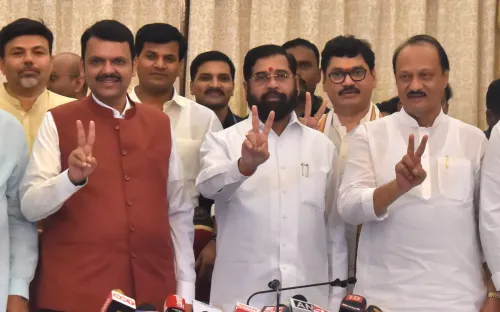
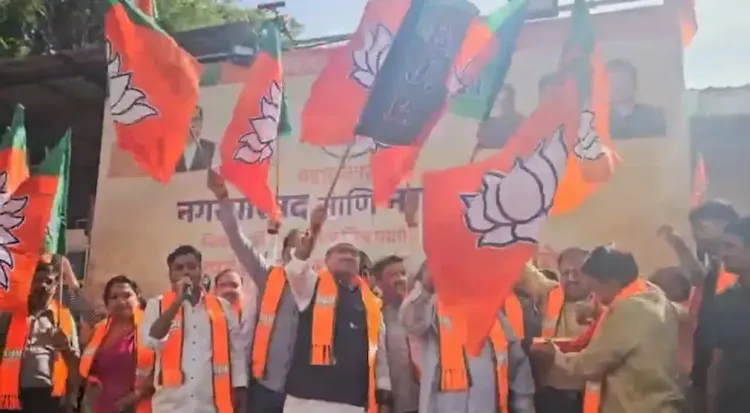
Mumbai, Dec 22 (NationPress) The outcomes of the 2025 Maharashtra Nagar Parishad and Nagar Panchayat elections have initiated a major transformation in the state's political scenery. The ruling Mahayuti coalition, which includes the BJP, Shiv Sena (Eknath Shinde), and NCP (Ajit Pawar), has achieved a remarkable, near-landslide victory. In contrast, the opposition Maha Vikas Aghadi (MVA) is facing a significant crisis of relevance, especially in semi-urban and rural regions.
Considered a key indicator for the Assembly polls, these results have firmly positioned the BJP as the preeminent political entity in Maharashtra. They also highlight a vital lesson for the ruling coalition: despite the BJP's expanding influence, maintaining the unity of the Mahayuti alliance is crucial for ongoing electoral success.
The results indicate that Mahayuti has effectively implemented the “double-engine government” narrative even at the municipal level. For the MVA, this outcome acts as a stern warning. Without addressing internal leadership conflicts and enhancing its organizational strength, the upcoming Zilla Parishad elections and major municipal corporation contests, including the critical Brihanmumbai Municipal Corporation (BMC) polls, may result in similar defeats.
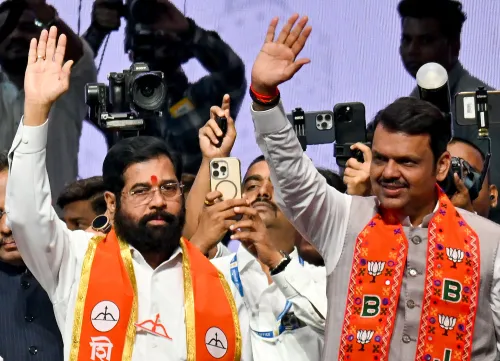
While the BJP emerged as a dominant force, various municipalities saw direct competition among Mahayuti constituents — BJP, Shiv Sena (Shinde faction), and NCP (Ajit Pawar faction). Party insiders interpret these results as a test case of what could occur if the allies were to run independently. The data reveals that although the BJP has made significant strides, it still relies on its allies to maintain a stronghold across Maharashtra's varied landscapes.
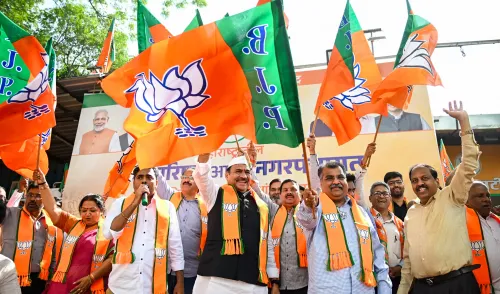
The BJP claimed 117 Municipal President positions, nearly doubling its previous tally from 2017. Its councillor count skyrocketed from 1,601 to 3,325, solidifying its status as the undisputed “big brother” within the coalition.
For Chief Minister Eknath Shinde’s Shiv Sena, the results negate the notion of being limited to Thane. Strong showings in Konkan, Raigad, and parts of Marathwada have strengthened its position, allowing it to advocate for a larger share of seats in future elections. The NCP is gradually extending its reach beyond Pune and western Maharashtra but still grapples with the need to solidify its statewide presence.
Despite the overall success, “friendly fights” were visible in areas like Ambernath and Pune, indicating escalating internal competition for the same voter demographic, particularly between the BJP and Shinde’s Sena. This has reignited discussions within the BJP regarding its long-term goal of achieving a 51 percent vote share. Even as the party expands, the growing strength of its allies suggests that a unified Mahayuti remains the most feasible path to political stability.
Conversely, the MVA's decline persists. The local body elections dealt another blow following a lackluster Assembly performance. The NCP, led by Sharad Pawar, once a dominant force in western Maharashtra, fell short of double digits in Municipal President positions, even losing ground in Baramati to the Ajit Pawar faction.
Uddhav Thackeray’s Shiv Sena (UBT), primarily focused on the upcoming BMC elections, delegated much of the local campaign to district leaders, resulting in limited success as Shinde consolidated his influence in Konkan. Meanwhile, the Congress found a minor silver lining, showing signs of recovery in Vidarbha—particularly in Chandrapur, where it performed better than in the recent Assembly elections.
The Congress's decision to contest independently in various regions, coupled with growing tensions with the Shiv Sena (UBT), particularly in Mumbai, has fragmented the anti-BJP vote. With single-digit victories in numerous councils, both the Sena (UBT) and NCP (SP) are struggling to keep grassroots supporters from drifting towards the ruling coalition.
The BJP has already begun to utilize this victory to assert that Mumbaikars are distancing themselves from the “Thackeray narrative.” The results provide the party with valuable momentum to challenge the Sena (UBT) in its last stronghold—Mumbai. The “Team Fadnavis” approach to booth-level management, engaging nearly 1.6 lakh booth workers, has been validated and serves as a model for the Zilla Parishad elections, where local networking is essential. Control over Municipal President positions in 122 councils also aids the BJP in cultivating loyal local leadership capable of influencing voters in nearby rural areas.
For the MVA, the poor performance may act as a bitter yet essential wake-up call. It could compel the coalition to eliminate “friendly fights” and establish a strict seat-sharing agreement to prevent vote splitting. For the Shiv Sena (UBT), the impending risk of losing the BMC has become a critical challenge, potentially pushing it towards a tighter alliance with the MNS or increasing its dependence on Congress for political survival.
The MVA is also likely to adjust its messaging—shifting from broad themes of “Constitution” and “democracy,” which failed to resonate locally, to hyper-local issues like agrarian distress, civic infrastructure, and employment to reclaim ground in Zilla Parishads.
Interestingly, the BJP's impressive showing has reignited discussions about its long-term “Shat Pratishat” (100 percent victory) aspirations ahead of the 2029 Assembly elections. However, the party faces a delicate balancing act between long-term ambitions and immediate political realities.
While Union Home Minister Amit Shah has suggested that the BJP may contest future elections independently, the municipal results indicate that uncoordinated “friendly fights” within Mahayuti could be counterproductive. Party insiders warn that failure to maintain coalition discipline in the forthcoming Municipal Corporation and Zilla Parishad elections could split votes and inadvertently benefit the MVA.
(Sanjay Jog can be reached at sanjay.j@ians.in)
Point of View
Our commitment is to provide a balanced perspective. The recent Maharashtra civic polls illustrate a significant shift, emphasizing the importance of coalition unity in politics. The BJP's rise highlights the need for the MVA to reassess its strategies. In a diverse political landscape, adaptability and cohesion will be vital for all parties moving forward.
NationPress
11 Oct 2026
Frequently Asked Questions
What led to the BJP's significant victory in Maharashtra?
The BJP's victory can be attributed to its effective coalition with the Mahayuti alliance, strong organizational strategies, and the MVA's internal challenges.
Why is the unity of the Mahayuti alliance crucial?
The cohesion of the Mahayuti alliance is essential to maintain electoral dominance and prevent internal competition that could benefit opposition parties.
How did the MVA perform in the recent elections?
The MVA faced a serious decline, struggling to secure significant positions and demonstrating a crisis of relevance, particularly in semi-urban and rural areas.
What are the implications of the BJP's performance for future elections?
The BJP's strong results may prompt it to pursue greater independence in future elections, though maintaining alliance discipline will be vital to avoid vote splitting.
What challenges does the MVA face moving forward?
The MVA must address internal leadership conflicts and establish a clear messaging strategy focused on local issues to regain voter support.