Buddha's Holy Relics to Be Displayed in Namsai, Nov 14–20

Synopsis
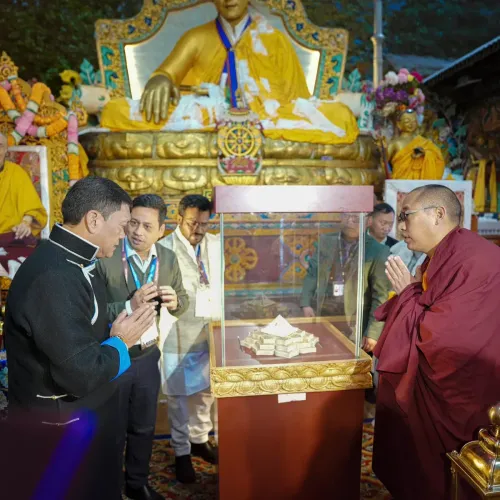
The Holy Relics of Bhagwan Buddha will be on public exposition in Namsai, Arunachal Pradesh, from 14 to 20 November 2026. The Chief Minister's Office announced the event as a historic celebration of India's Buddhist heritage, open to devotees seeking blessings.
Key Takeaways
The Holy Relics of Bhagwan Buddha will be on exposition in Namsai, Arunachal Pradesh , from 14 to 20 November 2026 .
Namsai is a Buddhist heartland in Arunachal Pradesh, home to the Golden Pagoda and deep Theravada traditions.
The Chief Minister's Office of Arunachal Pradesh framed the event around peace, compassion, and harmony.
India's Swadesh Darshan Buddhist Circuit scheme has been investing in pilgrimage infrastructure across Northeast India since 2014 .
Relic expositions serve dual roles as spiritual gatherings and drivers of regional tourism and cultural diplomacy.
For seven days next month, a quiet district in Arunachal Pradesh will become one of the most spiritually charged addresses in India. The Chief Minister's Office of Arunachal Pradesh announced on Monday, 2 November 2026, that the Holy Relics of Bhagwan Buddha will be placed on public exposition in Namsai from 14 to 20 November 2026, inviting devotees to seek blessings and witness the living legacy of one of humanity's most enduring philosophies.
Namsai: Why This District Was Chosen
Namsai, nestled in the plains of eastern Arunachal Pradesh, is not a random venue. The district is home to the landmark Golden Pagoda — formally the Kongmu Kham — and carries a deep-rooted Buddhist identity shaped by its Theravada traditions and a dense network of monasteries. Hosting the relics here is less a logistical choice and more a cultural statement: that Northeast India's own Buddhist heartland deserves a place in the country's most sacred religious calendar.
What the Relics Represent — and Why Expositions Draw Millions
Relics associated with Bhagwan Buddha occupy a singular place in Buddhist practice. Venerated across Sri Lanka, Thailand, Myanmar, Japan, and beyond, they are understood not as historical artefacts but as living embodiments of the Buddha's compassion and teachings. A public exposition — where devotees can physically approach and pay homage — is among the rarest and most emotionally resonant events a Buddhist community can witness. The CMO's post framed the event around 'peace, compassion and harmony,' the three pillars that have made Buddhism a cornerstone of India's soft-power identity in Asia.
India's Buddhist Circuit and the Bigger Diplomatic Picture
India has systematically elevated its Buddhist heritage as an instrument of cultural diplomacy, particularly toward Southeast and East Asian nations. The Swadesh Darshan scheme, launched in 2014, includes a dedicated Buddhist Circuit component channelling infrastructure investment into pilgrimage sites. Arunachal Pradesh — already home to the iconic Tawang Monastery — sits at the geographic and symbolic frontier of this effort, sharing borders with nations where Buddhism is a state religion. Each high-profile event in the state reinforces that argument at the regional level.
For the Namsai tourism sector, the seven-day window carries real economic weight. Relic expositions historically generate significant footfall from devotees across the country and from neighbouring Buddhist nations, turning a spiritual occasion into a driver of hospitality, transport, and local commerce.
A November to Mark on Every Devotee's Calendar
The Government of Arunachal Pradesh has called the event 'a historic celebration of India's rich Buddhist heritage' — a phrase that signals official intent to treat this as far more than a local religious gathering. Whether measured in pilgrims, in diplomacy, or in the quiet power of an ancient tradition finding its stage in India's northeast, the days between 14 and 20 November in Namsai promise to resonate well beyond the district's borders.
Point of View
A country that also claims Buddhist cultural authority in the region — India reinforces its northeastern frontier as a living centre of Buddhist civilisation. The event dovetails with the long-running Swadesh Darshan Buddhist Circuit push, signalling that heritage tourism and soft-power diplomacy are increasingly inseparable in India's Northeast strategy. For the state government, the exposition also offers a rare opportunity to place Namsai on a national and international religious map dominated by Bodh Gaya and Sarnath.
NationPress
2 Nov 2026
Frequently Asked Questions
When and where will the Holy Relics of Buddha be displayed in Arunachal Pradesh?
The Holy Relics of Bhagwan Buddha will be on exposition in Namsai, Arunachal Pradesh , from 14 to 20 November 2026 , as announced by the Chief Minister's Office.
What is special about Namsai for Buddhist pilgrims?
Namsai is one of Arunachal Pradesh's most significant Buddhist districts, home to the Golden Pagoda (Kongmu Kham) and a strong Theravada Buddhist community, making it a natural host for major religious events.
What is the Swadesh Darshan Buddhist Circuit?
The Swadesh Darshan scheme, launched in 2014 , includes a Buddhist Circuit component that channels government funds into developing infrastructure at key Buddhist pilgrimage sites across India, including in the Northeast.
Why does India promote Buddhist heritage in the Northeast?
India uses its Buddhist heritage — especially in states like Arunachal Pradesh — as a form of cultural diplomacy and soft power toward Buddhist-majority nations in Southeast and East Asia, while simultaneously boosting regional tourism.
Who organised the Buddha Relic exposition in Namsai 2026?
The event was announced by the Chief Minister's Office of the Government of Arunachal Pradesh , which regularly organises religious and cultural events to highlight the state's Buddhist heritage.