Cabinet clears ₹2,814 cr scheme for lithium, nickel processing
Synopsis
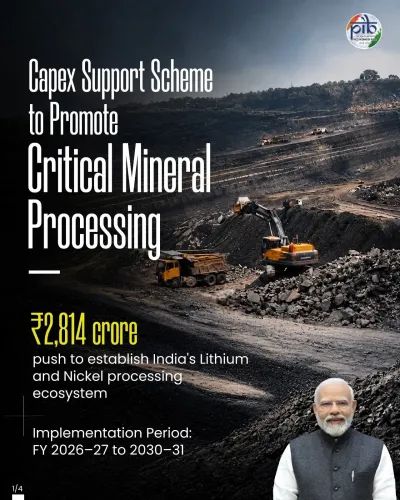
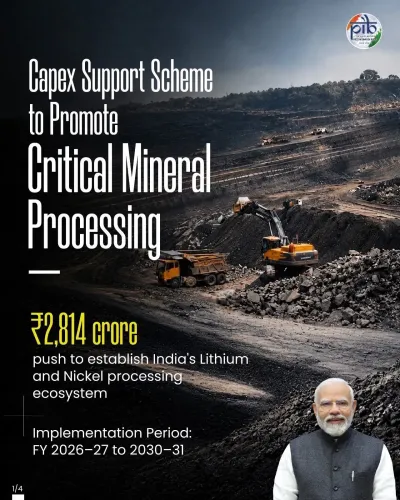
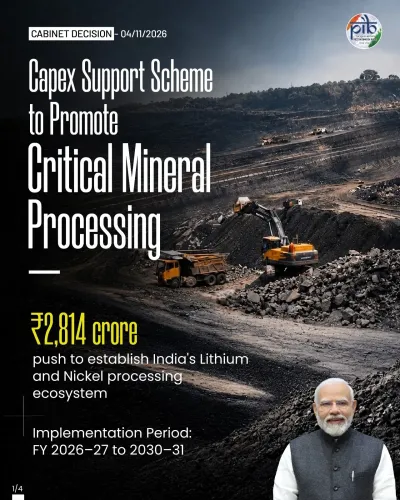
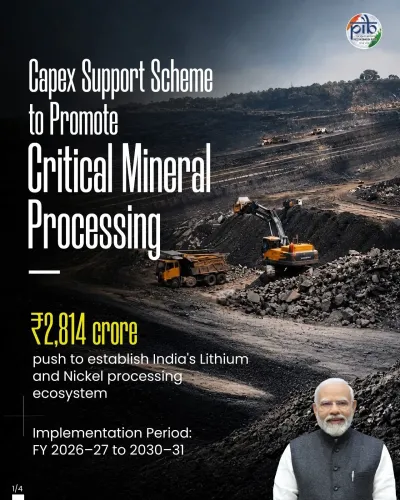
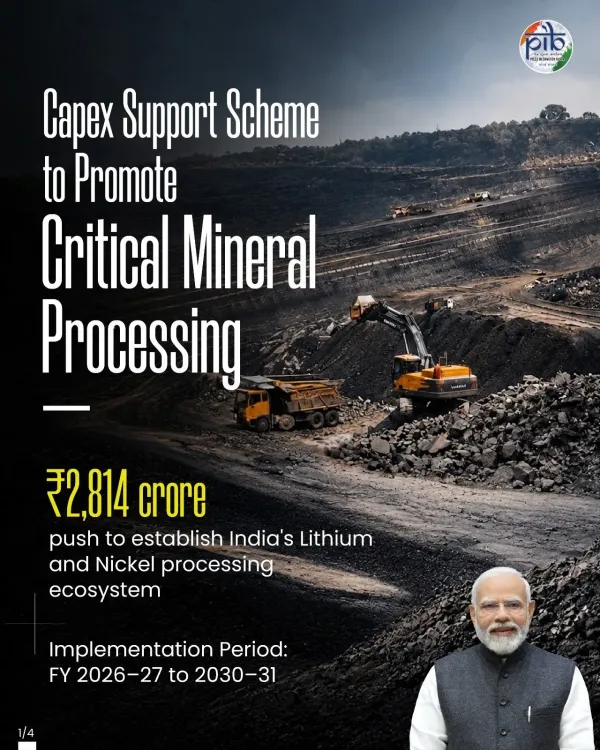
India's Cabinet has approved a ₹2,814 crore scheme to build four domestic lithium and nickel processing plants over five years, using capital subsidies to cut import dependence and strengthen EV, battery, defence and electronics supply chains under the Atmanirbhar Bharat framework.
Key Takeaways
The Union Cabinet approved a ₹2,814 crore scheme for domestic processing of lithium and nickel on 4 November 2026 .
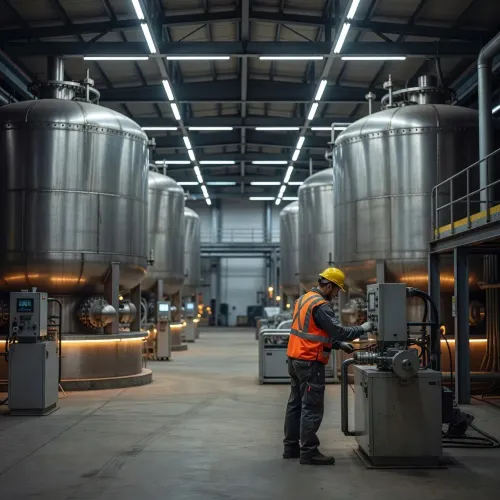
The scheme will fund four processing plants through capital subsidies over a five-year period.
Target sectors include electric mobility, battery storage, electronics, defence and speciality steel .
The move builds on the 2021 PLI scheme for Advanced Chemistry Cells , extending support further upstream into raw-material processing.
The scheme directly advances the Atmanirbhar Bharat goal of reducing dependence on imported critical mineral inputs.
Key watch items include selection of plant operators, locations, and subsidy disbursement timelines.
India just placed a serious bet on its own mineral future. The Union Cabinet, under Prime Minister Narendra Modi, has approved a ₹2,814 crore scheme to build domestic processing capacity for lithium and nickel — two minerals that sit at the heart of the global clean-energy race — over the next five years. Union Education Minister Dharmendra Pradhan announced the decision on Wednesday, 4 November 2026, calling it 'a major push towards building a self-reliant and resilient critical minerals ecosystem in India.'
Four plants, capital subsidies, and a five-year clock
The scheme's operational core is straightforward but significant: four domestic processing plants will receive capital subsidies to get off the ground. Capital subsidies — as opposed to production-linked incentives — front-load financial support, reducing the investment risk that has historically kept private players away from capital-intensive mineral processing. The government's logic is to seed indigenous capability now, before import dependence deepens further.
Lithium and nickel are not interchangeable industrial commodities. Lithium is the defining input for lithium-ion battery cells that power electric vehicles and grid-scale storage. Nickel is essential for high-energy-density battery chemistries, stainless steel, and defence-grade alloys. India currently sources both heavily from overseas, leaving its EV and electronics supply chains exposed to price shocks and geopolitical disruption.
Who stands to gain — and why the timing matters
The sectors named in the Cabinet decision read like a map of India's industrial ambitions: electric mobility, battery storage, electronics, defence, and speciality steel. Each is either a declared priority sector or a strategic vulnerability. EV manufacturers, in particular, have been pressing for upstream input security as domestic vehicle sales scale up. A homegrown processing base changes their cost equation fundamentally.
The move extends a policy lineage that began taking shape in 2021, when the government launched the Production Linked Incentive scheme for Advanced Chemistry Cells to stimulate domestic battery manufacturing. That scheme targeted the manufacturing end; this one reaches further upstream into raw-material processing — filling a critical gap in the value chain between mining and cell production.
India has also pursued international mineral partnerships and domestic block auctions in recent years to secure lithium and nickel supply. The processing-plant scheme knits those supply-side efforts to actual in-country value addition — moving India from a buyer of processed inputs to, eventually, a producer of them.
Atmanirbhar Bharat's most strategic chapter yet
Pradhan framed the scheme explicitly under the Atmanirbhar Bharat self-reliance framework — and the framing is apt. Critical minerals are where the next decade's economic dependencies will be won or lost. Nations that control processing, not just mining, control the value. China currently dominates global lithium and nickel processing; the entire Western industrial world is scrambling to diversify away from that chokepoint. India's ₹2,814 crore commitment is a statement of intent to carve out its own position in that realignment.
The watch item now is execution: which operators are selected, where the four plants are located, and whether capital subsidies translate into operational capacity within the five-year window. The policy architecture is in place. The build begins.
Point of View
Prioritising strategic capacity over immediate commercial returns. This fits a broader pattern of India trying to insert itself into critical mineral value chains at the processing stage, where the real economic leverage lies. For the Atmanirbhar Bharat framework, lithium and nickel processing represent perhaps the highest-stakes frontier yet — sectors where import dependence is not merely a cost issue but a national-security variable. The five-year horizon and four-plant structure suggest measured ambition; the real test will be whether private operators, backed by subsidies, can operationalise plants fast enough to serve India's rapidly scaling EV and electronics sectors.
NationPress
4 Nov 2026
Frequently Asked Questions
What is the ₹2,814 crore critical minerals scheme approved by the Cabinet?
The Cabinet approved a ₹2,814 crore scheme to promote domestic processing of lithium and nickel in India over five years, supporting four processing plants through capital subsidies to build indigenous capacity and reduce import dependence.
Why are lithium and nickel important for India?
Lithium and nickel are essential inputs for lithium-ion batteries used in electric vehicles and energy storage, as well as for electronics, defence equipment and speciality steel. India currently imports significant quantities, making domestic processing a strategic priority.
How many processing plants will be built under this scheme?
Four domestic processing plants will be established under the scheme, each receiving capital subsidies from the government to reduce upfront investment risk for operators.
How does this scheme relate to Atmanirbhar Bharat?
The scheme is framed as part of the Atmanirbhar Bharat self-reliance initiative, aiming to build indigenous mineral processing capability so India is less dependent on imported lithium and nickel for its clean-energy and defence industries.
What sectors will benefit from India's lithium and nickel processing scheme?
The key beneficiary sectors are electric mobility, battery storage, electronics, defence and speciality steel — all of which depend on processed lithium and nickel as critical inputs.