Cabinet Clears ₹3,907 Cr Rail Projects in Odisha, Jharkhand
Synopsis
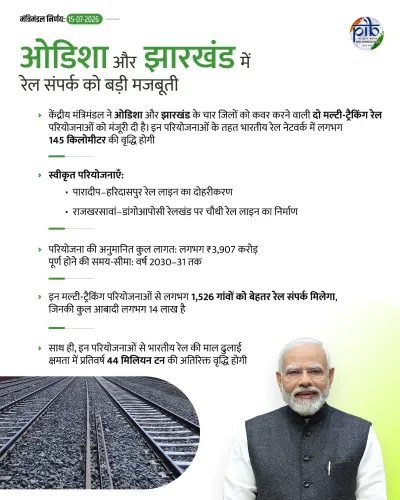
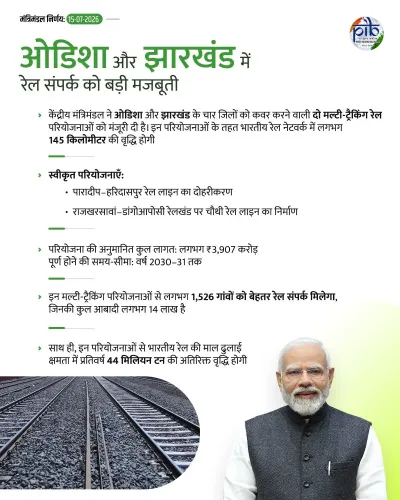
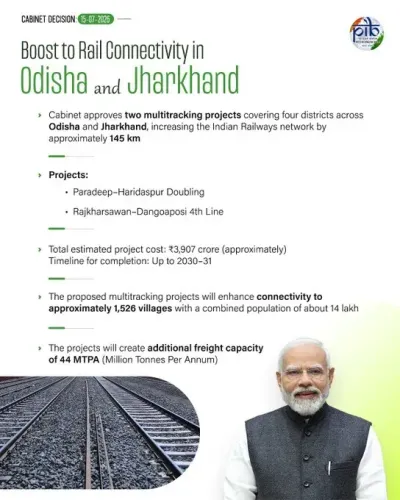
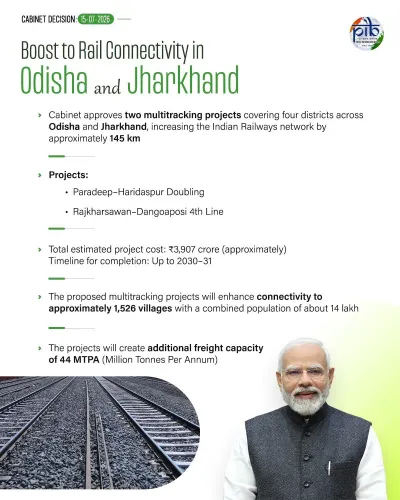
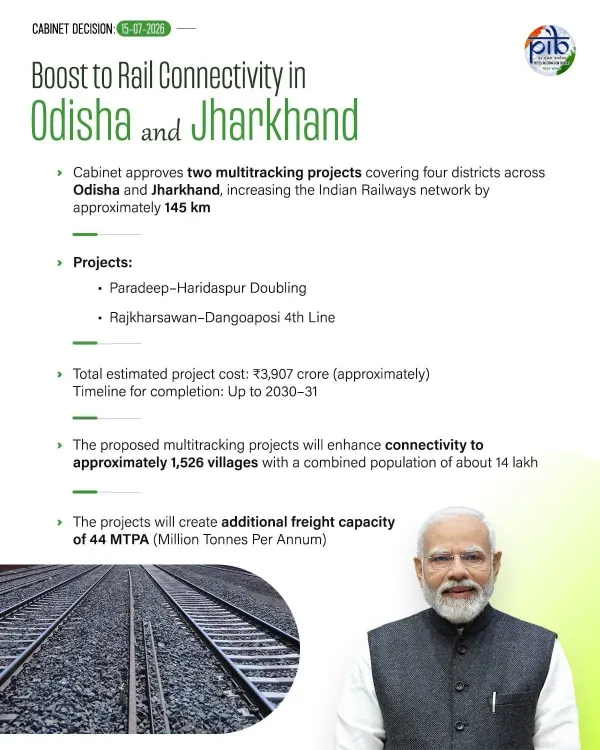
The Union Cabinet, chaired by PM Narendra Modi, has approved two multitracking railway projects in Odisha and Jharkhand at a cost of ₹3,907 crore. The projects will add about 145 km to the Indian Railways network and are targeted for completion by 2030–31, boosting freight and passenger connectivity in mineral-rich eastern India.
Key Takeaways
The Union Cabinet chaired by PM Narendra Modi approved two multitracking railway projects on July 15, 2026 .
The projects span four districts across Odisha and Jharkhand , adding approximately 145 km to the Indian Railways network.
Total estimated project cost is ₹3,907 crore , with a completion target of 2030–31 .
The approvals align with the PM Gati Shakti National Master Plan and the government's record railway capital expenditure drive.
Key beneficiaries include mining, freight, and industrial sectors in eastern India, as well as local passenger commuters.
Ministry of Railways progress reports and future Union Budget allocations will determine implementation pace.
Union Ports and Shipping Minister Sarbananda Sonowal on Wednesday, July 15, 2026, announced that the Union Cabinet, chaired by Prime Minister Narendra Modi, approved two multitracking railway projects spanning four districts across Odisha and Jharkhand, adding approximately 145 km to the Indian Railways network.
Context
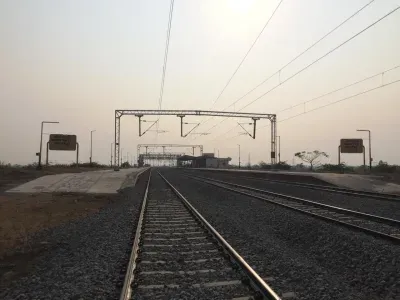
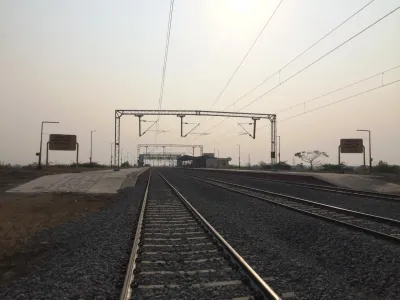
The Cabinet cleared the two projects at an estimated total cost of ₹3,907 crore, with a completion target of 2030–31. Multitracking — the addition of parallel rail lines alongside existing tracks — is a primary tool used by Indian Railways to decongest high-traffic corridors and increase freight throughput on routes that have historically operated at or beyond capacity.
Sonowal shared the announcement on social media, noting that the projects would 'expand the Indian Railways network by about 145 km' across the two eastern states. The approval came as part of a broader slate of Cabinet decisions taken at the July 15 meeting.
Policy Backdrop
The clearance fits squarely within the government's long-running infrastructure push in eastern India. The PM Gati Shakti National Master Plan, launched in 2021, brought railway expansion into an integrated multimodal planning framework, linking rail corridors with ports, highways, and industrial clusters across the country.
Union Budgets since 2019 have allocated record capital outlays to Indian Railways, with annual railway capital expenditure crossing ₹2 lakh crore in recent years. Multitracking projects in mineral-rich eastern states have been a consistent priority within this envelope, aimed at reducing logistics costs for the mining and heavy-industry sectors that dominate the regional economy of Odisha and Jharkhand.
Both states sit atop significant reserves of coal, iron ore, and other minerals, making efficient rail freight movement a direct lever on industrial competitiveness and export logistics through eastern ports.
Stakeholders and Impact
The primary beneficiaries of expanded rail capacity in this corridor are freight operators, mining companies, and the industrial clusters that depend on cost-effective movement of bulk commodities. Improved rail connectivity also eases passenger movement across four districts in the two states, with downstream benefits for local economies.
Eastern India has long faced rail congestion that pushes freight onto roads, raising costs and increasing wear on the highway network. Multitracking on key sections directly addresses this by allowing more trains to run simultaneously on the same corridor, cutting transit times and improving scheduling reliability.
The projects also align with the government's broader goal of raising the share of freight carried by rail — a target embedded in national logistics and climate policy — by making rail a more competitive option against road transport for bulk cargo.
What's Next
With a 2030–31 completion deadline, the projects will now move into detailed project report finalisation, land acquisition, and tendering phases under the Ministry of Railways. Progress will be tracked through periodic ministry reports and the pace of fund releases in successive Union Budgets.
Analysts watching India's railway capacity build-out will look to upcoming Budget sessions for signals on whether allocations keep pace with the growing pipeline of approved projects. Timely execution in eastern India is seen as critical to unlocking the region's freight potential and integrating it more deeply with port-led export infrastructure along the eastern coastline.
Point of View
907 crore and 145 km of new track, the projects are mid-scale but symbolically important as part of a multi-year pipeline that now stretches well into the 2030s. The 2030–31 deadline places execution squarely within the next electoral cycle, making timely delivery a political as well as an administrative test. Sonowal's amplification of the announcement signals the BJP's intent to keep infrastructure optics visible in eastern states where electoral competition remains intense.
NationPress
15 Jul 2026
Frequently Asked Questions
What did the Cabinet approve for Indian Railways on July 15 2026?
The Union Cabinet approved two multitracking railway projects covering four districts in Odisha and Jharkhand, adding about 145 km to the network at a total estimated cost of ₹3,907 crore, with a 2030–31 completion target.
What is multitracking in Indian Railways?
Multitracking refers to the construction of additional parallel rail lines alongside existing tracks on a corridor, which increases the number of trains that can run simultaneously, reduces congestion, and improves freight and passenger throughput.
Which states benefit from the new Cabinet-approved rail projects?
Odisha and Jharkhand are the two eastern states that will benefit, with the projects spanning four districts across both states.
What is the PM Gati Shakti plan and how does it relate to these projects?
The PM Gati Shakti National Master Plan, launched in 2021, integrates railway expansion with multimodal infrastructure planning. The newly approved multitracking projects in eastern India align with this framework by linking rail capacity to freight, port, and industrial connectivity goals.
When are the new railway projects expected to be completed?
Both projects are targeted for completion by 2030–31, subject to land acquisition, tendering, and fund releases in upcoming Union Budgets.