Cabinet clears ₹9,450 cr rail projects across 4 states
Synopsis
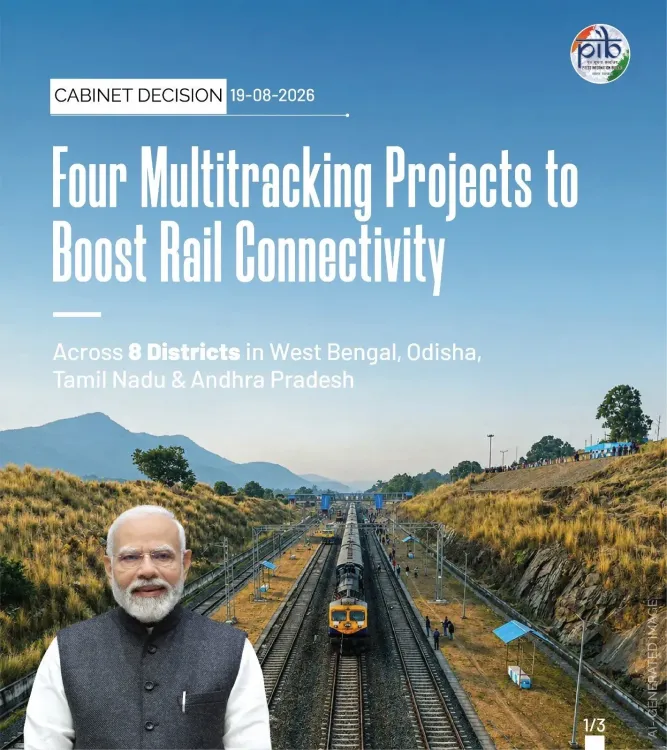
The Union Cabinet approved four rail multitracking projects worth ₹9,450 crore spanning 410 km across West Bengal, Odisha, Tamil Nadu, and Andhra Pradesh, set to improve connectivity for 60 lakh people in 6,448 villages and boost freight capacity under the Viksit Bharat framework.
Key Takeaways
The Union Cabinet approved four multitracking rail projects at a cost of ₹9,450 crore .
The projects cover 410 kilometres across West Bengal , Odisha , Tamil Nadu , and Andhra Pradesh .
Approximately 60 lakh people across 6,448 villages in 8 districts will gain improved rail connectivity.
Key goals include higher rail transport capacity, faster freight movement, and reduced logistics costs.
The decision aligns with the PM Gati Shakti National Master Plan and the broader Viksit Bharat development vision.
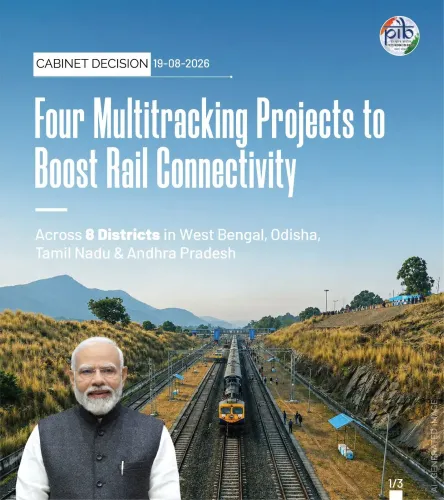
Sixty lakh people across four states are about to get a faster connection to India's rail network. Union Agriculture Minister Shivraj Singh Chouhan announced on Wednesday, 19 August 2026 that the Union Cabinet, under the leadership of Prime Minister Narendra Modi, approved four multitracking rail projects spanning 410 kilometres at a total cost of ₹9,450 crore — covering West Bengal, Odisha, Tamil Nadu, and Andhra Pradesh.
410 km, four states, eight districts
The approved projects will extend rail capacity across 8 districts, directly improving connectivity for roughly 6,448 villages and a population of nearly 60 lakh. Multitracking — the addition of parallel rail lines on existing corridors — is a proven lever for relieving bottlenecks without the cost or complexity of building entirely new routes. For the eastern and southern states in this package, that means faster passenger services and, crucially, more room on the network for freight.
The freight calculus behind the decision
The Cabinet's approval is explicitly tied to three economic outcomes: expanded rail transport capacity, faster freight movement, and lower logistics costs. India's logistics bill — estimated at roughly 13-14 percent of GDP, higher than most major economies — has been a persistent drag on manufacturing competitiveness. Multitracking projects like these directly address that by reducing dwell times and enabling heavier, more frequent freight trains on shared corridors.
The decision fits squarely within the architecture of the PM Gati Shakti National Master Plan, launched in 2021, which set out to integrate railways, roads, ports, and waterways into a single multimodal grid. The National Infrastructure Pipeline, announced in 2019, similarly earmarked rail network expansion as a priority investment. Today's cabinet nod is the latest instalment in that long-running commitment.
Why eastern and southern corridors matter now
West Bengal and Odisha anchor India's eastern industrial belt, with steel, coal, and port traffic all competing for rail bandwidth. Tamil Nadu and Andhra Pradesh, meanwhile, are home to fast-growing auto, electronics, and port-linked export clusters. Congested single or double-track sections in these corridors act as chokepoints that slow down the entire supply chain. Adding tracks here is not just infrastructure — it is industrial policy in steel and concrete.
Chouhan framed the decision in the language of 'Viksit Bharat' ('Developed India'), the government's overarching vision for a modernised economy by 2047. 'This decision,' he wrote, 'will further strengthen the resolve of Viksit Bharat by expanding modern, robust, and multi-modal connectivity across the country.'
The real test now lies in execution — land acquisition across eight districts in four states, each with its own political and administrative texture. Watch those timelines closely.
Point of View
Particularly land acquisition across eight districts in four states, will determine whether this approval translates into a genuine infrastructure milestone or another item in a long pipeline.
NationPress
20 Aug 2026
Frequently Asked Questions
Which states will benefit from the new rail multitracking projects approved by the Cabinet?
The four states are West Bengal, Odisha, Tamil Nadu, and Andhra Pradesh. Together, the projects cover 410 km across 8 districts.
What is the total cost of the rail projects approved by the Union Cabinet?
The Union Cabinet approved the four multitracking rail projects at a total cost of ₹9,450 crore.
How many people will benefit from these rail connectivity projects?
Approximately 60 lakh people living in around 6,448 villages across 8 districts are expected to gain improved rail connectivity.
What is multitracking in railways and why does it matter?
Multitracking means adding parallel rail lines on existing corridors to increase capacity. It reduces bottlenecks, allows more frequent freight trains, and lowers logistics costs without building entirely new routes.
How do these rail projects connect to PM Gati Shakti?
The PM Gati Shakti National Master Plan, launched in 2021, aims to integrate railways, roads, and ports into a unified multimodal network. These multitracking approvals are part of that broader infrastructure integration strategy.