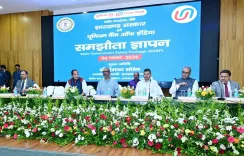
CM Majhi Backs Cabinet's 5-Year POCSO Court Extension

Synopsis
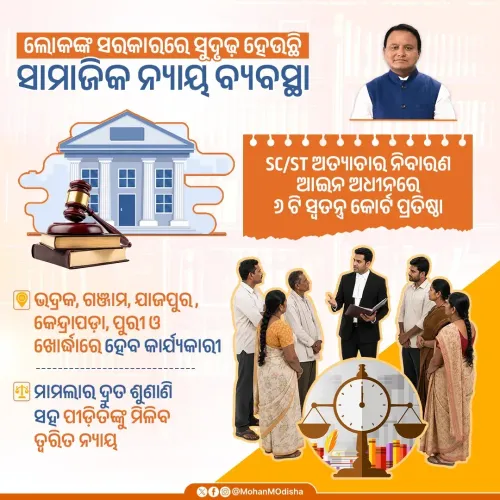
The Union Cabinet has approved the five-year continuation (2026–2031) of Fast Track Special Courts, including exclusive POCSO Courts, to ensure speedy trials in sexual offence and child abuse cases. Odisha CM Mohan Charan Majhi welcomed the move as a reaffirmation of India's commitment to justice for women and children.
Key Takeaways
The Union Cabinet has approved the extension of Fast Track Special Courts , including exclusive POCSO Courts , for five years from 2026 to 2031 .
The scheme was originally launched in 2019 with 1,023 specialised courts across states, funded partly through the Nirbhaya Fund .
POCSO Courts are dedicated exclusively to cases under the Protection of Children from Sexual Offences Act, 2012 .
Odisha CM Mohan Charan Majhi described the decision as reflecting India's 'continued commitment to strengthening the justice delivery system.' The extension is time-bound by design to allow periodic review and accountability of judicial performance.
State-level operationalisation and revised performance benchmarks will be key to the scheme's impact in the new cycle.
Justice for India's most vulnerable just got a five-year runway. Odisha Chief Minister Mohan Charan Majhi on Wednesday, November 4, 2026, welcomed the Union Cabinet's decision to extend the Fast Track Special Courts scheme — including exclusive POCSO Courts — for another five years, covering 2026 to 2031.
A Scheme Born from Crisis, Now Renewed for the Long Haul
The Fast Track Special Courts were not a routine policy invention. They emerged from a moment of national reckoning — a sustained push since 2012 to build dedicated judicial infrastructure for sexual offences and child abuse cases. The scheme was formally approved by the Union Cabinet in 2019, establishing 1,023 specialised courts across states, funded in part through the Nirbhaya Fund. The courts were time-bound by design — a deliberate choice to allow periodic review rather than create permanent structures that could calcify without accountability.
That design is now doing exactly what it was meant to do. The Cabinet's fresh approval locks in another five-year cycle, keeping the institutional machinery running for cases that cannot afford to wait in an overburdened general docket.
POCSO Courts and the Stakes for Children
Embedded within the broader Fast Track framework are the exclusive POCSO Courts — tribunals dedicated solely to offences under the Protection of Children from Sexual Offences Act, 2012. Child sexual abuse cases carry an acute urgency: survivors are young, evidence degrades, and trauma compounds with delay. A dedicated court strips away the procedural jostling that pushes such cases to the back of the queue.
CM Majhi framed the extension as a marker of the government's 'continued commitment to strengthening the justice delivery system, ensuring speedy trials in cases of sexual offences and protecting the rights and dignity of women and children.' For Odisha — a state still building its institutional capacity in the post-June 2024 BJP administration — the central funding and framework offer direct on-ground leverage.
What the 2026–2031 Cycle Must Deliver
The extension is an opportunity, not a guarantee. The critical variables now shift to the state level: how quickly governments operationalise the renewed courts, whether performance benchmarks are revised upward, and how effectively case pendency is tracked and published. Time-bound schemes are only as strong as the accountability mechanisms woven into their renewal cycles.
Under Prime Minister Narendra Modi, the government has consistently framed fast-track judicial infrastructure as a cornerstone of criminal justice reform for gender and child-related offences. The five-year extension signals that this remains a political and policy priority heading into the next half-decade.
Point of View
Nirbhaya Fund-backed judicial infrastructure to signal responsiveness on gender and child safety — a politically salient issue since 2012. For CM Majhi, amplifying a central scheme decision serves a dual purpose: it aligns Odisha's new BJP government with Delhi's reform narrative and builds a record on law-and-order governance ahead of potential state-level scrutiny. The critical test, however, is not the approval but the operationalisation — past cycles have shown that court establishment rates vary sharply across states, and the 2026–2031 window must be matched with hard performance targets to move from optics to outcomes.
NationPress
4 Nov 2026
Frequently Asked Questions
What are Fast Track Special Courts in India?
Fast Track Special Courts are specialised judicial bodies set up to expedite trials in rape and sexual offence cases. Established under the Union Cabinet's 2019 approval, they include exclusive POCSO Courts for child sexual abuse cases and are funded partly through the Nirbhaya Fund.
What is the new POCSO Court extension approved by the Cabinet?
The Union Cabinet has approved the continuation of Fast Track Special Courts, including exclusive POCSO Courts, for five years from 2026 to 2031, ensuring dedicated infrastructure for speedy trials in sexual offence and child abuse cases.
What is the Nirbhaya Fund and how is it linked to POCSO Courts?
The Nirbhaya Fund is a central government corpus created to support initiatives for the safety and security of women in India. It has been used to part-fund the Fast Track Special Courts scheme, including POCSO Courts, since the scheme's launch in 2019.
What did Odisha CM Mohan Charan Majhi say about the POCSO Court extension?
CM Mohan Charan Majhi welcomed the Union Cabinet decision, stating it reflects the Government of India's 'continued commitment to strengthening the justice delivery system' and ensuring timely justice for women and children.
How many Fast Track Special Courts were set up under the original 2019 scheme?
The Union Cabinet approved the establishment of 1,023 Fast Track Special Courts across India under the scheme first launched in 2019, including exclusive courts for POCSO cases.