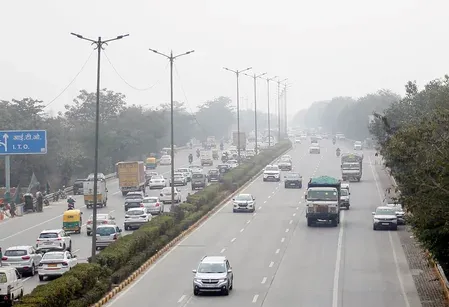
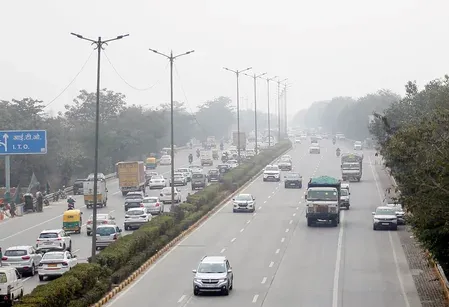
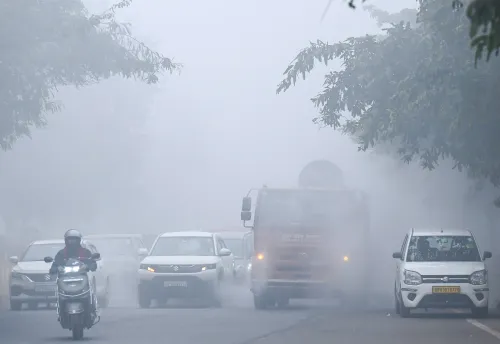
CAQM revokes GRAP Stage-I across NCR as Delhi AQI drops to 88
Synopsis
Delhi's AQI plunged from 175 to 88 in a single day, prompting CAQM to lift GRAP Stage-I restrictions across the entire NCR with immediate effect on 4 May. The improvement, driven by rain and favourable winds, offers temporary relief — but 34 road dust violations detected just days earlier underline how fragile the gains remain.
Key Takeaways
CAQM revoked GRAP Stage-I across the entire NCR on 4 May with immediate effect.
Delhi's AQI improved from 175 on Sunday to 88 on Monday , aided by rain and favourable meteorological conditions, per CPCB data.
Stage-I was originally invoked on 16 April after Delhi's AQI began rising consistently.
All state agencies and local bodies must continue to comply with existing statutory pollution control directions despite the revocation.
34 road dust violations were detected by CAQM flying squads in Civil Lines , Karol Bagh , and West Delhi on 23 April .
The Sub-Committee will monitor AQI using IMD and IITM forecasts and can re-invoke GRAP stages if conditions worsen.
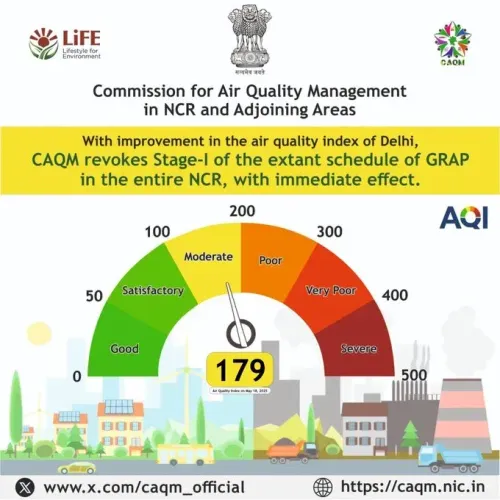
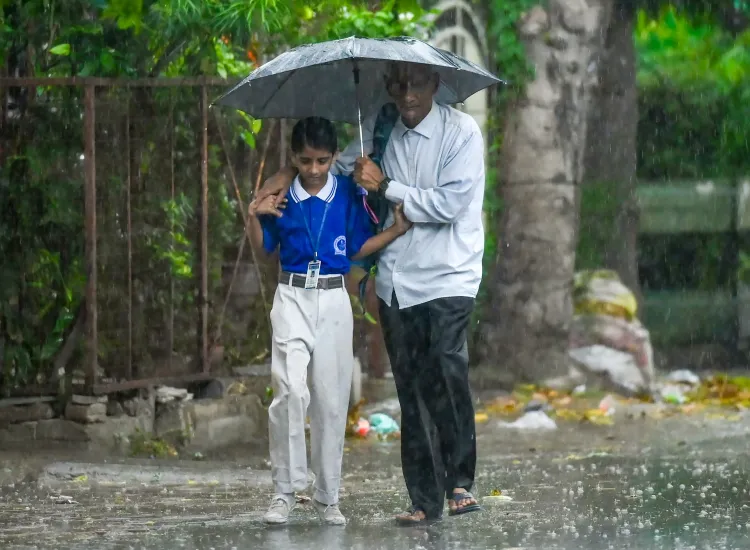
The Commission for Air Quality Management in NCR and Adjoining Areas (CAQM) Sub-Committee on Monday, 4 May unanimously decided to revoke all actions under Stage-I of the Graded Response Action Plan (GRAP) across the entire National Capital Region (NCR), with immediate effect, after Delhi's average Air Quality Index (AQI) improved sharply from 175 on Sunday to 88 on Monday, according to data from the Central Pollution Control Board (CPCB). The improvement was attributed to rainfall and favourable meteorological conditions.
Why Stage-I Was Invoked
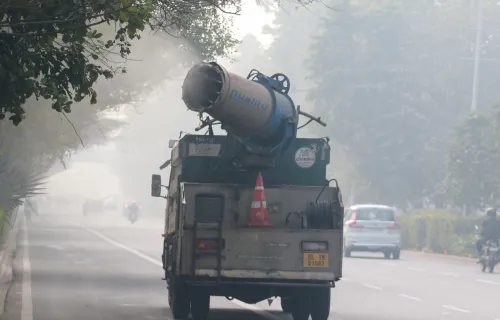
The CAQM Sub-Committee had originally invoked Stage-I of GRAP through an order dated 16 April, after Delhi's average AQI began exhibiting a consistent upward trend. Stage-I measures include restrictions on dust-generating activities, stricter enforcement of pollution norms, and heightened monitoring across contributing sectors. The revocation on Monday signals that air quality has returned to levels that no longer warrant emergency-level restrictions.
Conditions Attached to the Revocation
The CAQM has made clear that the rollback does not amount to a relaxation of baseline environmental obligations. All agencies of concerned state governments, the Government of NCT of Delhi (GNCTD), and local bodies must continue to comply with all statutory directions, advisories, and orders issued by the Commission. This includes rules and regulations issued by the Ministry of Environment, Forest and Climate Change (MoEFCC), the CPCB, respective state governments, and Pollution Control Boards. Dust mitigation measures, in particular, must be maintained rigorously, the statement said.
Violations Detected During Earlier Inspections
The revocation comes even as the CAQM's own enforcement record reveals persistent compliance gaps. On 23 April, five flying squads deployed by the Commission detected 34 instances of visible road dust violations during an inspection drive across three zones of Delhi — Civil Lines, Karol Bagh, and West Delhi — falling under the jurisdiction of the Municipal Corporation of Delhi (MCD). The violations were recorded on road stretches including Mahakavi Goswami Tulsidas Marg, Keshopur Road, Najafgarh Road, Vedic Marg, Ring Road, Punjabi Bagh, Azadpur Road, Bhalswa Dairy Road, and Faiz Road, among others. The violations primarily involved high levels of visible road dust and the accumulation of construction and demolition waste at multiple locations.
What Happens Next
The Sub-Committee has stated it will maintain close watch over the air quality situation and review it periodically, with further decisions to be guided by AQI readings in Delhi and weather forecasts provided by the India Meteorological Department (IMD) and the Indian Institute of Tropical Meteorology (IITM). Should the AQI deteriorate again, higher GRAP stages can be re-invoked swiftly. The situation remains contingent on sustained meteorological relief and ground-level enforcement across all contributing sectors.
Point of View
Not a policy victory. Delhi's AQI swung from 175 to 88 in 24 hours — a volatility that reflects how dependent the city's air quality remains on wind and rain rather than structural enforcement. The 34 road dust violations detected by CAQM's own squads just 11 days ago, on roads under MCD jurisdiction, are a reminder that ground-level compliance lags far behind the Commission's directives. Seasonal improvements have historically masked year-round failures in dust management and construction waste disposal, only for the problem to resurface when the weather turns unfavourable again.
NationPress
26 Sept 2026
Frequently Asked Questions
Why has CAQM revoked GRAP Stage-I in the NCR?
CAQM revoked GRAP Stage-I on 4 May after Delhi's average AQI improved sharply from 175 on Sunday to 88 on Monday, driven by rainfall and favourable meteorological conditions. The Sub-Committee determined that emergency-level restrictions were no longer warranted at this AQI level.
What is GRAP Stage-I and what restrictions does it involve?
GRAP Stage-I is the first tier of the Graded Response Action Plan, a set of emergency pollution-control measures activated when Delhi's AQI deteriorates. It includes stricter enforcement of dust norms, curbs on certain construction activities, and heightened monitoring across sectors contributing to air pollution in the NCR.
When was GRAP Stage-I originally invoked this year?
The CAQM Sub-Committee invoked GRAP Stage-I on 16 April 2025, after Delhi's average AQI began showing a consistent upward trend. It remained in force until 4 May, when the sharp improvement in air quality prompted its revocation.
Does the revocation mean all pollution restrictions are lifted?
No. CAQM has clarified that all agencies and local bodies must continue to comply with existing statutory directions, advisories, and orders from the Commission, MoEFCC, CPCB, and state pollution control boards. Dust mitigation measures remain mandatory.
What violations were found during recent CAQM inspections in Delhi?
On 23 April, CAQM's five flying squads detected 34 instances of visible road dust violations across Civil Lines, Karol Bagh, and West Delhi zones under MCD jurisdiction. The violations involved high levels of road dust and accumulation of construction and demolition waste on multiple road stretches.