Pradhan Hails CCEA Nod for ₹2,534 Cr Amaravati Projects
Synopsis
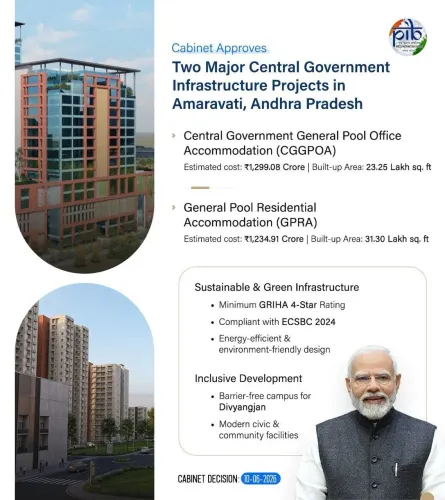
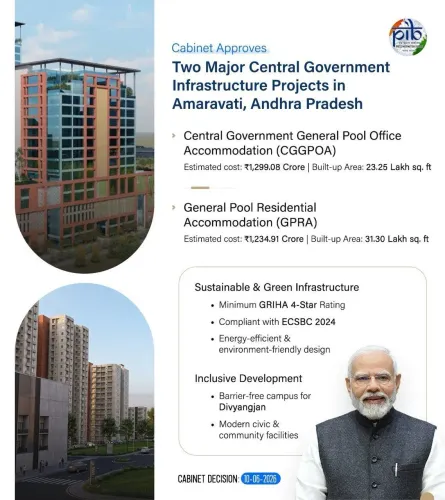
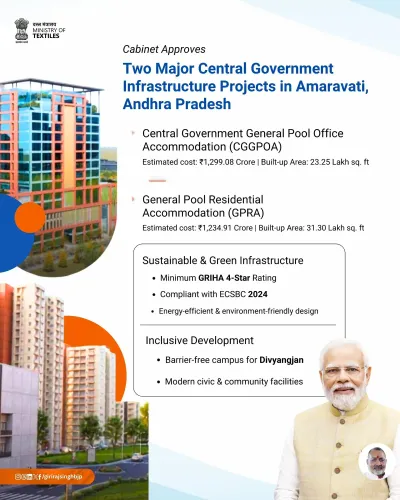
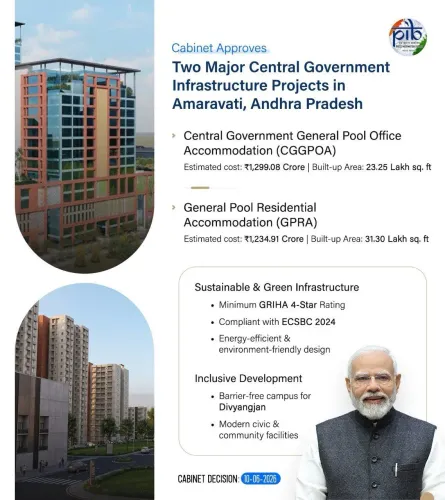
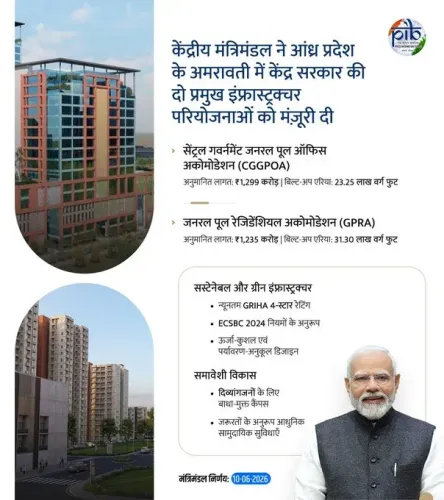
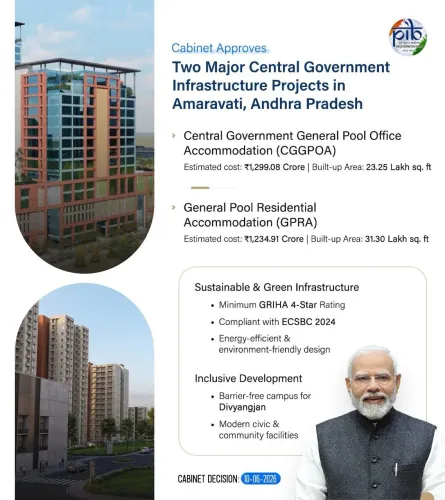
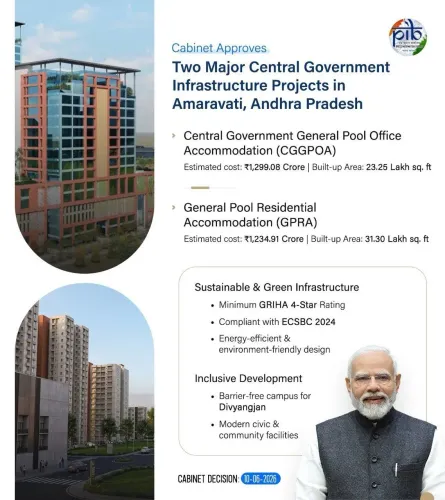
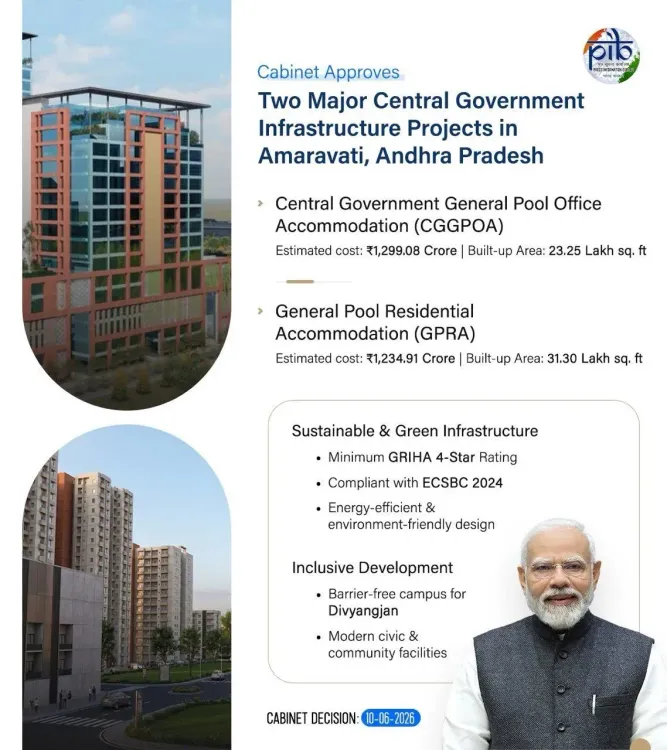
The Cabinet Committee on Economic Affairs, chaired by PM Narendra Modi, has approved two central infrastructure projects in Amaravati worth over ₹2,534 crore, creating 23.25 lakh sq ft of office space under CGGPOA and 31.30 lakh sq ft of residential accommodation under GPRA, both built to green and energy-efficient standards.
Key Takeaways
The CCEA approved two central infrastructure projects in Andhra Pradesh with a combined outlay of over ₹2,534 crore .
Project one: 23.25 lakh sq ft of office space under the Central Government General Pool Office Accommodation (CGGPOA) scheme.
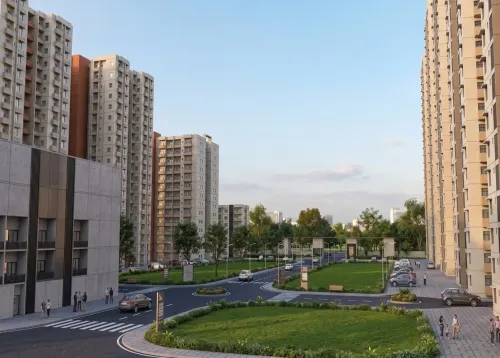
Project two: 31.30 lakh sq ft of residential infrastructure under the General Pool Residential Accommodation (GPRA) programme.
Both projects are mandated to follow green and energy-efficient design standards .
The approvals align with the TDP-led Andhra Pradesh government's commitment to Amaravati as the state's sole capital following the 2024 assembly elections .
The investments are expected to accelerate Amaravati's transition into a functional modern administrative hub .
Union Education Minister Dharmendra Pradhan on Wednesday, June 10, 2026, welcomed the Cabinet Committee on Economic Affairs (CCEA) decision to approve two major central infrastructure projects in Andhra Pradesh, with a combined investment of over ₹2,534 crore, calling it 'a major boost to the development of Amaravati.'
Context
The CCEA, chaired by Prime Minister Narendra Modi, cleared two distinct infrastructure components for Amaravati, the designated capital of Andhra Pradesh. The first covers 23.25 lakh square feet of office space under the Central Government General Pool Office Accommodation (CGGPOA) scheme. The second involves 31.30 lakh square feet of residential infrastructure under the General Pool Residential Accommodation (GPRA) programme, both designed to meet green and energy-efficient standards.
Pradhan described the projects as infrastructure that is 'sustainable, inclusive and future-ready,' framing the approval as a step toward strengthening Amaravati's role as a modern administrative hub.
Policy Backdrop
The need for a dedicated capital city arose from the Andhra Pradesh Reorganisation Act, 2014, which bifurcated the erstwhile united Andhra Pradesh and created the new state of Andhra Pradesh with Amaravati as its chosen capital. The central government had committed special assistance packages for Amaravati's construction under earlier frameworks, and schemes such as CGGPOA and GPRA have been progressively expanded since 2014 to support administrative infrastructure in newly formed state capitals.
The present approvals come after the 2024 Andhra Pradesh assembly elections returned a Telugu Desam Party (TDP)-led government that has consistently prioritised Amaravati as the state's singular capital, reviving central-state coordination on the project after years of policy flux under the previous administration.
Stakeholders and Impact
The approved office complexes will house central government departments and ministries operating in the new capital, reducing the administrative burden currently managed from Hyderabad, which serves as the shared capital until 2024 under transition arrangements. The residential blocks under GPRA will provide accommodation for central government employees posted to Amaravati, a prerequisite for attracting and retaining a functional bureaucratic presence in the city.
Residents of Amaravati and surrounding areas in the Krishna and Guntur districts are among the primary beneficiaries, as the projects are expected to stimulate ancillary economic activity, employment in construction, and downstream demand for urban services. Similar central infrastructure support extended to Telangana after its formation in 2014 offers a precedent for the scale and sequencing of such investments.
What's Next
Attention will now shift to the tendering and construction timelines for both the office and residential complexes. Observers will watch whether the current budget session or subsequent central announcements include additional grants, land acquisition support, or connectivity investments to complement the approved outlay. The pace of on-ground execution will be a key indicator of how quickly Amaravati can transition from a planned capital to a functioning administrative centre.
Point of View
534 crore for Amaravati signals a deliberate reinvestment in a capital project that had stalled under the previous state government, and reflects renewed central-state alignment following the TDP's return to power in 2024. For the BJP-led central government, backing Amaravati serves a dual purpose: honouring a longstanding commitment made at the time of the 2014 bifurcation and consolidating political goodwill in a strategically important southern state. The scale of the approval — covering both office and residential stock — suggests the centre is moving beyond symbolic gestures toward building the functional administrative core that Amaravati has lacked. Whether this momentum translates into on-ground delivery will determine whether Amaravati finally cements its status as a working capital or remains a long-deferred promise.
NationPress
26 Oct 2026
Frequently Asked Questions
What did the CCEA approve for Amaravati in June 2026?
The Cabinet Committee on Economic Affairs approved two central infrastructure projects in Andhra Pradesh with a combined investment of over ₹2,534 crore, comprising 23.25 lakh sq ft of office space under the CGGPOA scheme and 31.30 lakh sq ft of residential accommodation under the GPRA programme, both built to green and energy-efficient standards.
What is the CGGPOA scheme?
CGGPOA stands for Central Government General Pool Office Accommodation, a Union government scheme that funds the construction of office space for central government departments and ministries, including in new or emerging state capitals.
Why is Amaravati being developed as a capital city?
Amaravati was designated the capital of Andhra Pradesh following the state's bifurcation under the Andhra Pradesh Reorganisation Act of 2014, which created the separate state of Telangana and left Andhra Pradesh without an established capital city.
How does this approval relate to the 2024 Andhra Pradesh elections?
The 2024 Andhra Pradesh assembly elections returned a TDP-led government that made Amaravati's development a central campaign commitment. The renewed state government's focus has revived central-state coordination on the capital project after years of uncertainty under the previous administration.
Who will benefit from the Amaravati office and housing projects?
Central government employees posted to Amaravati will benefit directly from the new office and residential infrastructure. Residents of Amaravati and surrounding districts in Krishna and Guntur are also expected to benefit from increased economic activity, construction employment, and improved urban services.