Cabinet clears ₹1,235 crore housing project in Amaravati, AP's new capital
Synopsis
The Centre has made its most tangible infrastructure commitment to Amaravati yet — a ₹1,235 crore, 1,504-unit residential campus for Central government employees. It is the first GPRA project in Andhra Pradesh, and its approval signals that New Delhi is now actively investing in the long-contested capital city.
Key Takeaways
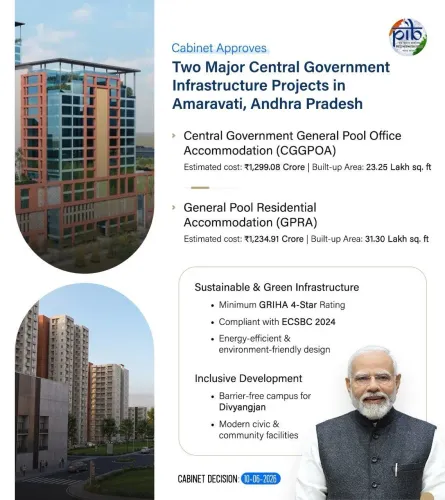
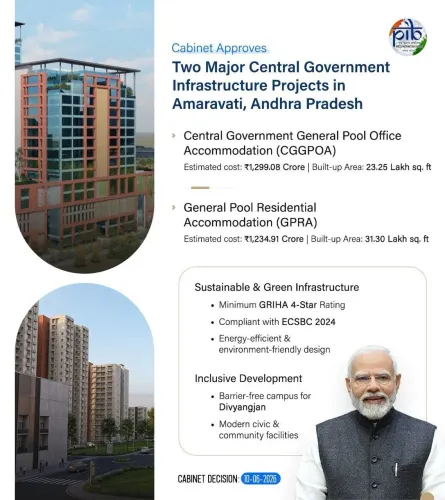
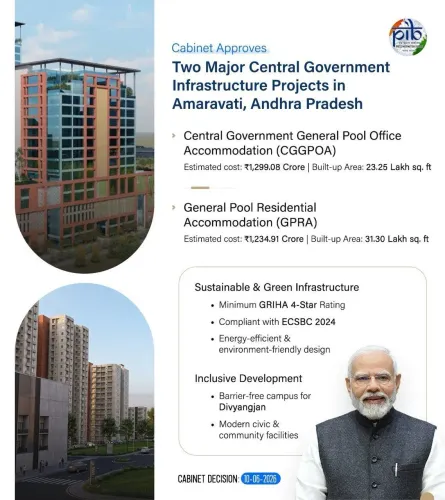
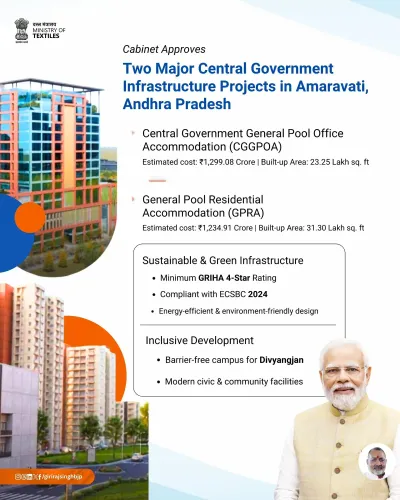
The CCEA , chaired by PM Modi , approved a ₹1,234.91 crore GPRA campus in Amaravati on 10 June .
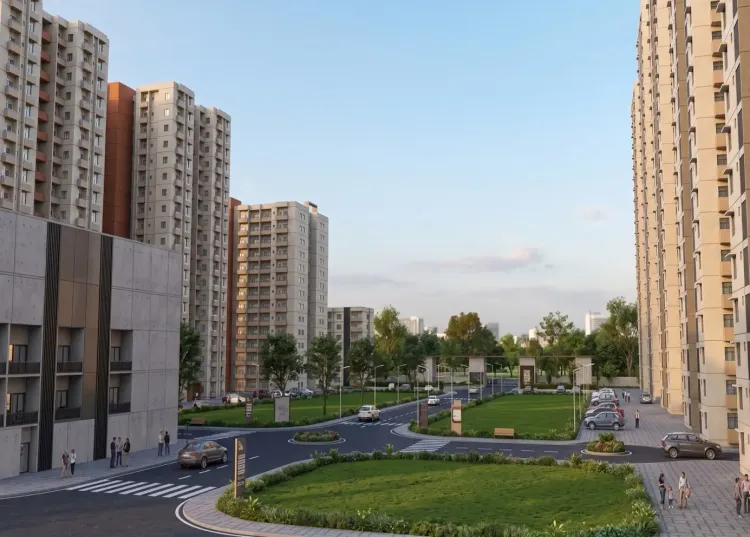
The campus spans 17 acres with 11 towers and 1,504 dwelling units (Type II–VI).
Total built-up area: 31.30 lakh sq ft ; basement parking for 1,972 cars .
This is the first GPRA project in Amaravati and in all of Andhra Pradesh .
All buildings to be certified at minimum GRIHA 4-Star under ECSBC 2024 and ENS 2024 .
Project to generate approximately 7 lakh man-days of employment annually during construction.
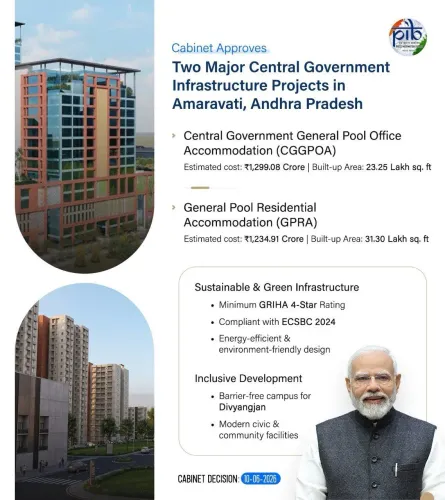
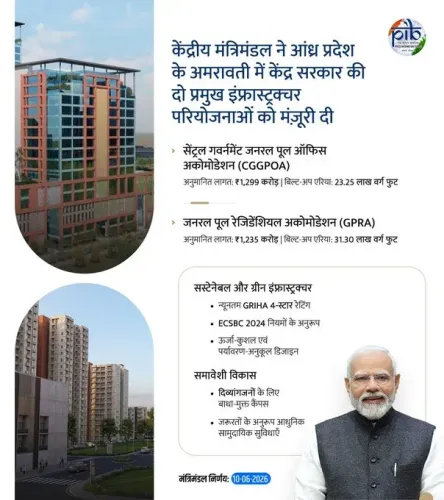
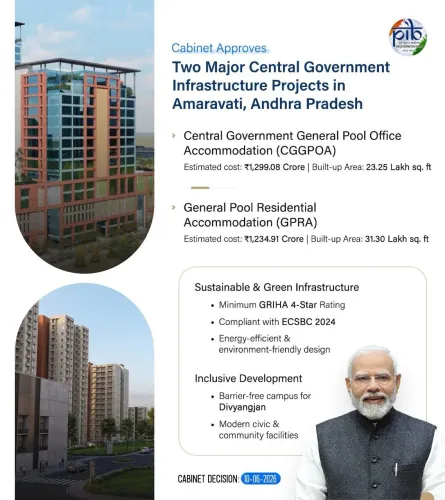
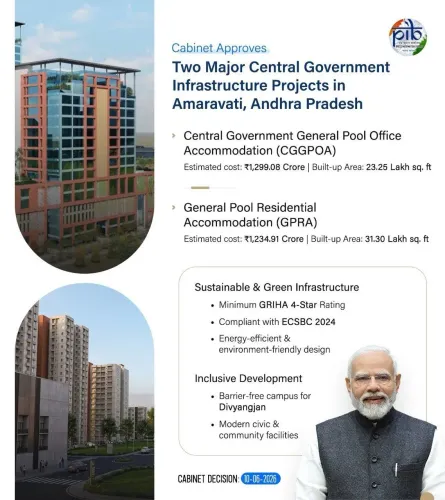
The Cabinet Committee on Economic Affairs (CCEA), chaired by Prime Minister Narendra Modi, on Wednesday, 10 June approved the construction of a General Pool Residential Accommodation (GPRA) campus in Amaravati, Andhra Pradesh's new capital city, at an investment of ₹1,234.91 crore. This marks the first-ever GPRA project both in Amaravati and in the state of Andhra Pradesh.
Project Scope and Scale
The GPRA campus will come up on 17 acres and comprise 11 residential towers housing 1,504 dwelling units, ranging from Type II to Type VI, including refuge areas. The total built-up area is 31.30 lakh square feet (2,90,762 square metres), with a basement area of 9.10 lakh square feet (84,394 sqm). Basement parking will accommodate 1,972 Equivalent Car Spaces (ECS).
The project will be executed by the Ministry of Housing and Urban Affairs through the Central Public Works Department (CPWD), funded entirely through budgetary support under Head of Account 4216 — Capital Outlay on Housing (Residential Buildings). Pre-bid activities have already commenced and tender documents are currently being prepared, according to the Cabinet communiqué.
Why This Project Matters for Amaravati
Amaravati has been at the centre of Andhra Pradesh's capital relocation saga for nearly a decade. The GPRA approval signals a concrete step toward operationalising the city as a functional administrative hub. By housing Central government employees in close proximity to their workplaces, the project aims to support efficient governance and ensure staff availability, the communiqué stated.
Notably, this is the first major Central government residential infrastructure commitment to Amaravati, lending institutional momentum to a capital-building project that has faced prolonged political and legal uncertainty.
Green Building Standards
All buildings on the campus will be designed to achieve a minimum GRIHA 4-Star Rating, in compliance with the Energy Conservation and Sustainable Building Code (ECSBC) 2024 and the Eco-Niwas Samhita (ENS) 2024. The design will prioritise sustainable site planning, energy efficiency, water conservation, use of locally available materials, and occupant health and comfort.
The campus will also be fully barrier-free, ensuring accessibility for Divyangjan (persons with disabilities) in line with applicable accessibility standards.
Amenities and Employment Impact
Beyond residential units, the campus will include a bank and ATM, post office, crèche, community hall with dining facilities, food court, shopping complex, service centre, and guest house.
On the employment front, the project is estimated to generate approximately 7 lakh man-days of employment per annum during construction, and around 50,000 man-days per annum during the operational phase, covering skilled, semi-skilled, and unskilled workers.
With tender documents in progress and pre-bid activities already under way, the pace of execution over the next 12 to 18 months will be closely watched as a barometer of the Centre's commitment to Amaravati's long-delayed capital-building ambitions.
Point of View
235 crore residential campus for Central employees is not just a housing decision; it is an institutional bet on the city's permanence. The real measure of intent, however, will be execution speed: Amaravati has seen many announcements and few completions. With tender documents still being drafted, the gap between approval and occupancy remains wide — and politically consequential for both the state government and the Centre.
NationPress
24 Sept 2026
Frequently Asked Questions
What did the Cabinet approve for Amaravati on 10 June?
The Cabinet Committee on Economic Affairs approved a ₹1,234.91 crore General Pool Residential Accommodation (GPRA) campus in Amaravati, Andhra Pradesh's new capital city. The campus will have 11 residential towers with 1,504 dwelling units spread across 17 acres.
Who will build and fund the Amaravati GPRA project?
The project will be funded entirely by the Government of India through budgetary support and executed by the Ministry of Housing and Urban Affairs via the Central Public Works Department (CPWD). Pre-bid activities have already commenced.
Why is this GPRA project significant for Andhra Pradesh?
This is the first GPRA project in Amaravati and the first such Central government residential project anywhere in Andhra Pradesh. It represents a concrete federal infrastructure commitment to the long-contested new capital city.
What green standards will the Amaravati GPRA campus meet?
All buildings will be designed to achieve a minimum GRIHA 4-Star Rating, in compliance with the Energy Conservation and Sustainable Building Code (ECSBC) 2024 and Eco-Niwas Samhita (ENS) 2024, with a focus on energy efficiency, water conservation, and sustainable materials.
How many jobs will the Amaravati housing project create?
The project is estimated to generate approximately 7 lakh man-days of employment per annum during the construction phase, and around 50,000 man-days per annum during the operational phase, covering skilled, semi-skilled, and unskilled workers.