Giriraj Singh hails Cabinet nod for ₹2,500 cr Amaravati infra push
Synopsis
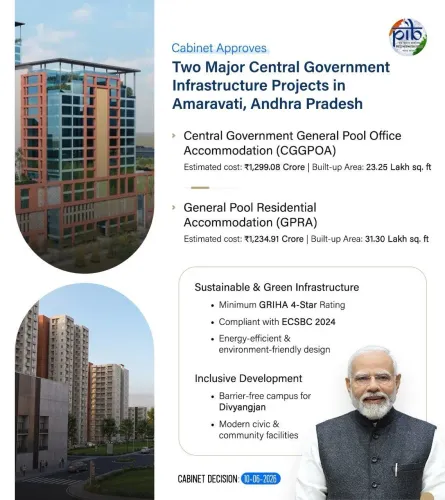
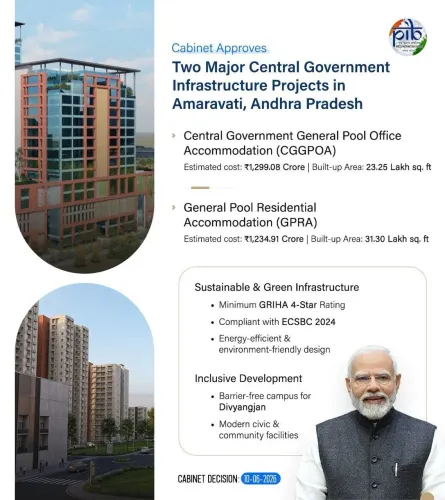
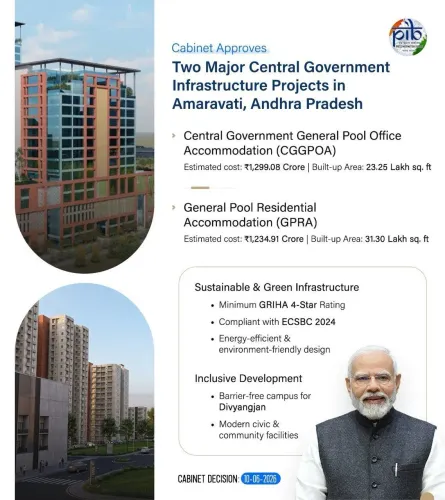
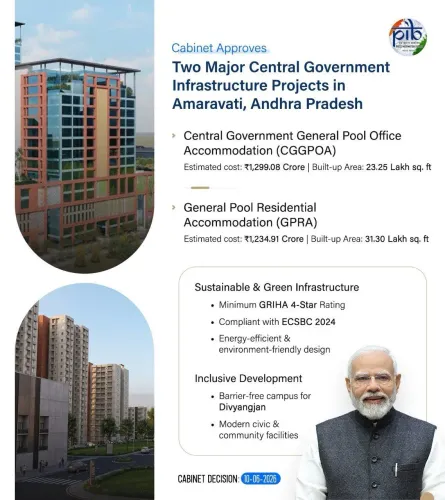
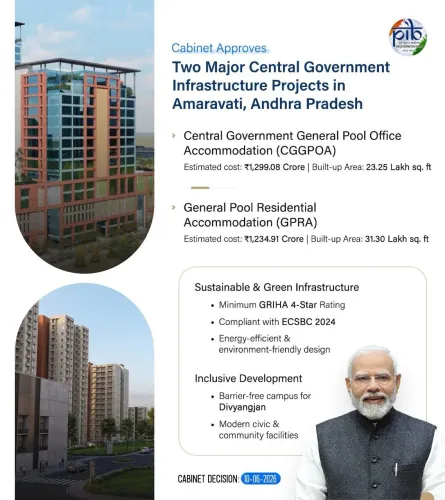
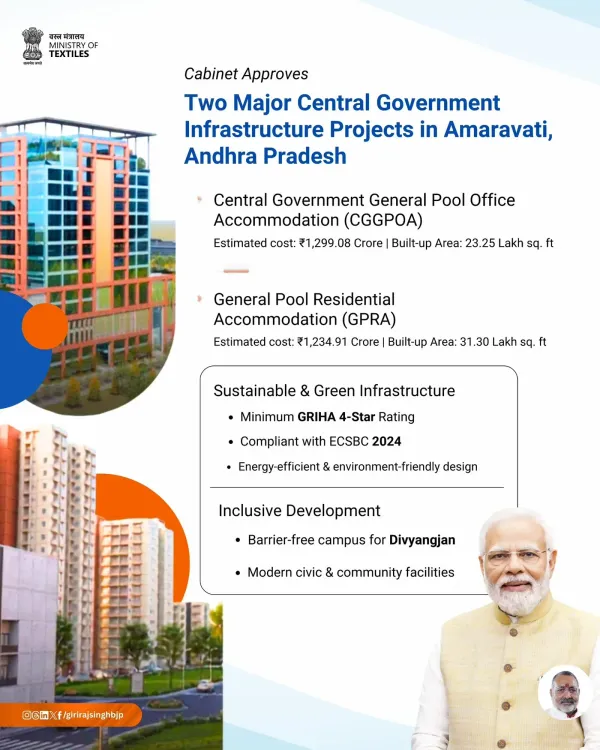
The Union Cabinet has approved two central infrastructure projects — CGGPOA and GPRA — worth over ₹2,500 crore in Amaravati, Andhra Pradesh's planned capital. Union Textiles Minister Giriraj Singh hailed the decision as a step toward Viksit Bharat, continuing post-bifurcation federal commitments to the state.
Key Takeaways
The Union Cabinet approved two central infrastructure projects — CGGPOA and GPRA — in Amaravati , Andhra Pradesh.
The combined project cost exceeds ₹2,500 crore .
Union Textiles Minister Giriraj Singh welcomed the decision on June 10, 2026 .
The projects will provide central government office and residential accommodation in the new state capital.
The approvals continue central commitments made after Andhra Pradesh's bifurcation in 2014 .
The move aligns with the Viksit Bharat 2047 vision of modernised public infrastructure across India.
Union Textiles Minister Giriraj Singh on Wednesday, June 10, 2026, welcomed the Union Cabinet's approval of two major central infrastructure projects in Amaravati, Andhra Pradesh, valued at over ₹2,500 crore, calling the move a decisive step toward realising the vision of a developed India.
Posting on X, Singh wrote: 'Mananiya Pradhan Mantri Shri Narendra Modi ji ke netritva mein Andhra Pradesh ke infrastructure ko ek abhutpurva gati mil rahi hai' — ('Under the leadership of honoured Prime Minister Shri Narendra Modi, Andhra Pradesh's infrastructure is receiving an unprecedented momentum'). He specifically cited Cabinet approval for two central projects — CGGPOA and GPRA — in Amaravati, describing the decision as one that 'strengthens the resolve of Viksit Bharat.'
Context
Amaravati is the planned capital city of Andhra Pradesh, designated after the state's bifurcation under the Andhra Pradesh Reorganisation Act of 2014, which carved out Telangana as a separate state. The central government had committed support for building Amaravati's core infrastructure at the time of bifurcation, with the foundation stone laid in 2015. The latest Cabinet approvals represent a continuation of that long-standing commitment, now with specific allocations exceeding ₹2,500 crore.
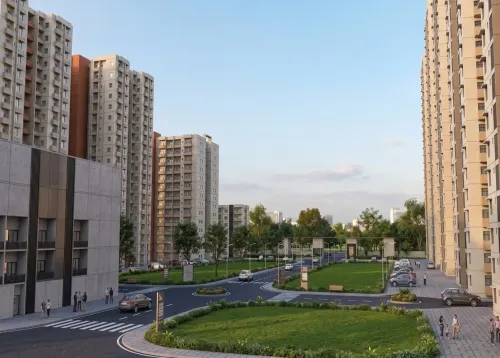
The two projects — identified as CGGPOA (a central government general pool office accommodation complex) and GPRA (General Pool Residential Accommodation) — are designed to house central government offices and employee residences in the new capital. Such facilities are essential for operationalising a state capital and enabling the relocation of administrative functions from Hyderabad, which now serves as a shared capital under a transitional arrangement.
Policy Backdrop
The approvals align with the Viksit Bharat 2047 framework, the central government's long-term vision of modernised public infrastructure across all states by India's centenary of independence. Successive Union Cabinets have sanctioned central government office and residential complexes in emerging or newly designated state capitals as part of a broader decentralisation of administration.
The Ministry of Housing and Urban Affairs typically oversees the construction and fund disbursement for GPRA and central office pool projects. Similar projects have been sanctioned in other expanding administrative centres in recent years, reflecting a pattern of centrally funded support for state capital infrastructure.
Stakeholders and Impact
The primary beneficiaries of the two projects are central government employees posted in Andhra Pradesh, who currently lack dedicated residential and office accommodation in Amaravati. The Andhra Pradesh state government stands to gain from accelerated capital city development, which has faced funding and political headwinds over the past decade.
Residents and investors in the Amaravati Capital Region are also likely to benefit, as central government presence typically catalyses ancillary urban development — roads, utilities, and commercial activity. The approval signals renewed federal commitment to the city's viability at a time when its development trajectory has been closely watched.
What's Next
Attention will now shift to execution timelines and the pace of fund releases by the Ministry of Housing and Urban Affairs. Any follow-up proposals in the next Union Budget or in the Andhra Pradesh Legislative Assembly session could further define the scope and speed of Amaravati's buildout. The central government's ability to translate Cabinet approvals into ground-level progress will be the key test of whether this ₹2,500 crore commitment accelerates the capital city's long-delayed completion.
Point of View
500 crore for Amaravati's central infrastructure is a politically significant signal ahead of Andhra Pradesh's ongoing capital city debate. By publicly amplifying the decision, Giriraj Singh — a senior BJP voice — reinforces the party's narrative of federal delivery to a state that has long sought bifurcation compensation. The approvals fit a broader pattern of the Modi government using central pool accommodation projects to demonstrate tangible commitment to new or developing state capitals. Whether the funding translates into on-ground momentum will determine how much electoral and administrative goodwill the Centre actually harvests from this move.
NationPress
26 Oct 2026
Frequently Asked Questions
What are the CGGPOA and GPRA projects approved for Amaravati?
CGGPOA refers to a central government general pool office accommodation complex, while GPRA stands for General Pool Residential Accommodation — both are centrally funded facilities to house government offices and employees in Amaravati, Andhra Pradesh's planned capital.
How much has the Cabinet approved for Amaravati infrastructure in 2026?
The Union Cabinet approved two central infrastructure projects in Amaravati worth over ₹2,500 crore in total, as highlighted by Union Minister Giriraj Singh on June 10, 2026.
Why is the central government investing in Amaravati?
Following the Andhra Pradesh Reorganisation Act of 2014 and the state's bifurcation from Telangana, the central government committed to supporting Amaravati as the new state capital, including funding core administrative infrastructure.
What is the Viksit Bharat vision that Giriraj Singh referenced?
Viksit Bharat 2047 is the central government's long-term framework targeting a fully developed India by the country's centenary of independence, with modernised public infrastructure across all states as a key pillar.
Who benefits from the Amaravati GPRA and office projects?
Central government employees posted in Andhra Pradesh are the direct beneficiaries, gaining dedicated office and residential facilities. The broader Amaravati Capital Region is also expected to benefit from the urban development activity these projects generate.