Shivraj Singh Chouhan Welcomes Cabinet Nod for Amaravati Projects
Synopsis
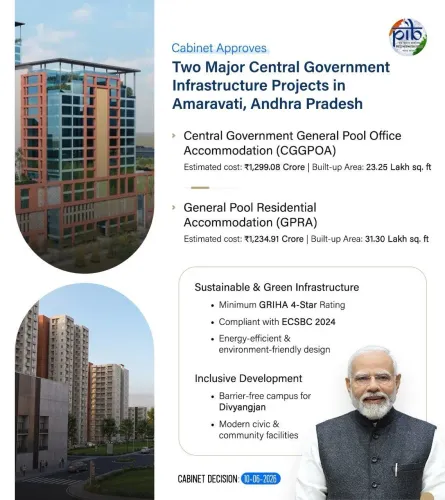
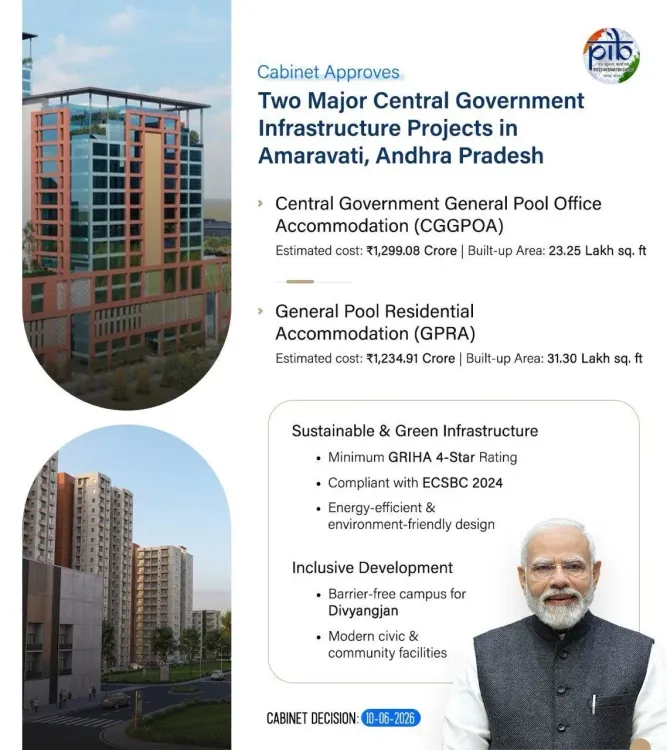
The Union Cabinet has approved two central infrastructure projects for Amaravati — a ₹1,299.08 crore office complex and a ₹1,234.91 crore residential complex — reinforcing the Centre's commitment to building Andhra Pradesh's post-bifurcation capital to world-class, green-building standards.
Key Takeaways
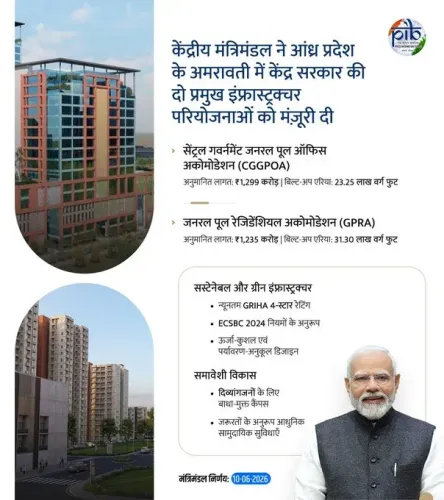
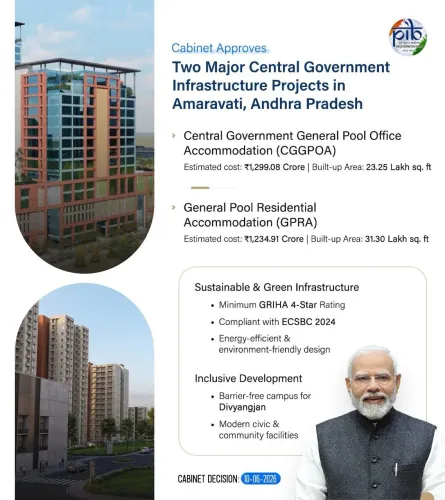
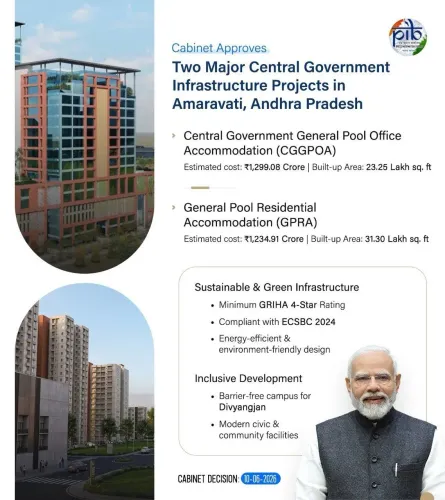
The Union Cabinet approved the CGGPOA for Amaravati at a cost of ₹1,299.08 crore .
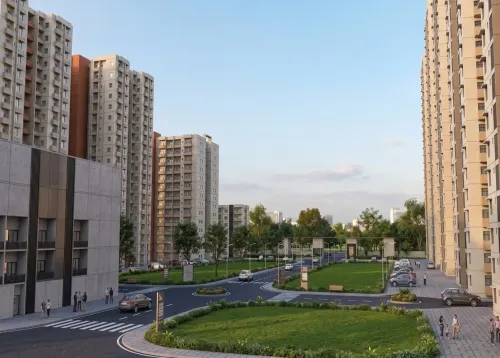
The GPRA for central government employees in Amaravati was sanctioned at ₹1,234.91 crore .
Combined central outlay for the two projects exceeds ₹2,534 crore .
Both projects are to be built to environment-friendly and energy-efficient standards.
The approvals are rooted in the statutory framework of the Andhra Pradesh Reorganisation Act, 2014 , which mandated central support for the new capital.
The projects are expected to generate employment and improve administrative coordination in Amaravati .
Union Agriculture Minister Shivraj Singh Chouhan on Wednesday, June 10, 2026, welcomed the Union Cabinet's approval of two major central infrastructure projects for Amaravati, the capital of Andhra Pradesh, crediting the decision to the leadership of Prime Minister Narendra Modi.
What Was Approved
The Cabinet cleared two projects: the Central Government General Pool Office Accommodation (CGGPOA), to be built at a cost of ₹1,299.08 crore, and the General Pool Residential Accommodation (GPRA), sanctioned at ₹1,234.91 crore. Together, the two projects represent a combined central outlay of over ₹2,534 crore for Amaravati's administrative and residential spine. Chouhan described the approvals as providing 'new strength to modern administrative and residential infrastructure' in the planned capital.Context
Amaravati has been envisioned as a greenfield, world-class capital city for the residuary state of Andhra Pradesh following the bifurcation that created Telangana under the Andhra Pradesh Reorganisation Act, 2014. That legislation also laid the statutory basis for central assistance toward building the new capital's core infrastructure. The two projects now cleared fit squarely within that framework, with the central government stepping in to fund key administrative and housing assets in the city.Policy Backdrop
The GPRA programme is a longstanding central government mechanism under which the Central Public Works Department (CPWD) constructs and manages residential complexes for central government employees posted across the country. Extending it to Amaravati signals the Centre's intent to operationalise a full-fledged administrative ecosystem in the city. Both projects are to be built to environment-friendly and energy-efficient standards, in line with the broader push for green-building norms in centrally funded construction. Chouhan noted that the projects would promote 'sustainable development, inclusive infrastructure, and employment generation.'Stakeholders and Impact
The immediate beneficiaries are central government employees who will be posted in Amaravati and require coordinated office space and housing. Beyond the bureaucratic apparatus, the projects are expected to improve coordination among central government offices, raise administrative efficiency, and expand civic amenities for residents of the capital region. Construction activity on this scale is also projected to generate significant direct and indirect employment in Andhra Pradesh. Chouhan emphasised that the projects would help establish Amaravati as a 'modern, well-organised, and future-oriented capital.'What's Next
Attention will now shift to the issuance of formal project sanction letters and the commencement of CPWD tendering processes for both complexes. The pace of tendering and contractor selection will determine when ground is broken on the two sites. Broader progress on Amaravati's master plan — including state-funded civic infrastructure and the long-pending High Court building — will set the context in which these central projects take shape. The Cabinet approvals add fresh momentum to a capital-building exercise that has seen multiple political and legal interruptions since 2014, and they reinforce the Centre's commitment to seeing a functional administrative capital emerge in Andhra Pradesh.Point of View
Arriving at a moment when the capital project has regained political momentum after years of legal and policy uncertainty. For the BJP, the announcement allows the Centre to present itself as a reliable partner to Andhra Pradesh — a state whose support is politically consequential — ahead of any future electoral cycle. The green-building and energy-efficiency framing also aligns the projects with the Centre's broader 'sustainable urbanisation' narrative. That Chouhan — a Cabinet heavyweight with a mass political base — chose to amplify the announcement underscores its intended resonance beyond Andhra Pradesh alone.
NationPress
26 Oct 2026
Frequently Asked Questions
What projects did the Union Cabinet approve for Amaravati?
The Cabinet approved two central infrastructure projects: the Central Government General Pool Office Accommodation (CGGPOA) at ₹1,299.08 crore and the General Pool Residential Accommodation (GPRA) at ₹1,234.91 crore, both to be built in Amaravati, Andhra Pradesh.
What is the total cost of the Amaravati central infrastructure projects approved in June 2026?
The combined cost of the two approved projects is over ₹2,534 crore — ₹1,299.08 crore for the office complex and ₹1,234.91 crore for the residential complex.
Why is the Centre funding infrastructure in Amaravati?
The Andhra Pradesh Reorganisation Act of 2014, which bifurcated the state to create Telangana, provided the statutory basis for central assistance toward building a new capital for the residuary state of Andhra Pradesh.
What is GPRA and who benefits from it in Amaravati?
GPRA stands for General Pool Residential Accommodation, a central government programme managed by CPWD that builds housing for central government employees. In Amaravati, it will provide residential facilities for officials posted to the new capital.
Are the Amaravati projects environment-friendly?
Yes, both the CGGPOA and GPRA projects are to be constructed to environment-friendly and energy-efficient standards, in line with the Centre's green-building norms for publicly funded construction.