Gadkari: Cabinet Clears Two Big Projects for Amaravati
Synopsis
The Union Cabinet has approved two central infrastructure projects in Amaravati — a ₹1,299.08 crore office complex and a ₹1,234.91 crore residential complex — marking a major push to establish a full federal administrative presence in Andhra Pradesh's planned capital city.
Key Takeaways
The Union Cabinet , chaired by PM Narendra Modi , approved two central government infrastructure projects in Amaravati on June 10, 2026 .
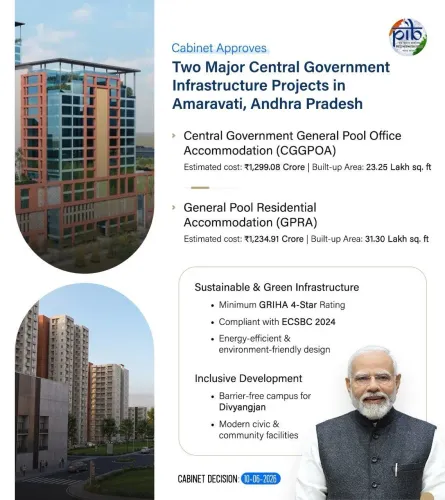
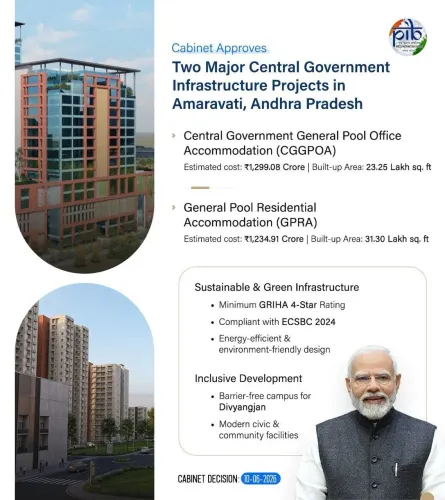
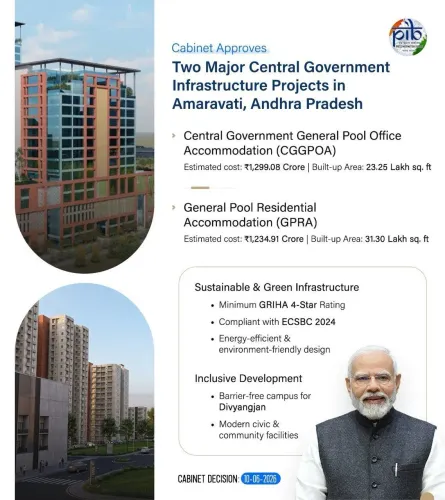
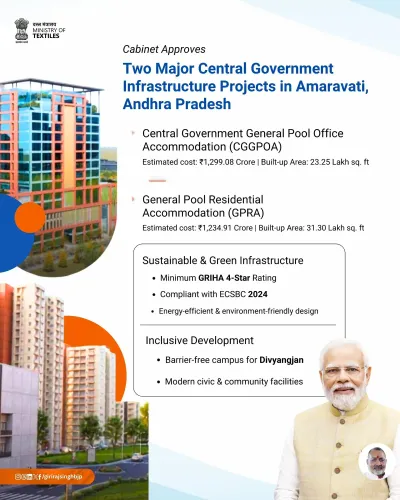
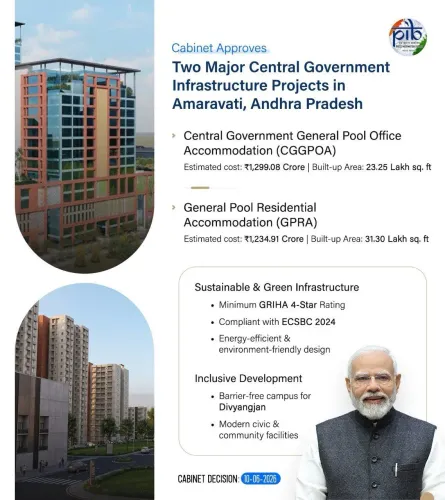
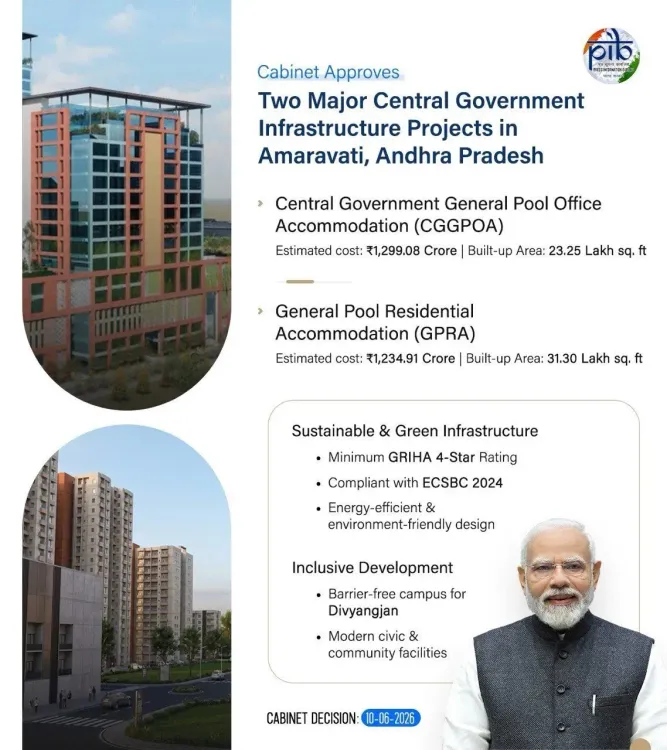
The Central Government General Pool Office Accommodation (CGGPOA) is estimated to cost ₹1,299.08 crore with a built-up area of 23.25 lakh sq ft .
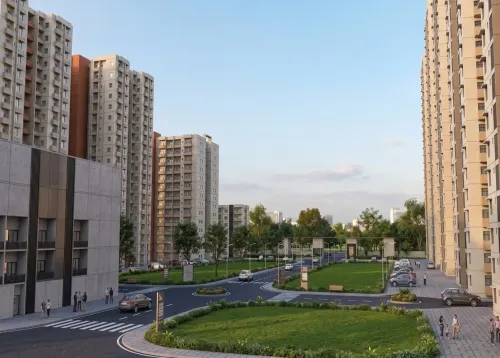
The General Pool Residential Accommodation (GPRA) project is estimated to cost ₹1,234.91 crore with a built-up area of 31.30 lakh sq ft .
Combined investment across both projects exceeds ₹2,533 crore and covers over 54 lakh square feet of built-up area.
The approvals are part of post-bifurcation central support for Andhra Pradesh following the 2014 Reorganisation Act .
Construction and tendering will be handled by the Central Public Works Department (CPWD) .
Union Road Transport and Highways Minister Nitin Gadkari announced on Wednesday, June 10, 2026, that the Union Cabinet, chaired by Prime Minister Narendra Modi, has approved two major central government infrastructure projects in Amaravati, Andhra Pradesh, with a combined estimated cost of over ₹2,533 crore.
What Was Approved
The Cabinet cleared the development of a Central Government General Pool Office Accommodation (CGGPOA) at an estimated cost of ₹1,299.08 crore, with a built-up area of 23.25 lakh square feet. Alongside this, a General Pool Residential Accommodation (GPRA) project was approved at an estimated cost of ₹1,234.91 crore, covering a built-up area of 31.30 lakh square feet. Together, the two projects represent one of the largest single-round central investments in Amaravati's administrative infrastructure.
Context
Amaravati was designated the capital of the newly formed state of Andhra Pradesh following the Andhra Pradesh Reorganisation Act of 2014, which bifurcated the erstwhile united state. Prime Minister Modi laid the foundation stone for Amaravati in 2015, signalling early central commitment to building the greenfield capital. The approval of General Pool Accommodation — office and residential complexes maintained by the central government for its own employees — is a standard but significant step in establishing a full federal administrative presence in a new capital.
Central funding for such projects in state capitals is part of a broader post-bifurcation stabilisation framework. Successive cabinets have approved similar CGGPOA and GPRA schemes in new or relocated administrative centres to ensure that central government departments can function effectively from the state capital.
Policy Backdrop
The General Pool Accommodation system is administered by the Central Public Works Department (CPWD), which handles tendering, construction, and maintenance of office and residential stock for central government employees across the country. Approvals of this scale typically follow a period of alignment between the central government and the concerned state on capital-city planning and land allocation. Andhra Pradesh has seen renewed momentum on Amaravati's development in recent years, making central investment in core administrative infrastructure a logical next step.
Gadkari described the decisions as 'a significant step towards strengthening Amaravati's infrastructure, enhancing administrative capacity, and supporting its emergence as a modern governance hub.'
Stakeholders and Impact
The primary beneficiaries are central government employees posted in Andhra Pradesh, who currently lack purpose-built office and residential facilities in the capital. The projects are also expected to accelerate the relocation of central ministries and departments to Amaravati, reducing dependence on makeshift arrangements in Vijayawada and other nearby cities. For the state administration, a stronger central presence in the capital city reinforces Amaravati's status as a functioning seat of government.
What's Next
The immediate focus will shift to CPWD tendering and the award of construction contracts for both projects. The scale of the two complexes — together covering over 54 lakh square feet of built-up area — means construction is likely to proceed in phases. Further Cabinet notes on connectivity, civic utilities, and related infrastructure for Amaravati are expected as the capital-building programme gathers pace.
Point of View
The move suggests the centre and the current state government have reached the administrative alignment necessary for large-scale capital-city investment. For the BJP, backing Amaravati's development also carries political weight in Andhra Pradesh, where the capital's fate has long been a contested issue. The scale of the two approvals — together exceeding ₹2,533 crore — sets a benchmark for central commitment that will be closely watched by other states with similar infrastructure gaps.
NationPress
26 Oct 2026
Frequently Asked Questions
What did the Union Cabinet approve for Amaravati on June 10 2026?
The Union Cabinet approved two projects: a Central Government General Pool Office Accommodation (CGGPOA) costing ₹1,299.08 crore and a General Pool Residential Accommodation (GPRA) costing ₹1,234.91 crore, both to be built in Amaravati, Andhra Pradesh.
What is the total cost of the Amaravati central government projects?
The combined estimated cost of the two projects is over ₹2,533 crore, covering a total built-up area of more than 54 lakh square feet.
Why is the central government building offices and residences in Amaravati?
Amaravati is the designated capital of Andhra Pradesh, created after the 2014 state bifurcation. Central government employees posted in the state need purpose-built office and residential facilities in the capital, which these projects will provide.
Who will construct the Amaravati CGGPOA and GPRA projects?
Projects of this nature are typically executed by the Central Public Works Department (CPWD), which handles tendering, construction, and maintenance of central government accommodation across India.
What is General Pool Accommodation in India?
General Pool Accommodation refers to office and residential complexes owned and managed by the central government — through CPWD — for use by central government employees and departments, distinct from state government or private facilities.