Chirag Paswan Hails Cabinet Nod for Amaravati Infrastructure
Synopsis
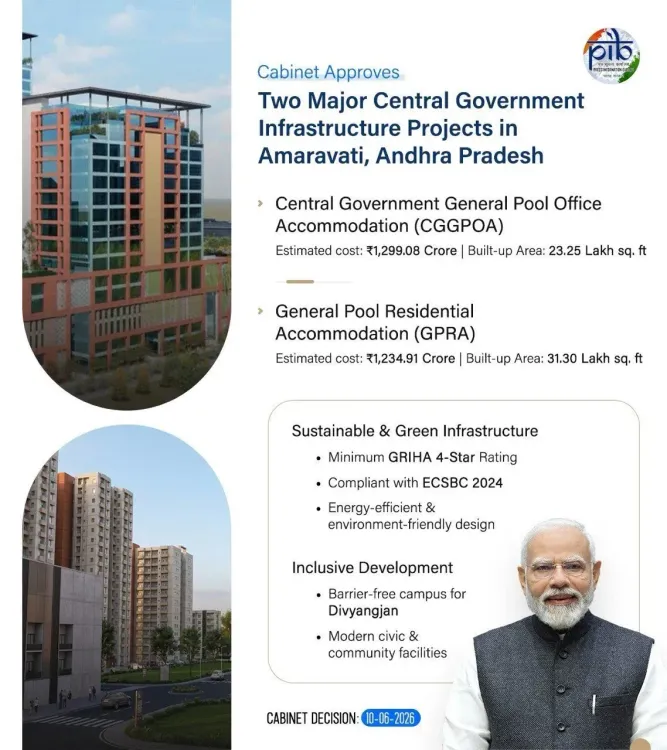
The Union Cabinet, under PM Modi, has cleared two central infrastructure projects in Amaravati — a ₹1,299.08 crore office complex and a ₹1,234.91 crore residential complex. Minister Chirag Paswan welcomed the approvals as a boost to administrative efficiency and the city's emergence as a world-class green capital.
Key Takeaways
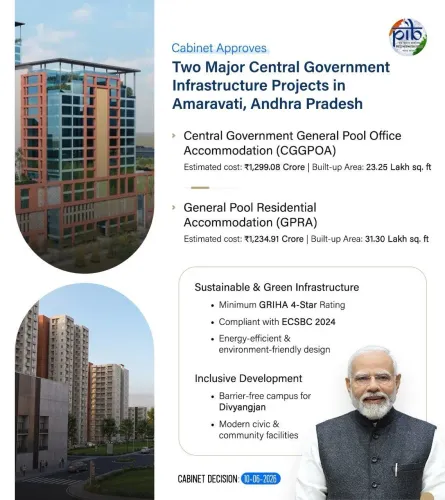
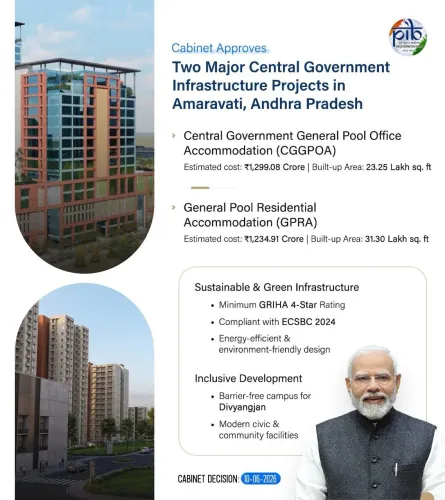
The Union Cabinet approved the CGGPOA at a cost of ₹1,299.08 crore in Amaravati , Andhra Pradesh .
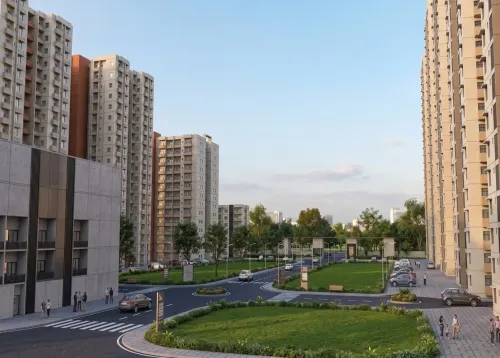
A General Pool Residential Complex (GPRA) worth ₹1,234.91 crore was also cleared in the same cabinet meeting.
Combined central outlay for both projects stands at approximately ₹2,534 crore .
Minister Chirag Paswan credited the approvals to the leadership of PM Narendra Modi and said they will improve coordination among central offices and raise administrative efficiency.
Amaravati is being developed as a greenfield, world-class green capital following Andhra Pradesh's bifurcation in 2014 .
The approvals continue a pattern of central government investment in pooled office and residential infrastructure for post-bifurcation state capitals.
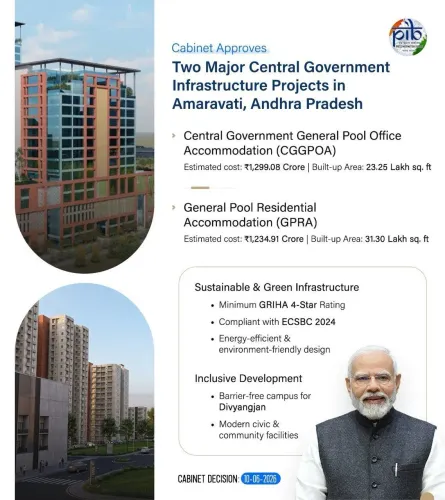
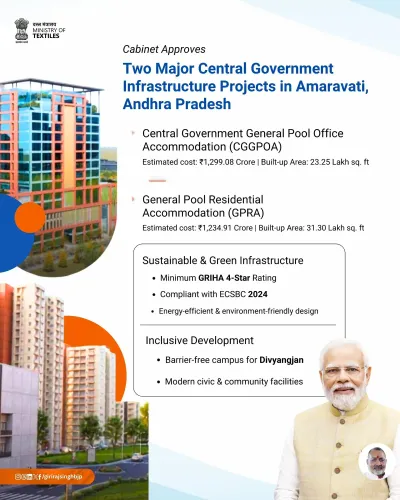
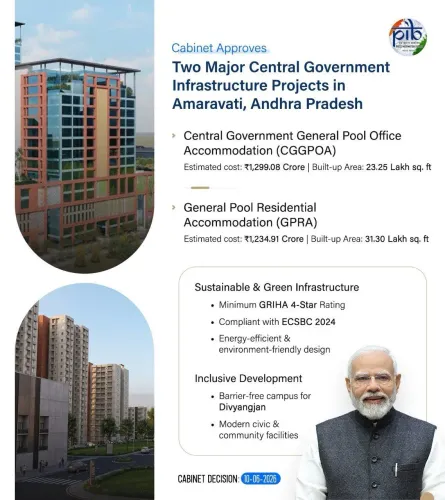
Union Food Processing Minister Chirag Paswan on Wednesday, June 10, 2026, welcomed the Union Cabinet's approval of two major central infrastructure projects in Amaravati, Andhra Pradesh's greenfield capital — a Central Government General Pool Office Complex (CGGPOA) worth ₹1,299.08 crore and a General Pool Residential Complex (GPRA) worth ₹1,234.91 crore.
Posting on X, Paswan credited the decisions to the leadership of Prime Minister Narendra Modi, writing: 'Aadaraniya Pradhan Mantri Shri @narendramodi ji ke netritva mein' ('Under the leadership of respected Prime Minister Shri Narendra Modi'), the cabinet had cleared both complexes as part of Amaravati's emergence as a world-class green capital city. He noted that the projects would strengthen modern administrative and residential infrastructure, improve coordination among central government offices, raise administrative efficiency, deliver better civic amenities, and accelerate overall development.
Context
Amaravati was designated the capital of residual Andhra Pradesh following the 2014 Andhra Pradesh Reorganisation Act, which bifurcated the state and created Telangana. The city was conceived as a greenfield, sustainable administrative hub, with a foundation stone laid in 2015 under a master plan developed with Singapore's assistance. Central government support for Amaravati's development has been a recurring commitment across successive Union budgets and cabinet agendas since bifurcation.
Policy Backdrop
The CGGPOA and GPRA approvals follow a well-established central policy of building pooled government office and residential complexes in emerging state capitals to consolidate scattered administrative functions and provide standardised housing for central employees. Such complexes reduce dependence on leased premises, lower long-term costs to the exchequer, and create a unified government presence in new administrative centres. The combined outlay of approximately ₹2,534 crore for both projects represents a significant central commitment to Amaravati's infrastructure backbone.
The cabinet clearances are consistent with the broader NDA government's positioning of Amaravati as a model for planned, sustainable urbanisation in post-bifurcation states. Earlier central budget provisions had earmarked funds for urban and administrative infrastructure in the city, and these two approvals continue that programmatic lineage.
Stakeholders and Impact
Central government employees posted to Andhra Pradesh cadre and Union offices in the state stand to be the most direct beneficiaries, gaining purpose-built office and residential facilities in the state capital. The Andhra Pradesh government and Amaravati landowners and developers are also key stakeholders, as central infrastructure investment typically catalyses surrounding private and state-level development. Improved inter-agency coordination within a single campus is expected to speed up the delivery of government services to citizens across the state.
For the broader Amaravati project, the approvals lend fresh momentum at a time when the capital's development trajectory has been closely watched by investors, urban planners, and state officials. A visible central commitment of this scale signals continued federal support for the city's long-term master plan.
What's Next
Attention will now shift to tendering timelines, land acquisition status, and phased construction schedules for both complexes. Subsequent cabinet meetings may bring additional approvals for complementary Amaravati components — courts, central public sector unit offices, or social infrastructure — as the capital build-out progresses. The pace of implementation will be closely tracked by the Andhra Pradesh government and stakeholders who have long awaited tangible central investment on the ground.
Point of View
NDA ally Chirag Paswan signals that the alliance is keen to demonstrate deliverables in Andhra Pradesh ahead of future electoral cycles. The combined ₹2,534 crore outlay also fits a broader Modi-government pattern of using central pooled infrastructure to anchor greenfield capitals, reducing state dependence on ad hoc leasing. Whether ground-level execution matches the cabinet mandate will be the real test of this commitment.
NationPress
26 Oct 2026
Frequently Asked Questions
What did the Union Cabinet approve for Amaravati on June 10 2026?
The Union Cabinet approved two central infrastructure projects in Amaravati: the Central Government General Pool Office Complex (CGGPOA) at ₹1,299.08 crore and the General Pool Residential Complex (GPRA) at ₹1,234.91 crore, together totalling approximately ₹2,534 crore.
What is CGGPOA and GPRA in Amaravati?
CGGPOA stands for Central Government General Pool Office Complex — a consolidated campus for Union government offices in Amaravati. GPRA stands for General Pool Residential Complex, which will provide standardised housing for central government employees posted in the state capital.
Why is Amaravati being developed as a new capital?
Amaravati was designated the capital of residual Andhra Pradesh after the state was bifurcated in 2014 under the Andhra Pradesh Reorganisation Act, which created Telangana as a separate state. The city is being built as a greenfield, sustainable administrative hub.
What did Chirag Paswan say about the Amaravati cabinet decision?
Union Minister Chirag Paswan posted on X welcoming the cabinet approvals, crediting PM Narendra Modi's leadership and stating that the projects would strengthen administrative and residential infrastructure, improve coordination among central offices, enhance administrative efficiency, and provide better civic amenities.
What is the total central investment approved for Amaravati infrastructure in this cabinet meeting?
The total central investment approved in this cabinet meeting for Amaravati's two projects is approximately ₹2,534 crore — ₹1,299.08 crore for the office complex and ₹1,234.91 crore for the residential complex.