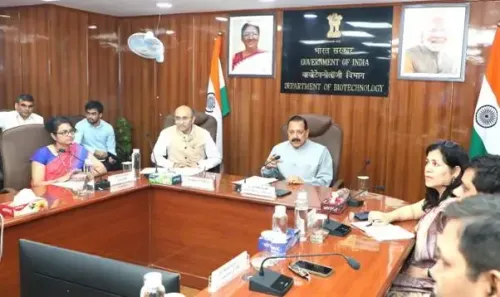
Dr. Jitendra Singh: Centre, Bengal to jointly implement science schemes
Synopsis
Union Science and Technology Minister Dr. Jitendra Singh has flagged a new centre-state collaboration with West Bengal to jointly implement science and innovation schemes, marking a concrete step toward cooperative federalism in India's R&D ecosystem.
Key Takeaways
Union Science and Technology Minister Dr.
Jitendra Singh shared a report on May 27, 2026 confirming Centre-West Bengal joint implementation of science and innovation schemes.
The announcement is tagged to Kolkata , indicating the geographic focus of the initiative.
The collaboration aligns with India's draft Science, Technology and Innovation Policy (STIP) of 2020 , which called for greater centre-state R&D coordination.
Key beneficiaries include West Bengal's research institutions, state universities, and innovation startups, with the WBSCST likely to serve as a nodal partner.
Next steps involve potential memoranda of understanding or joint working groups between the DST and the West Bengal government.
The model, if formalised, could serve as a template for similar centre-state science partnerships across India.
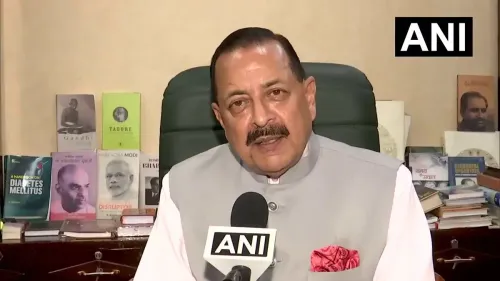
Union Science and Technology Minister Dr. Jitendra Singh on Wednesday, May 27, 2026, shared a report indicating that the Centre and West Bengal will work together to implement science and innovation schemes, signalling a new phase of cooperative federalism in India's research and development landscape.
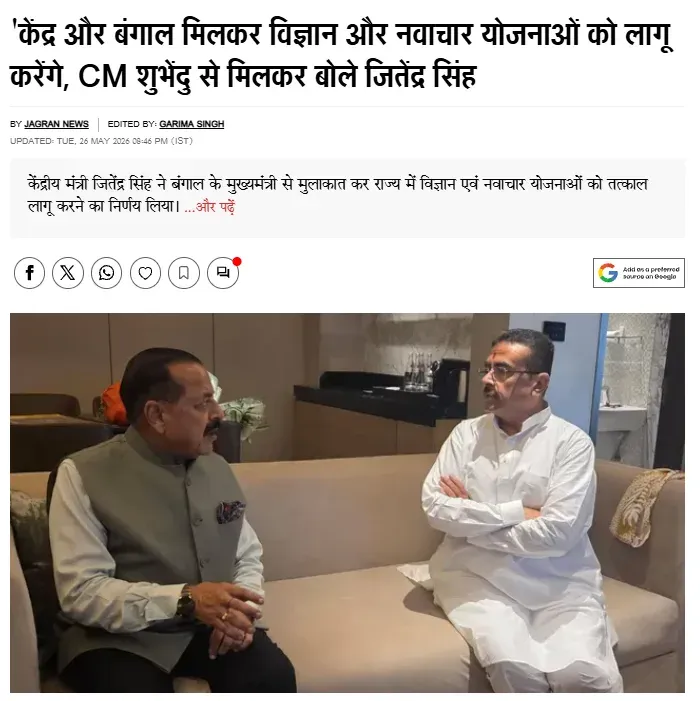
The minister shared a Dainik Jagran report headlined 'Kendra aur Bengal milkar vigyan aur navachar yojanaon ko lagoo karenge' ('Centre and Bengal will jointly implement science and innovation schemes'), tagged to Kolkata, underlining the geographic focus of the initiative.
Context
The post highlights a significant shift in the Centre's approach toward West Bengal on science policy, a domain where central and state governments have historically operated in parallel rather than in concert. By publicly flagging the collaboration, Dr. Singh signals institutional intent to bring state-level bodies into the fold of centrally driven innovation missions.
The development comes as India pushes to expand its R&D ecosystem beyond the concentration of central laboratories, aiming to build regional innovation infrastructure that can tap into local talent and institutional capacity.
Policy Backdrop
India's draft Science, Technology and Innovation Policy (STIP), circulated in 2020, explicitly called for greater centre-state coordination in building R&D ecosystems. The policy envisioned state governments as active partners in rolling out national science missions rather than passive recipients of central funding.
Successive governments at the Centre have pursued this 'cooperative federalism' model across sectors — including biotechnology parks and innovation hubs — where national missions are aligned with state-level science and technology councils. A similar architecture is now being extended to West Bengal, one of India's academically rich but institutionally underserved states in terms of central science investment.
The Department of Science and Technology (DST) and the Department of Biotechnology (DBT), both under Dr. Singh's charge, have in recent years expanded scheme implementation through state nodal agencies, making this announcement consistent with a broader administrative trend.
Stakeholders and Impact
The primary beneficiaries of joint implementation would be West Bengal's research institutions, state universities, and startup ecosystems, which stand to gain access to centrally funded programmes, infrastructure grants, and technology transfer pipelines. State innovation bodies such as the West Bengal State Council of Science and Technology (WBSCST) are likely to serve as key implementation partners.
For the scientific community in cities like Kolkata, which hosts institutions of national repute, closer centre-state coordination could mean faster disbursal of research grants, co-funded laboratories, and joint innovation challenges. Early-stage startups and deep-tech ventures operating in the state could also benefit from improved access to national scheme frameworks.
What's Next
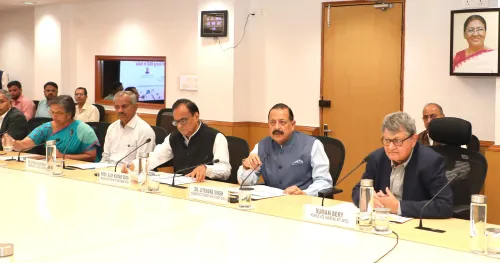
Attention will now turn to whether the two governments formalise the collaboration through a memorandum of understanding or a joint working group between the DST and the West Bengal government. The specific schemes earmarked for joint rollout — whether under national missions in space technology, clean energy, or digital innovation — have not yet been detailed publicly.
If structured agreements follow, West Bengal could serve as a template for replicating centre-state science partnerships in other large states, reinforcing India's ambition to build a distributed, nationally integrated innovation economy by the end of the decade.
Point of View
The minister positions science and innovation as a domain above political rivalry. The move also fits a broader pattern in which the Centre has used scheme-based partnerships to build institutional presence in opposition-governed states. If the collaboration results in concrete joint agreements, it could reset the template for how central science ministries engage with large, academically significant states going forward.
NationPress
10 Oct 2026
Frequently Asked Questions
What is the Centre-West Bengal science collaboration announced by Dr. Jitendra Singh?
Union Science and Technology Minister Dr. Jitendra Singh flagged on May 27, 2026, that the Centre and West Bengal will jointly implement science and innovation schemes, deepening cooperative federalism in India's R&D ecosystem.
Which central ministry is leading the Centre-Bengal science initiative?
The initiative is being led by the Ministry of Science and Technology, headed by Dr. Jitendra Singh as Union Minister of State (Independent Charge).
What is India's Science, Technology and Innovation Policy and how does it relate?
India's draft STIP, released in 2020, called for greater centre-state coordination in building R&D ecosystems. The West Bengal collaboration is consistent with that policy direction.
Who benefits from the Centre-West Bengal science scheme partnership?
West Bengal's research institutions, state universities, startups, and innovation bodies — particularly in Kolkata — stand to benefit through improved access to centrally funded programmes and infrastructure grants.
What are the next steps for the Centre-Bengal science collaboration?
Stakeholders are watching for a formal memorandum of understanding or joint working group between the Department of Science and Technology and the West Bengal government to specify which schemes will be jointly implemented.