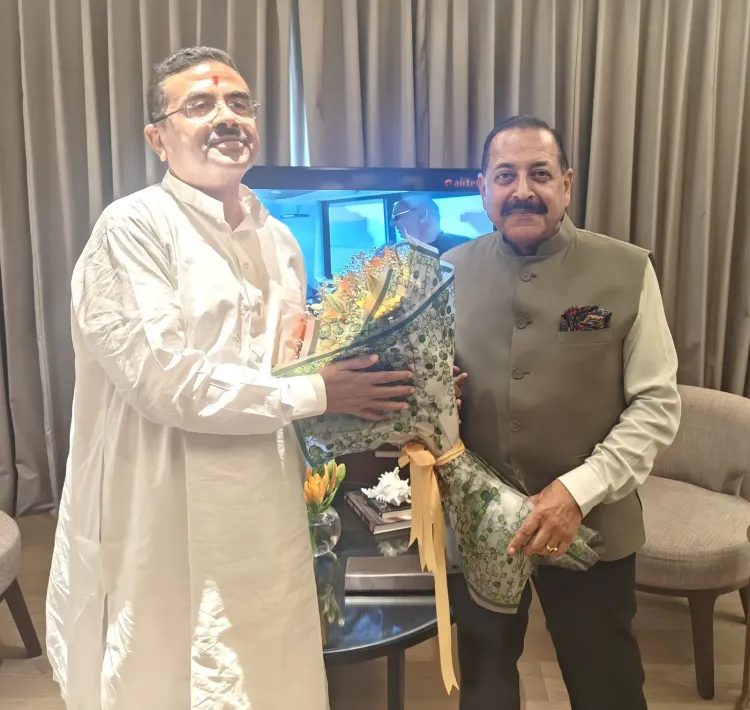
Jitendra Singh, Suvendu Adhikari chart science roadmap for Bengal
Synopsis
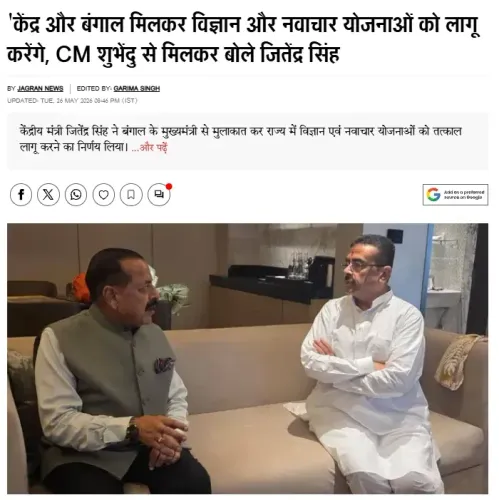
Science Minister Dr. Jitendra Singh and West Bengal CM Suvendu Adhikari met in Kolkata on 26 May 2026, deciding to deploy CSIR for arsenic studies, DST for cancer drug trials, and Central schemes including INSPIRE, AI Mission and Quantum Computing across the state.
Key Takeaways
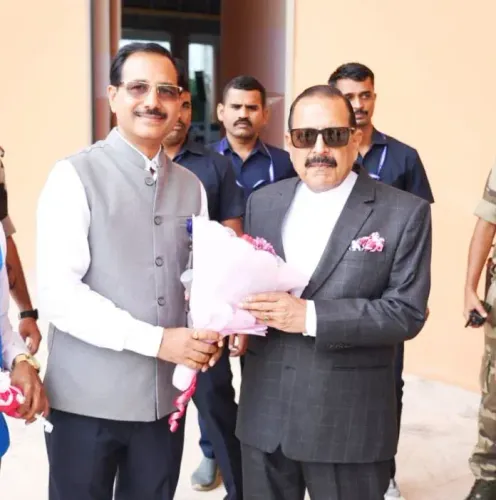
Jitendra Singh held the first formal official meeting with West Bengal CM Suvendu Adhikari in Kolkata on 26 May 2026 .
Central CSIR institutions will study arsenic contamination in drinking water in affected districts of West Bengal .
Central DST institutions will conduct cancer and antimicrobial drug trials in partnership with state medical colleges and cancer hospitals.
Flagship programmes — INSPIRE , INSPIRE MANAK , Vigyan Jyoti , KIRAN , WISE , AI Mission , and Quantum Computing — are to be rolled out in a coordinated manner across the state.
Serial follow-up meetings between Central and State officials will be held to finalise an implementation roadmap aligned with PM Modi 's vision for West Bengal .
The meeting invoked Dr.
Syama Prasad Mukherjee 's legacy, framing the BJP's governance of Bengal as an ideological milestone.
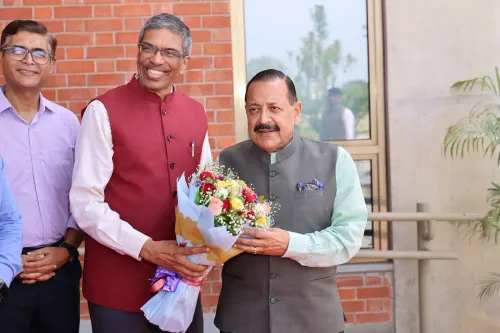
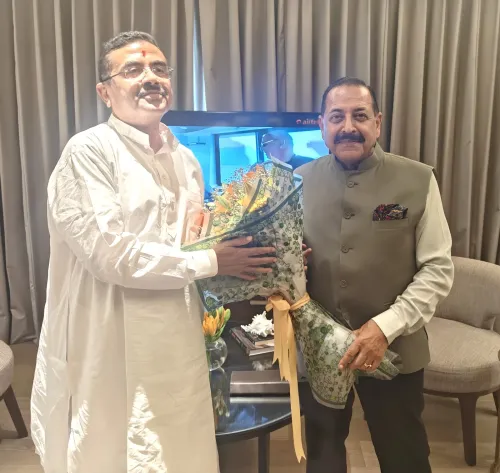
Union Science and Technology Minister Dr. Jitendra Singh met West Bengal Chief Minister Suvendu Adhikari in Kolkata on 26 May 2026 in the first formal official meeting since the state's first-ever BJP government took charge, with several on-the-spot decisions taken to align Central science institutions with the state's development priorities.
Context
Dr. Singh described Kolkata as wearing 'an entirely different look, with fragrance of newfound rejuvenation ready to restore Bengal to its pristine glory.' The minister noted a 'proud sense of vindication towards Dr. Syama Prasad Mukherjee' — the founder of the Bharatiya Jana Sangh and a towering historical figure from Bengal — as greetings were exchanged with Chief Minister Adhikari. The reference underscores the BJP's long-standing ideological connection to the state.
The meeting was later joined by officers from both the Central and State governments, elevating it from a bilateral political exchange to a working policy session with administrative follow-through built in from the outset.
Policy Backdrop
Among the most immediate decisions, arsenic contamination in drinking water across affected districts of West Bengal is to be studied through the state's Central CSIR institutions. Drug trials for cancer and antimicrobial therapies will be conducted by Central DST institutions in collaboration with state institutes, Government Medical Colleges, cancer hospitals, and other state medical networks — a significant step given the region's longstanding public health challenges.
Centre flagship programmes covering StartUps, Artificial Intelligence, and Quantum Computing are to be implemented in a coordinated manner. Youth-focused schemes — INSPIRE, INSPIRE MANAK, Vigyan Jyoti for school girls, KIRAN, and WISE for women — will be rolled out to tap what Dr. Singh called West Bengal's 'vast under-explored resources.' INSPIRE was launched by the Department of Science and Technology in 2008 to attract students to science careers; Vigyan Jyoti and KIRAN were introduced specifically to raise women's participation in STEM.
The broader ambition articulated at the meeting is a 'convergence of scientific institutions, academia, healthcare infrastructure and innovation ecosystems' to create what Dr. Singh called 'a new role model of growth for Eastern India.' Central science ministries have increasingly routed flagship programmes through state governments following political alignment at the Centre, with similar institutional convergence seen in other eastern states.
Stakeholders and Impact
The decisions, if implemented, stand to benefit a wide cross-section of West Bengal's population: residents in arsenic-affected districts who face long-term health risks from contaminated groundwater; cancer patients who could gain access to new drug trials through government medical colleges; school students and women scientists who stand to benefit from expanded INSPIRE, Vigyan Jyoti, KIRAN, and WISE outreach; and the state's startup and technology ecosystem through the AI Mission and Quantum Computing programmes.
The political symbolism is equally significant. The invocation of Dr. Syama Prasad Mukherjee frames the BJP's governance of West Bengal as a historical homecoming, lending ideological weight to what are otherwise administrative coordination decisions.
What's Next
Dr. Singh confirmed that 'serial meetings will be held between State and Central representatives to finalise a roadmap' enabling what he described as the 'double engine' Sarkar to live up to Prime Minister Narendra Modi's 'grand vision for West Bengal.' The 'double engine' framing — referring to alignment between the ruling party at the Centre and in the state — has been a consistent BJP governance motif since 2014.
Observers will watch for parliamentary or budget-level announcements on additional CSIR and DST centres in the state, as well as the pace at which the arsenic study and drug trial frameworks are formally notified and funded.
Point of View
The BJP simultaneously addresses its ideological base while projecting a governance-delivery narrative. The bundling of public health interventions — arsenic studies, cancer drug trials — with youth and women-centric STEM schemes is consistent with a pattern seen in other BJP-governed eastern states, where Central institutions are mobilised rapidly after political alignment. The 'double engine' framing, now applied to West Bengal, will be closely watched as a test case for whether institutional convergence translates into measurable outcomes in one of India's most complex and politically contested states.
NationPress
11 Oct 2026
Frequently Asked Questions
What was decided at the Jitendra Singh and Suvendu Adhikari meeting in Kolkata?
At the meeting held on 26 May 2026 , decisions were taken to deploy Central CSIR institutions to study arsenic in drinking water, conduct cancer and antimicrobial drug trials through DST institutions in collaboration with state medical colleges, and roll out flagship schemes including INSPIRE , Vigyan Jyoti , AI Mission , and Quantum Computing across West Bengal .
Why is arsenic in drinking water a concern in West Bengal?
Several districts of West Bengal have long faced arsenic contamination in groundwater, posing serious long-term health risks including poisoning and increased cancer risk. The decision to study this through Central CSIR institutions marks a formal Central intervention in the issue.
What is the INSPIRE scheme and how does it relate to West Bengal?
INSPIRE (Innovation in Science Pursuit for Inspired Research) is a Department of Science and Technology flagship programme launched in 2008 to attract school and college students to science careers. It is now slated for expanded, coordinated rollout across West Bengal alongside INSPIRE MANAK , Vigyan Jyoti for school girls, and KIRAN and WISE for women.
Who is Dr. Syama Prasad Mukherjee and why was he mentioned?
Dr. Syama Prasad Mukherjee was the founder of the Bharatiya Jana Sangh, the ideological precursor to the BJP, and a prominent political figure from Bengal. Dr. Jitendra Singh invoked his legacy to frame the BJP's governance of West Bengal as a moment of historical and ideological vindication.
What is the 'double engine' government model referenced by Jitendra Singh?
The 'double engine' government refers to the BJP's governance concept where the same party ruling both at the Centre and in a state enables faster, more coordinated policy implementation. Dr. Singh cited it as the framework for aligning Central science programmes with West Bengal 's state administration under CM Suvendu Adhikari .