Dr. Jitendra Singh Advocates for Enhanced Private Sector Engagement in R&D

Synopsis
In a call to action, Dr. Jitendra Singh emphasizes the pivotal role of the private sector in advancing India's innovation landscape. The Minister of State for Science and Technology urges for more collaboration and investment in R&D to overcome systemic challenges and harness India's scientific potential.
Key Takeaways
Private sector involvement is vital for India's innovation ecosystem.
The government has implemented several enabling measures to facilitate R&D.
Streamlining processes is essential to enhance research productivity.
Challenges remain in funding and procedural bottlenecks.
Ongoing reforms are necessary to support scientific endeavors.
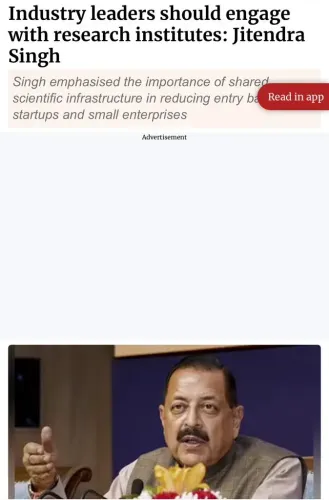
New Delhi, April 9 (NationPress) On Thursday, Dr. Jitendra Singh, the Minister of State for Science and Technology, urged the private sector to enhance its involvement in research and development (R&D). He emphasized that increased collaboration with industry is essential for cultivating a resilient innovation ecosystem in India.
The minister highlighted that the government has implemented various enabling initiatives, such as allowing private entities to enter sectors like space and nuclear energy and launching the Research, Development and Innovation (RDI) fund. However, he noted that it is now imperative for the industry to reciprocate with heightened investments and partnerships.
During the announcement of two reports by NITI Aayog aimed at simplifying R&D processes, Dr. Singh pointed out that reforms should prioritize not only the system's architecture but also the genuine experiences of researchers.
He underscored India's expanding scientific capabilities, stating that the nation possesses a wealth of talent increasingly acknowledged on a global scale. Nonetheless, he acknowledged that institutional and procedural barriers continue to impede results.
Simultaneously, the minister raised concerns about the limited involvement of the private sector in funding and executing research, asserting that governmental support alone cannot sustain long-term innovation.
Dr. Singh mentioned initiatives like 'One Nation, One Subscription' for research journals as measures to enhance knowledge accessibility. He stressed that optimizing routine processes, such as approvals, funding flows, and administrative clearances, could substantially boost research productivity.
Suman Bery, Vice Chairman of NITI Aayog, remarked that the effort to streamline R&D processes stems from longstanding appeals by the scientific community to alleviate administrative burdens and enhance efficiency.
Professor A.K. Sood, the Principal Scientific Adviser, noted that improving the ease of conducting R&D must be an ongoing commitment, highlighting challenges such as low funding success rates, hiring limitations, and infrastructure constraints, along with the necessity for improved implementation coordination.
The reports from NITI Aayog, derived from discussions with researchers, emphasize the need for increased flexibility, transparency, and predictability in research systems to ensure ongoing support and confidence in scientific endeavors.
Point of View
It is clear that the call for increased private sector participation in research and development is both timely and necessary. Dr. Jitendra Singh's emphasis on collaboration indicates a shift towards a more integrated approach in fostering innovation, which is essential for India's progress in the global scientific arena.
NationPress
9 Oct 2026
Frequently Asked Questions
Why is private sector involvement essential in R&D?
Private sector involvement is crucial as it brings additional funding, expertise, and innovation that can complement government efforts, ultimately leading to a more robust and sustainable research environment.
What initiatives has the government taken to promote R&D?
The government has initiated several measures, including the opening of sectors like space and nuclear energy to private players and the creation of the Research, Development and Innovation (RDI) fund.
What are the current challenges in India's R&D sector?
Challenges include limited private sector funding, procedural bottlenecks, and the need for better coordination and efficiency within research systems.
How can R&D processes be improved?
Streamlining approval processes, enhancing funding flows, and increasing transparency can significantly boost research productivity and efficiency.
What is the significance of the reports released by NITI Aayog?
The reports highlight the need for reducing administrative burdens and improving the flexibility and predictability of research systems to foster a more conducive environment for researchers.