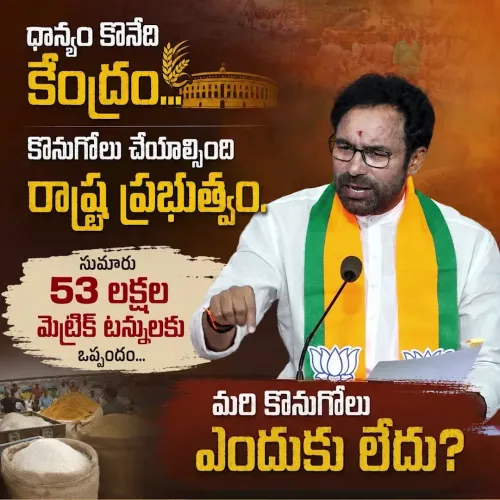
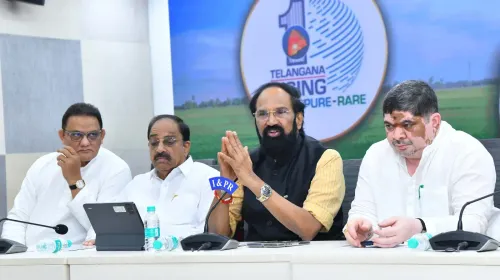
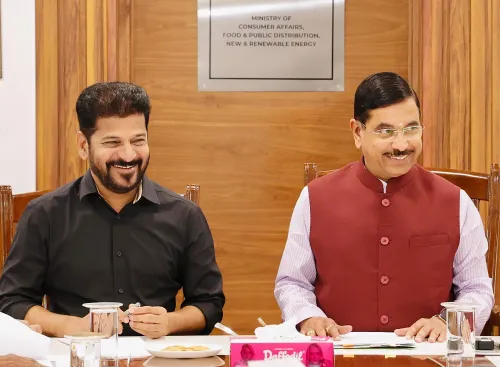
Kishan Reddy Hails 8 LMT Rice Procurement Hike for Telangana
Synopsis
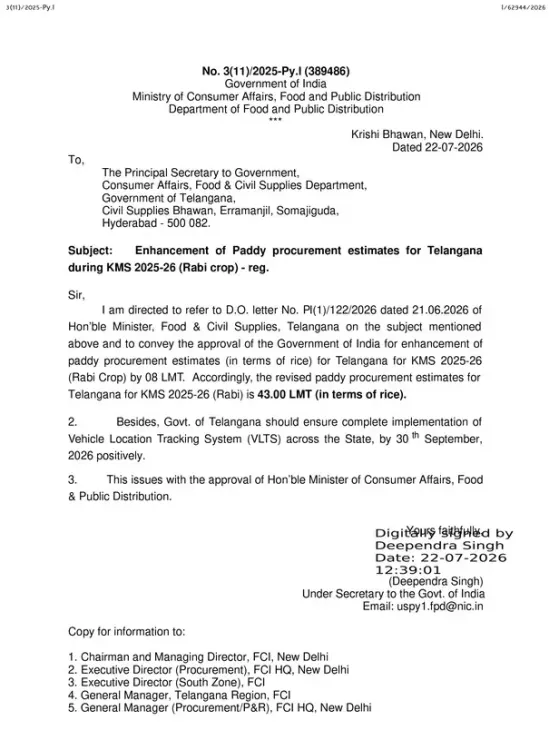
Union Minister G. Kishan Reddy on 22 July 2026 welcomed the Centre's decision to raise Telangana's FCI rice procurement quota by 8 LMT to 43 LMT for Rabi 2025-26, crediting PM Modi and Minister Pralhad Joshi, while urging the state government to clear pending rice handovers.
Key Takeaways
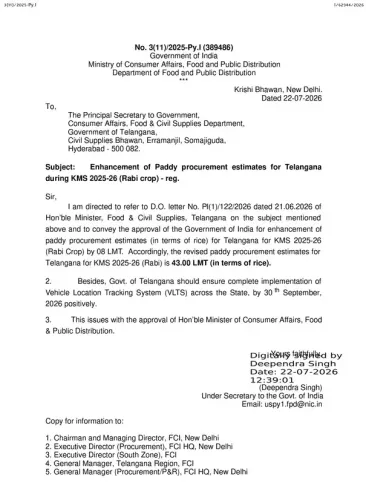
FCI rice procurement from Telangana for Rabi 2025–26 has been raised by 8 Lakh Metric Tonnes , from 35 LMT to 43 LMT .
The enhancement translates into an additional 12 LMT of paddy procurement for Telangana farmers at MSP.
A BJP delegation including MPs, MLCs and MLAs met Union Minister Pralhad Joshi on 8 July to press for the increase.
Kishan Reddy credited PM Narendra Modi and Pralhad Joshi for prioritising Telangana's farmers.
Kishan Reddy urged the Telangana state government to clear pending rice handovers to FCI from previous procurement seasons.
The decision supports both Telangana's farming community and the national Public Distribution System .
Union Coal and Mines Minister G. Kishan Reddy on Wednesday, 22 July 2026 welcomed the central government's decision to enhance rice procurement from Telangana for the Rabi season 2025–26 by 8 Lakh Metric Tonnes, raising the total allocation from 35 LMT to 43 LMT — a move he credited to the direct intervention of Prime Minister Narendra Modi and Union Minister Pralhad Joshi.
Context
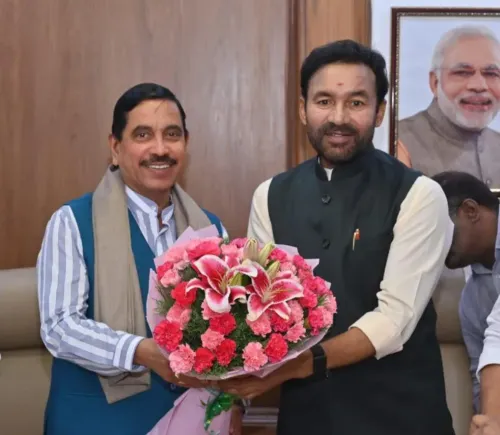
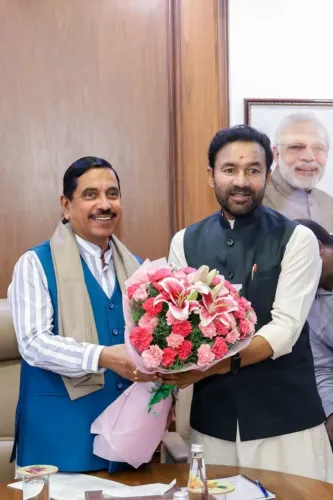
Kishan Reddy, who also serves as BJP Telangana state president, expressed 'deep gratitude' to PM Modi and Union Minister of Consumer Affairs, Food and Public Distribution Pralhad Joshi for 'prioritising the interests of Telangana's farmers.' He noted that a delegation of BJP members including MPs, MLCs and MLAs accompanied him to meet Joshi on 8th July specifically to press for the enhancement, underscoring the organised political push behind the demand.
The minister described the decision as translating into an additional 12 LMT of paddy procurement, which he said 'will provide greater support to our farming community.' The enhanced quota directly affects the volume of paddy that the Food Corporation of India (FCI) will purchase from Telangana farmers at the Minimum Support Price during the upcoming Rabi season.
Policy Backdrop
The Food Corporation of India, established in 1965, is the central agency responsible for procuring paddy at MSP, maintaining national buffer stocks, and supplying rice for the Public Distribution System (PDS). Each year, the Union government calibrates state-wise procurement quotas based on production estimates and representations received from state units — a mechanism expanded significantly under the decentralised procurement scheme in the 2000s.
Telangana, a major rice-producing state formed in 2014, has periodically sought higher FCI allocations to cover farmer distress and ensure timely payments. BJP leaders in the state have historically raised such demands directly with the Centre, often in parallel with calls for the state government to resolve pending handovers from earlier seasons — a pattern that continues with this latest development.
Stakeholders and Impact
The enhanced procurement quota stands to benefit Telangana's farming community directly, as a higher FCI offtake guarantees more paddy is purchased at MSP rather than being sold at potentially lower open-market prices. For PDS beneficiaries across the country, a larger rice inflow into FCI's buffer stocks supports continued supply stability.
However, Kishan Reddy simultaneously issued a pointed call to the Telangana state government, urging it to 'honour its pending commitments from previous procurement seasons and hand over the agreed quantity of rice to FCI at the earliest in the interest of farmers and the Public Distribution System.' This signals that the enhanced central quota comes alongside unresolved coordination issues between the state administration and FCI.
What's Next
The practical impact of the enhanced quota will depend on the actual volumes lifted by FCI during Rabi 2025–26 and whether the Telangana government clears its backlog of rice stocks from prior seasons. Any formal response from the state government on the pending handover commitment will be closely watched by both farmers and the broader federal food-security apparatus.
As Rabi procurement operations approach, the alignment — or friction — between central targets and state-level execution will determine whether the 8 LMT enhancement translates into tangible relief for Telangana's paddy growers.
Point of View
While simultaneously holding the state's Congress-led government accountable for pending FCI commitments. By leading a cross-party BJP delegation to meet Pralhad Joshi, Kishan Reddy positions the party — not the state administration — as the effective champion of Telangana's paddy growers. The call to clear pending rice handovers also serves as a political pressure point, framing any delay in farmer relief as the state government's responsibility. Taken together, this fits a broader BJP pattern of using central procurement policy as both a welfare instrument and a political differentiator in opposition-governed states.
NationPress
21 Oct 2026
Frequently Asked Questions
How much has FCI rice procurement from Telangana been increased for Rabi 2025-26?
FCI rice procurement from Telangana for Rabi 2025-26 has been increased by 8 Lakh Metric Tonnes , raising the total quota from 35 LMT to 43 LMT , which translates into an additional 12 LMT of paddy procurement .
Who approved the enhanced rice procurement quota for Telangana?
Union Minister of Consumer Affairs, Food and Public Distribution Pralhad Joshi , with the backing of Prime Minister Narendra Modi , approved the enhanced procurement quota following a representation from a BJP delegation led by G. Kishan Reddy on 8 July .
What is the role of FCI in rice procurement in India?
The Food Corporation of India (FCI) , established in 1965 , is the central government agency that procures paddy from farmers at the Minimum Support Price, maintains national buffer stocks, and supplies rice to the Public Distribution System (PDS) .
Why did G. Kishan Reddy urge the Telangana government to hand over rice to FCI?
G. Kishan Reddy stated that the Telangana state government has pending commitments from previous procurement seasons and urged it to hand over the agreed quantity of rice to FCI at the earliest, in the interest of farmers and the Public Distribution System .
How does higher FCI procurement benefit Telangana farmers?
A higher FCI procurement quota means more paddy is purchased from Telangana farmers at the guaranteed Minimum Support Price , reducing their dependence on open-market prices that can be lower, and providing more assured income during the Rabi season.