CM Vishnu Deo Sai: Chhattisgarh 2nd in PM Surya Ghar Award
Synopsis
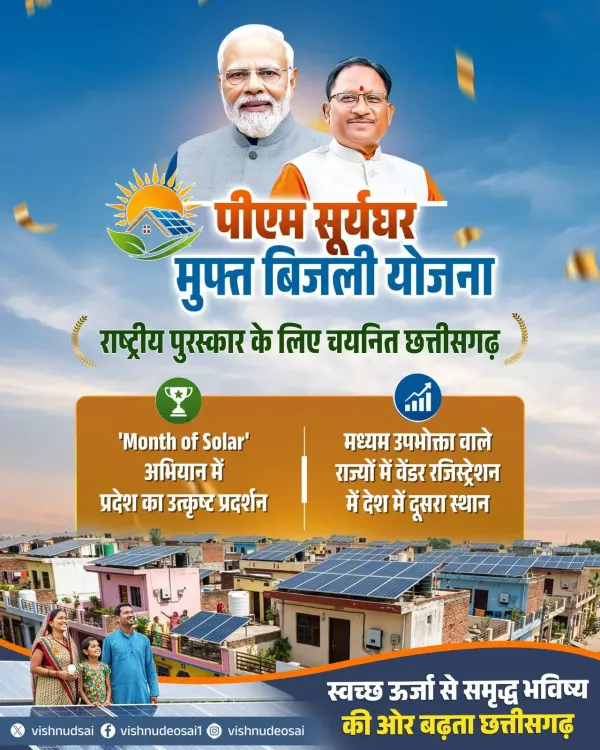
Chhattisgarh has secured the second position nationally in the PM Surya Ghar Excellence Awards under the 'Month of Solar – Maximum Vendor Registration' category, Chief Minister Vishnu Deo Sai announced. He credited the recognition to grassroots outreach and the state's push for clean, distributed solar energy under the Union government's flagship rooftop scheme.
Key Takeaways
Chhattisgarh ranked second nationally in the PM Surya Ghar 'Month of Solar – Maximum Vendor Registration' category.
The award was conferred by the Government of India under the PM Surya Ghar Muft Bijli Yojana .
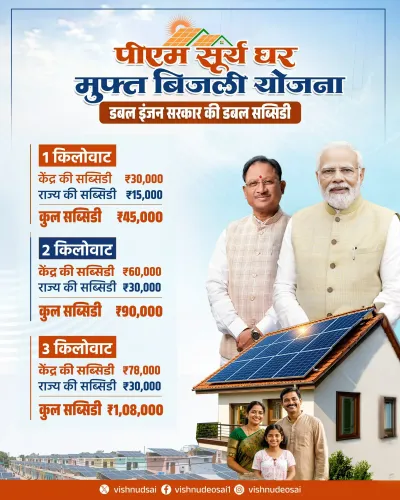
The scheme, launched in February 2024 , targets 1 crore rooftop solar installations and up to 300 units of free electricity per month.
CM Vishnu Deo Sai credited public participation and government outreach for the recognition.
The achievement supports India's 500 GW non-fossil capacity target by 2030 .
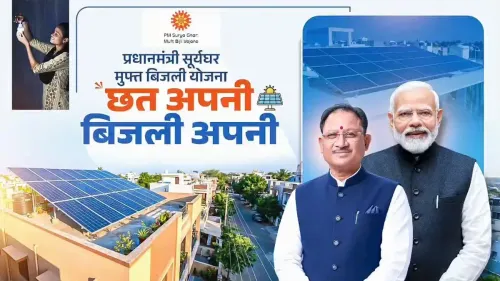
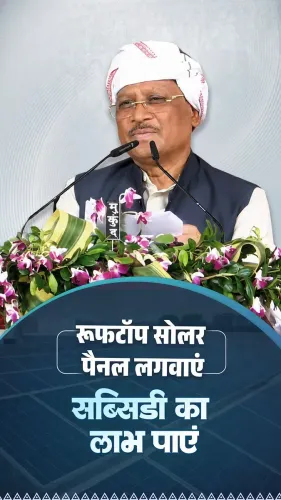
Chhattisgarh Chief Minister Vishnu Deo Sai on Thursday announced that the state has secured the second position nationally in the 'Month of Solar Campaign – Maximum Vendor Registration' category of the PM Surya Ghar Excellence Awards conferred by the Government of India. He credited the recognition to the effective rollout of the Pradhan Mantri Surya Ghar Muft Bijli Yojana and grassroots outreach on rooftop solar across the state.
In his post, the Chief Minister said the achievement reflected sustained efforts to take solar energy to every household. 'Yah samman swachh aur harit urja ko badhava dene ki disha mein sushasan sarkar ke satat prayason aur janbhagidari ka parinam hai' (This honour is the result of the good-governance government's continuous efforts and people's participation in promoting clean and green energy), he wrote, adding that the milestone strengthens the resolve to build an 'energy self-reliant and environment-friendly Chhattisgarh'.
Context
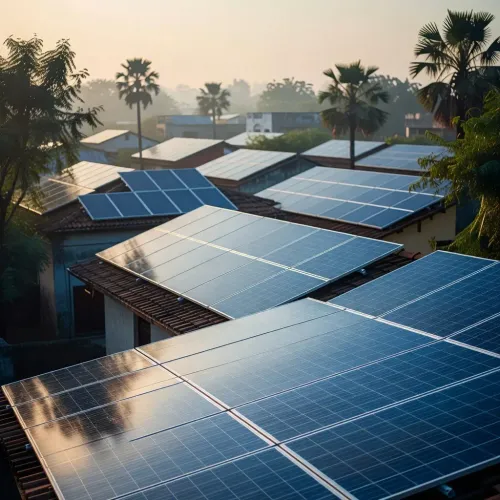
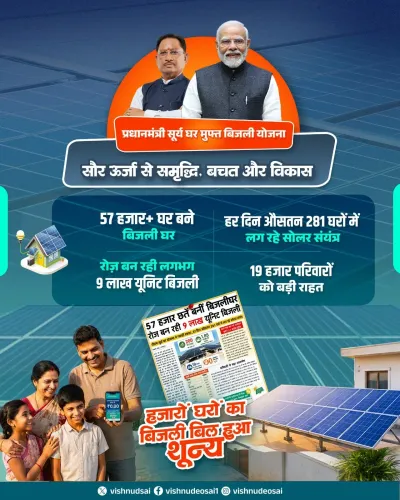
The PM Surya Ghar Muft Bijli Yojana was launched by the Union government in February 2024 with the goal of installing rooftop solar systems on one crore households and providing up to 300 units of free electricity per month. Vendor registration is a critical input metric under the scheme, since installation throughput depends on the depth and reach of the empanelled installer network.
The 'Month of Solar' campaign was designed by the centre to compress the vendor-onboarding cycle and create a competitive league table among states. Chhattisgarh's runner-up placement in this category places it among the better-performing states on supply-side readiness for distributed solar.
Policy backdrop
The recognition fits within India's larger renewable-energy framework, anchored by the National Solar Mission first launched in 2010 and revised in subsequent years. The country has committed to 500 GW of non-fossil-fuel electricity capacity by 2030, of which rooftop solar is expected to contribute a meaningful share.
The Union Ministry of New and Renewable Energy administers vendor empanelment, subsidy disbursal and state-level performance evaluation under the scheme. Awards in categories such as vendor registration, household applications and installations have become the central government's preferred levers to nudge state implementation.
Stakeholders and impact
For Chhattisgarh, a state historically dependent on coal for both electricity generation and revenue, distributed solar represents a structural diversification opportunity. A deeper vendor network typically translates into faster site surveys, quicker installations and shorter wait times for households applying for subsidised rooftop systems.
Solar installers and small electrical contractors stand to gain the most immediate benefit, with new business pipelines opening across Tier-2 and Tier-3 towns. For households, the scheme promises reduced monthly electricity bills and, in many cases, the ability to export surplus power back to the grid under net-metering arrangements.
What's next
Attention will now turn to whether the state can convert its strong vendor-registration performance into commensurate installation numbers in the coming financial year. State-wise rooftop solar capacity additions for FY 2026-27 and any fresh household or vendor targets from the Union ministry will be the next markers of progress.
For the Vishnu Deo Sai administration, sustaining momentum on the scheme offers a politically resonant narrative that combines welfare delivery with climate-friendly infrastructure — a combination the BJP has sought to project at both the state and national levels.
Point of View
Recognition on a supply-side metric such as vendor registration signals administrative readiness rather than capacity addition itself — the harder test will come when installations and subsidy disbursals are measured. Politically, the milestone gives the Sai government a clean-energy talking point that aligns with the BJP's national climate messaging. The real watch is whether vendor depth translates into household-level rollout speed.
NationPress
20 Oct 2026
Frequently Asked Questions
What is the PM Surya Ghar Muft Bijli Yojana?
It is a Union government scheme launched in February 2024 to install rooftop solar systems on one crore households, providing up to 300 units of free electricity per month. Subsidies are offered to households for installation through empanelled vendors.
Why has Chhattisgarh been awarded under the scheme?
Chhattisgarh has been ranked second nationally in the 'Month of Solar Campaign – Maximum Vendor Registration' category of the PM Surya Ghar Excellence Awards. The category measures the number of solar installers empanelled by states during the campaign period.
Who announced the recognition for Chhattisgarh?
Chhattisgarh Chief Minister Vishnu Deo Sai announced the achievement in a post on X, crediting the state's outreach efforts and public participation in promoting rooftop solar adoption.
How does vendor registration help rooftop solar adoption?
A larger pool of registered vendors expands the installer network available to households, shortening wait times for site surveys and installations. It is considered a key supply-side enabler for scaling up rooftop solar.
What is India's overall renewable energy target?
India has committed to reaching 500 GW of non-fossil-fuel electricity capacity by 2030 under its updated climate commitments. Rooftop solar under the PM Surya Ghar scheme is one of the contributing pillars of this target.