CM Sai Champions PM Surya Ghar Scheme in Chhattisgarh
Synopsis
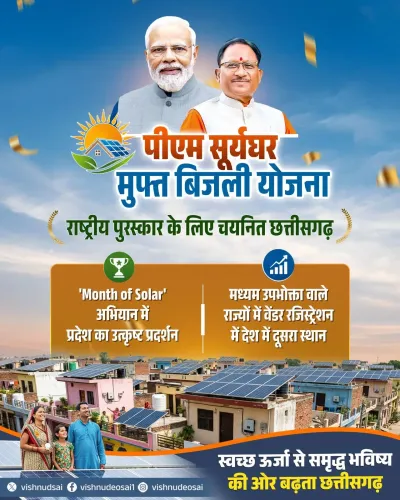
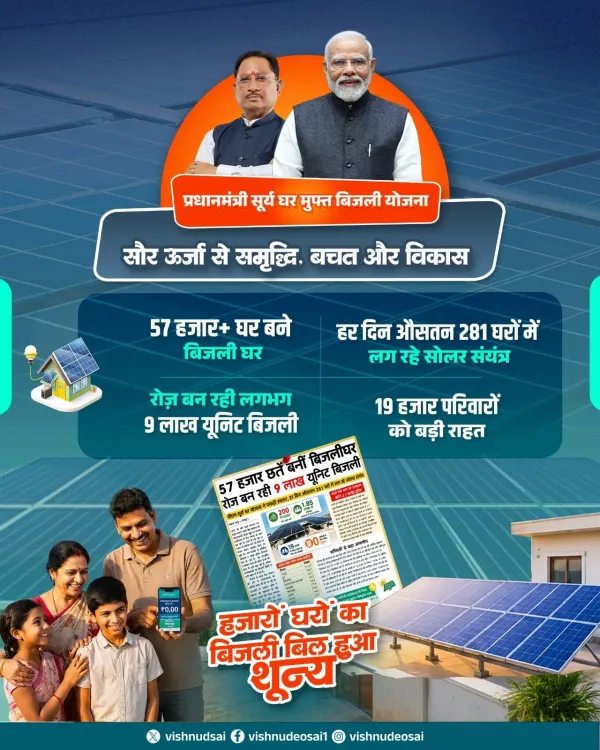
Chhattisgarh Chief Minister Vishnu Deo Sai on 25 May 2026 championed the PM Surya Ghar: Muft Bijli Yojana, calling it a new solar revolution for the state. The Rs 75,000 crore central scheme targets rooftop solar in one crore homes, offering up to 300 units of free electricity monthly as India chases its 500 GW renewable target by 2030.
Key Takeaways
CM Vishnu Deo Sai publicly endorsed the PM Surya Ghar: Muft Bijli Yojana on 25 May 2026 , calling it a solar revolution for Chhattisgarh.
The scheme was launched in February 2024 with an outlay of Rs 75,000 crore , targeting one crore households nationwide.
Eligible families can receive up to 300 units of free electricity per month through rooftop solar installations.
Chhattisgarh , historically coal-dependent, is aligning with India's national renewable energy push to diversify its power mix.
India's overarching target is 500 GW of non-fossil fuel capacity by 2030 , with rooftop solar a key pillar of that ambition.
State power utilities and low-to-middle-income households are the primary stakeholders expected to benefit from wider scheme adoption.
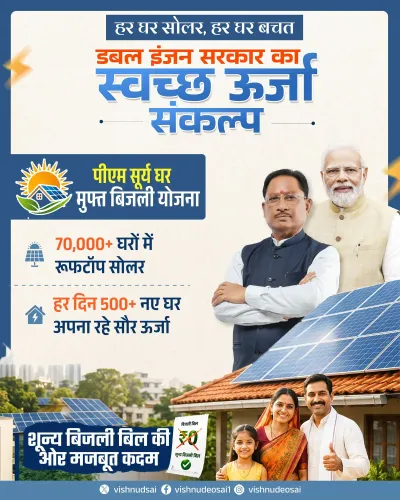
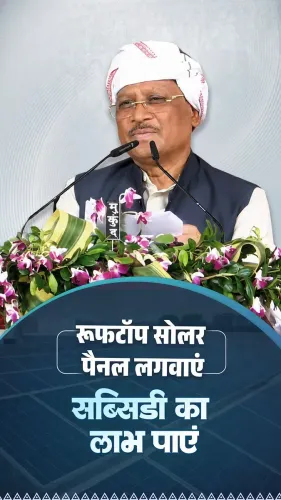
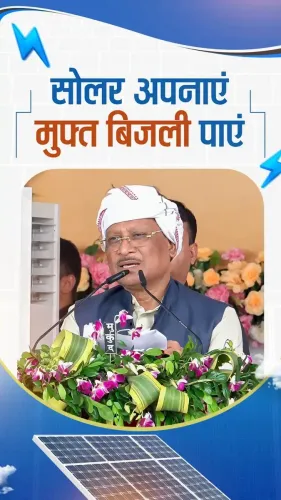
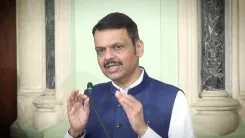
Chhattisgarh Chief Minister Vishnu Deo Sai on Sunday, 25 May 2026 declared that the state is scripting a new revolution in self-reliance through solar energy, highlighting the Centre's flagship rooftop solar programme as the vehicle for delivering energy security and economic empowerment to lakhs of families across the state.
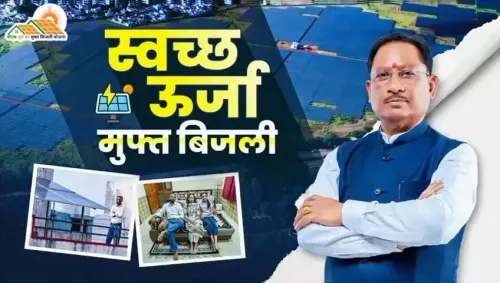
Posting on X, CM Sai wrote: 'सौर ऊर्जा से आत्मनिर्भरता की नई क्रांति लिख रहा छत्तीसगढ़' ['Chhattisgarh is writing a new revolution of self-reliance through solar energy'], adding that the state is moving forward strongly in a new direction of development with a resolve for green energy, a clean environment, and economic empowerment. He specifically credited Prime Minister Narendra Modi and the PM Surya Ghar: Muft Bijli Yojana for connecting lakhs of families to energy security, economic savings, and self-sufficiency.
Context
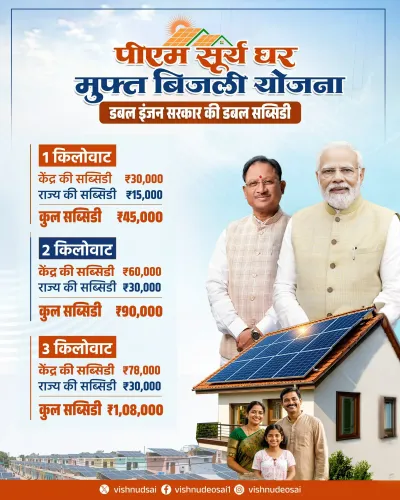
The PM Surya Ghar: Muft Bijli Yojana was launched by the Central government in February 2024 with an outlay of Rs 75,000 crore, targeting rooftop solar installations in one crore households across India. The scheme provides financial assistance to eligible families and promises up to 300 units of free electricity per month through solar generation, directly reducing household electricity bills and dependence on the grid.
Chhattisgarh, a state historically anchored to coal-based power, has been aligning its energy policy with India's broader renewable transition. Promoting distributed rooftop solar generation is seen as a way to reduce transmission losses and lower the electricity burden on households, particularly in semi-urban and rural areas.
Policy Backdrop
India's push toward renewable energy is underpinned by a stated national target of 500 GW of non-fossil fuel-based power capacity by 2030. The trajectory stretches back to the National Solar Mission launched in 2010, which initially aimed for 20 GW of grid-connected solar power by 2022 before being revised sharply upward under the current government. The PM Surya Ghar scheme represents the most direct household-level intervention in this arc, combining central subsidies with state-level implementation machinery.
For states like Chhattisgarh, which hold significant coal reserves and have traditionally relied on thermal power, the pivot to rooftop solar signals both an economic and an environmental recalibration. Distributed generation reduces the load on state power utilities and can insulate households from tariff volatility.
Stakeholders and Impact
The primary beneficiaries of the scheme are residential households, particularly those in the lower and middle-income segments who spend a disproportionate share of income on electricity. State power utilities stand to benefit from reduced peak-load pressure, while local solar equipment suppliers and installers are expected to see increased business as adoption scales up.
For the BJP-led state government, visible progress on a centrally sponsored scheme that delivers tangible household savings also carries political weight ahead of future electoral cycles. CM Sai's public endorsement reinforces the party's messaging around 'Aatmanirbhar Bharat' [self-reliant India] at the state level.
What's Next
Attention will now turn to state-level progress reports on rooftop solar installations and subsidy disbursements under the scheme in Chhattisgarh. Any new state solar policy announcements ahead of the next assembly session could further signal the pace of the state's green energy transition.
As India's 2030 renewable energy targets draw closer, the rate at which states like Chhattisgarh convert central scheme allocations into on-ground installations will be a key indicator of whether the country's distributed solar ambitions are on track.
Point of View
The solar pivot is substantively significant: a coal-rich state visibly embracing distributed renewables signals a broader economic hedge as the energy transition accelerates. The timing, well ahead of any immediate electoral deadline, suggests the government is attempting to build a durable green-development identity rather than making a short-cycle political play. Whether on-ground installation numbers in the state match the rhetorical ambition will be the real test of this positioning.
NationPress
6 Oct 2026
Frequently Asked Questions
What is PM Surya Ghar Muft Bijli Yojana?
The PM Surya Ghar: Muft Bijli Yojana is a Central government scheme launched in February 2024 with a Rs 75,000 crore outlay to install rooftop solar panels in one crore households across India, providing up to 300 units of free electricity per month to eligible families.
What did Chhattisgarh CM Vishnu Deo Sai say about solar energy?
CM Vishnu Deo Sai said Chhattisgarh is writing a new revolution of self-reliance through solar energy, crediting PM Modi's PM Surya Ghar scheme for connecting lakhs of families to energy security, economic savings, and self-sufficiency.
How many households does PM Surya Ghar scheme target?
The scheme targets rooftop solar installations in one crore (10 million) households across India, backed by a central financial outlay of Rs 75,000 crore.
Is Chhattisgarh a coal or solar energy state?
Chhattisgarh is historically one of India's major coal-producing and coal-dependent states, but it is now actively expanding rooftop and distributed solar capacity in line with the national renewable energy transition.
What is India's renewable energy target for 2030?
India has set a target of achieving 500 GW of non-fossil fuel-based power generation capacity by 2030, with solar energy — both utility-scale and rooftop — as a central pillar of that goal.