CM Sai Promotes PM Surya Ghar Solar Scheme in Chhattisgarh
Synopsis
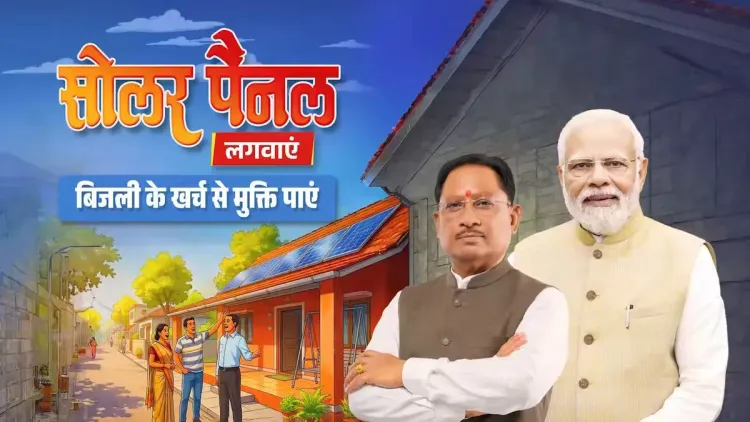
Chhattisgarh Chief Minister Vishnu Deo Sai has promoted the PM Surya Ghar Muft Bijli Yojana, saying thousands of state families are joining the rooftop solar grid under combined central and state subsidies, and urging more households to adopt solar energy for savings and a green future.
Key Takeaways
CM Vishnu Deo Sai publicly promoted the PM Surya Ghar Muft Bijli Yojana on 19 July 2026 via X.
The scheme was launched in February 2024 and targets one crore households nationally with up to 300 units of free electricity per month .
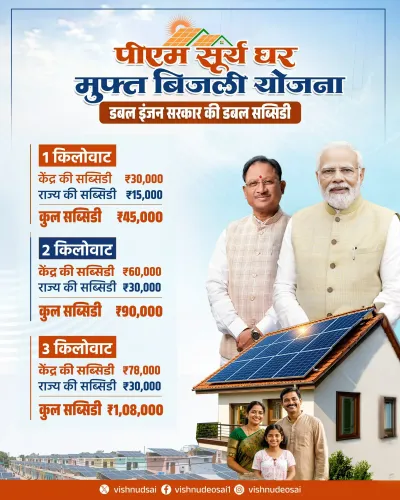
Both central and Chhattisgarh state subsidies are available, reducing the financial burden on adopting households.
Enrolled households can supply surplus electricity back to the grid, earning income as energy providers under net-metering.
The initiative is part of India's target of 100 GW rooftop solar and 500 GW total non-fossil fuel capacity by 2030 .
Chhattisgarh has had a BJP government since 2023 and actively brands central-state programme delivery as 'double engine' governance.
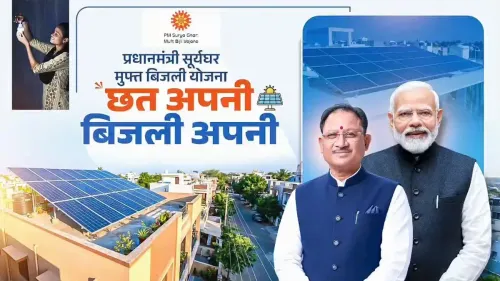
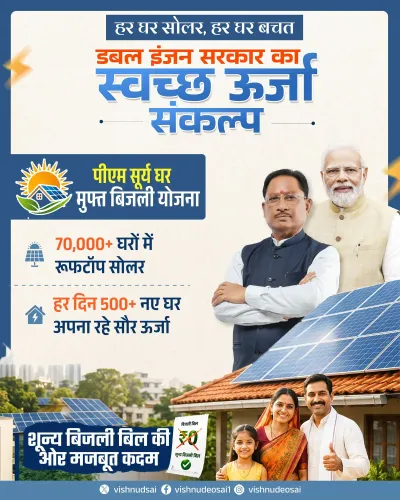
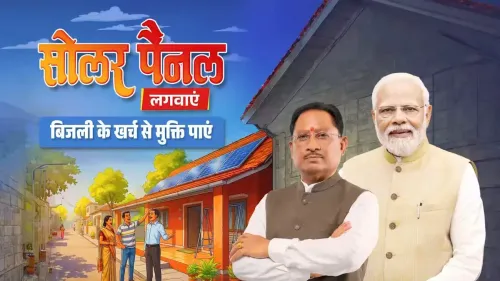
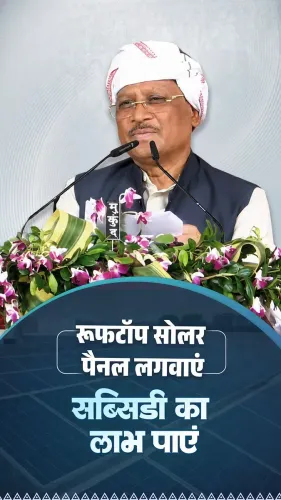
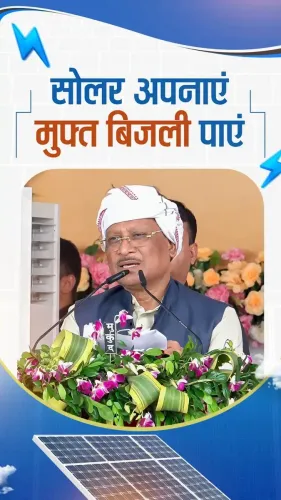
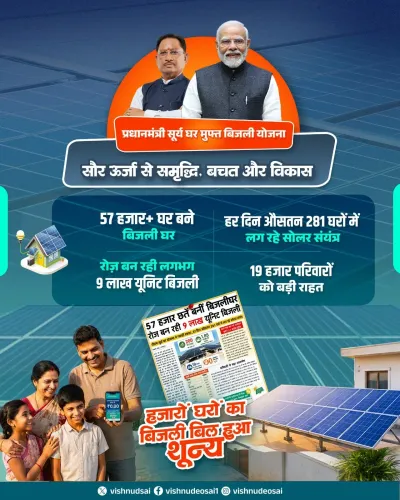
Chhattisgarh Chief Minister Vishnu Deo Sai on Sunday, 19 July 2026, urged residents of the state to adopt rooftop solar energy under the central government's PM Surya Ghar Muft Bijli Yojana, highlighting that thousands of families are already connected to solar power through combined central and state subsidies.
Context
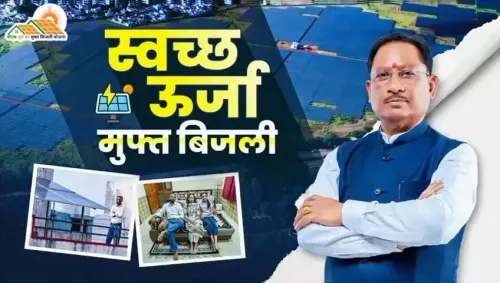
Posting in Hindi on X, CM Sai said: 'डबल इंजन सरकार में पीएम सूर्यघर मुफ्त बिजली योजना के तहत छत्तीसगढ़ के हजारों परिवार सौर ऊर्जा से जुड़ रहे हैं' ['Under the double-engine government, thousands of families in Chhattisgarh are connecting to solar energy through the PM Surya Ghar Muft Bijli Yojana']. He added that households now have the opportunity not only to save on electricity bills but also to supply surplus power back to the grid, effectively becoming energy providers themselves.
The post carried a call to action: 'आइए, सूरज की असीम ऊर्जा को अपने घर की ताकत बनाएं' ['Let us make the limitless energy of the sun the strength of our homes'], framing rooftop solar as a path toward savings, prosperity, and a green future.
Policy Backdrop
The PM Surya Ghar Muft Bijli Yojana was launched in February 2024 after being announced in the 2024-25 interim Union Budget, with a national target of reaching one crore households. The scheme offers up to 300 units of free electricity per month through central financial assistance, with BJP-governed states such as Chhattisgarh layering additional state-level subsidies on top.
The programme sits within India's broader renewable energy ambition: the central government has progressively scaled rooftop solar targets, aiming for 100 GW of rooftop solar capacity by 2030 as part of its commitment to 500 GW of non-fossil fuel energy. Chhattisgarh, which returned a BJP government in 2023, has actively publicised the convergence of central capital subsidies with state-level implementation support under the 'double engine' branding.
Stakeholders and Impact
The primary beneficiaries are residential households across Chhattisgarh, particularly those in areas with reliable grid connectivity who can install rooftop panels and feed excess generation back under net-metering arrangements. The scheme is designed to reduce household electricity expenditure while simultaneously easing demand pressure on the state grid.
For the state government, wider solar adoption also advances Chhattisgarh's renewable energy obligations and aligns local energy policy with national climate commitments. Rooftop solar vendors, installation contractors, and financing institutions operating in the state stand to benefit from increased demand driven by subsidised uptake.
What's Next
Attention will now turn to Chhattisgarh's state-level installation dashboards to track the actual pace of household enrolments and panel installations. Any supplementary budget allocations for solar subsidies in the next fiscal year will be a key indicator of the state government's commitment to scaling the programme beyond its current reach.
With the national one-crore-household target still in progress, the performance of large states like Chhattisgarh will be closely watched as a measure of ground-level implementation under the 'double engine' model of centre-state coordination.
Point of View
Where a BJP state government publicly amplifies a central flagship scheme to demonstrate aligned governance and shared credit. By foregrounding both savings and the opportunity to sell surplus power, the communication attempts to reframe rooftop solar from a welfare handout into an aspirational economic proposition for middle-income households. This fits a broader BJP pattern of positioning renewable energy not merely as an environmental obligation but as a direct livelihood benefit, particularly ahead of state budget cycles. The real test will be whether installation numbers in Chhattisgarh keep pace with the rhetoric, a metric that will shape the credibility of the 'double engine' narrative going into future electoral cycles.
NationPress
18 Oct 2026
Frequently Asked Questions
What is PM Surya Ghar Muft Bijli Yojana?
PM Surya Ghar Muft Bijli Yojana is a central government rooftop solar subsidy scheme launched in February 2024 that provides eligible households with up to 300 units of free electricity per month through financial assistance for installing solar panels.
How can Chhattisgarh residents apply for PM Surya Ghar scheme?
Residents of Chhattisgarh can apply through the national PM Surya Ghar portal, where they can register, check subsidy eligibility, and connect with empanelled solar vendors for installation.
What subsidy is available for rooftop solar in Chhattisgarh?
Eligible households in Chhattisgarh can access both the central government's capital subsidy under PM Surya Ghar Muft Bijli Yojana and an additional state government subsidy, reducing the upfront cost of rooftop solar installation.
Can households sell extra solar power back to the grid in Chhattisgarh?
Yes. Under net-metering arrangements, households that generate more electricity than they consume can supply the surplus to the grid, effectively earning as energy providers and offsetting their electricity bills further.
What is India's rooftop solar target by 2030?
India has set a rooftop solar capacity target of 100 GW by 2030 as part of its broader commitment to achieving 500 GW of non-fossil fuel energy capacity.