Chhattisgarh Cabinet amends 2015 industrial land rules

Synopsis
The Chhattisgarh Cabinet has amended the Industrial Land and Building Management Rules, 2015, to simplify land-use procedures, ease plot access, reduce disputes, and mandate transparent e-auctions for vacant or surplus industrial land — a push to strengthen the state's Ease of Doing Business standing.
Key Takeaways
The Chhattisgarh Industrial Land and Building Management Rules, 2015 have been amended by the state Cabinet as decision number 18.
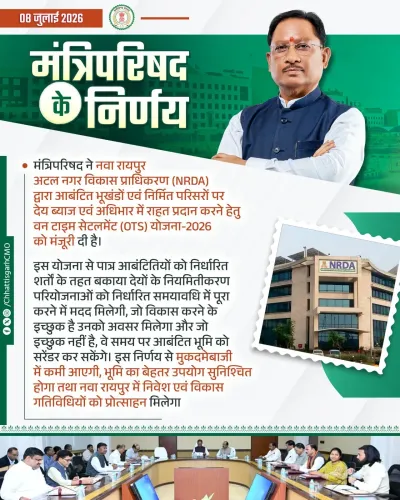
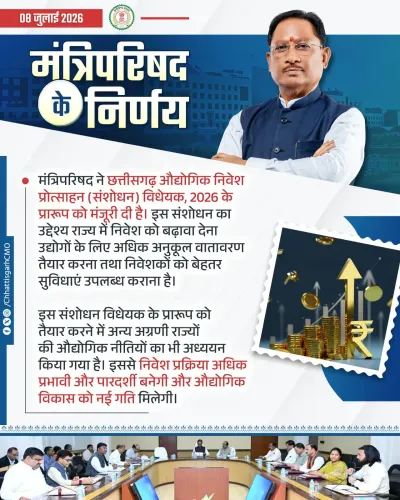
The amendment aims to simplify land-use classification and ease access to industrial plots for investors.
Disputes over industrial land and buildings are targeted for reduction under the new provisions.
Vacant or surplus industrial land will now be allotted through transparent e-auctions , replacing discretionary processes.
Chief Minister Vishnu Deo Sai has framed the move as an Ease of Doing Business reform under his BJP-led government.
The reform aligns with the national DPIIT Ease of Doing Business ranking framework that has incentivised state-level land reforms since 2015.
Land disputes, idle plots, and opaque allotments have long been the silent tax on industry in Chhattisgarh — and the state's Cabinet has now moved to settle the bill. The Chief Minister's Office of Chhattisgarh announced on Tuesday, 27 October 2026 that the Chhattisgarh Industrial Land and Building Management Rules, 2015 have been formally amended, targeting simpler land use, fewer disputes, and transparent e-auctions for surplus plots.
What the Cabinet actually changed
The amendment, listed as decision number 18 in the Cabinet readout, takes aim at four specific pain points. First, it simplifies land-use classification procedures — the bureaucratic maze that often delays a factory's change-of-use request by months. Second, it eases plot availability, making it faster for investors to identify and access industrial land. Third, it directly targets the dispute load on industrial land and building matters, a recurring drag on investor confidence in many Indian states. Fourth — and most consequentially — it mandates that vacant or surplus industrial land be put to productive use through transparent e-auctions, removing the discretionary back-channel allotments that have historically bred litigation and allegations of favouritism.
The 2015 rules and why amendments matter now
The original Chhattisgarh Industrial Land and Building Management Rules were notified in 2015 to create a uniform framework for allocating and managing state industrial land. A decade on, the rules needed retrofitting: the investment climate has shifted, digital infrastructure now supports e-procurement, and the national Ease of Doing Business rankings — run annually by the Department for Promotion of Industry and Internal Trade (DPIIT) since 2015 — have made industrial land reform a competitive priority for every state government. Chhattisgarh under Chief Minister Vishnu Deo Sai, who has led the BJP-led state government since December 2023, has framed the amendment explicitly as an Ease of Doing Business measure.
Competitive federalism at work
The move fits a well-worn but genuinely effective pattern: Indian states updating land and building regulations in cycles to reduce procedural friction, cut litigation, and improve their DPIIT ranking position — which in turn influences investor perception. E-auction mechanisms, in particular, have become a near-standard reform tool after several states demonstrated measurable reductions in allotment disputes following their introduction. The Chhattisgarh amendment now puts the state in step with that broader reform wave. Industrial investors and existing Chhattisgarh businesses are the direct beneficiaries, with clearer rules on plot access and a defined channel for surplus land that was previously sitting idle.
The real test, as always, is implementation — specifically, how quickly the amended rules are notified in operational detail, whether the e-auction platform is live and robust, and whether dispute filings on industrial land actually trend downward in the months ahead. Those numbers will tell the fuller story.
Point of View
Which is both a genuine anti-corruption step and a reputational signal to large industrial investors who have historically avoided states with opaque land processes. The broader arc here is a BJP-governed state aligning its industrial land framework with the Centre's reform narrative ahead of what will likely be a fresh investment summit pitch. Whether the operational machinery — platform readiness, dispute-resolution mechanisms — keeps pace with the Cabinet announcement is the critical open question.
NationPress
27 Oct 2026
Frequently Asked Questions
What are the Chhattisgarh Industrial Land and Building Management Rules, 2015?
These are state rules notified in 2015 that govern the allotment, use, and management of industrial land and buildings in Chhattisgarh. The 2026 Cabinet amendment updates them to simplify procedures and introduce e-auctions.
What does the Chhattisgarh Cabinet's industrial land amendment do?
The amendment simplifies land-use classification, eases plot access for investors, reduces the scope for disputes over industrial land, and mandates transparent e-auctions for vacant or surplus industrial plots.
How does this relate to Ease of Doing Business rankings?
India's DPIIT has run annual Ease of Doing Business rankings for states since 2015. Industrial land reforms — especially e-auction mechanisms and dispute reduction — are key criteria that influence a state's score and investor perception.
Who is Vishnu Deo Sai and what is his role in this decision?
Vishnu Deo Sai is the Chief Minister of Chhattisgarh, leading the BJP-led state government since December 2023. The Cabinet decision was announced by his office as part of the government's 'Sushasan' (good governance) agenda.
What will happen to vacant industrial land in Chhattisgarh now?
Under the amended rules, vacant or surplus industrial land must be put to productive use and allotted through transparent e-auctions, replacing earlier discretionary allotment processes.