Chirag Paswan backs KhetBachaoAbhiyan for farm future
Synopsis
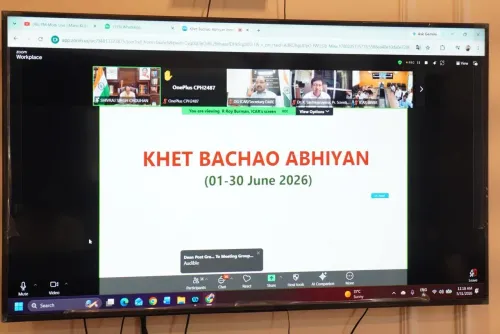
Union Food Processing Minister Chirag Paswan on June 1, 2026 championed #KhetBachaoAbhiyan as a national resolve linking soil conservation, water management and food security, tagging PM Modi and Agriculture Minister Shivraj Singh Chouhan in a call for sustainable farming and farmer welfare.
Key Takeaways
Chirag Paswan on June 1, 2026 publicly endorsed #KhetBachaoAbhiyan , calling it a national pledge for agriculture, environment, and future generations.
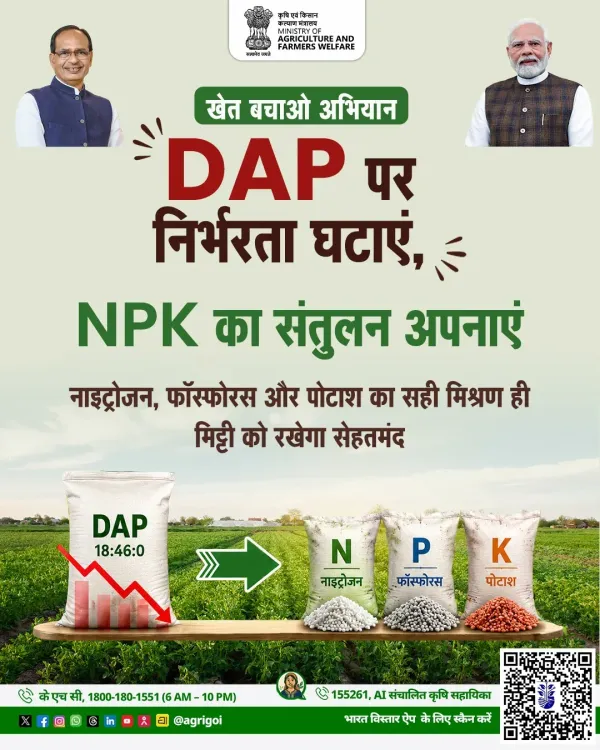
The campaign focuses on soil conservation , water conservation , field fertility , and food security for Indian farmers.
Paswan tagged PM Narendra Modi and Agriculture Minister Shivraj Singh Chouhan , signalling cross-ministerial coordination on the initiative.
The campaign builds on a decade of central-government policy including the Soil Health Card scheme (2015) , the National Mission for Sustainable Agriculture , and the Per Drop More Crop programme.
Small and marginal farmers stand to benefit most from awareness drives linking soil health to long-term productivity and rural incomes.
State-level rollout and possible integration with existing schemes such as Paramparagat Krishi Vikas Yojana will be the key developments to monitor.
Union Food Processing Minister Chirag Paswan on Monday, June 1, 2026 voiced strong support for the #KhetBachaoAbhiyan, describing the campaign as a national resolve to secure the future of Indian agriculture, the environment, and generations to come. Tagging Prime Minister Narendra Modi and Agriculture Minister Shivraj Singh Chouhan, Paswan framed the initiative as far more than a routine awareness drive.
Context
Posting in Hindi, Paswan wrote that '#KhetBachaoAbhiyan केवल एक अभियान नहीं, बल्कि भारत की कृषि, पर्यावरण और आने वाली पीढ़ियों के सुरक्षित भविष्य का संकल्प है' — translating as: 'KhetBachaoAbhiyan is not merely a campaign, but a pledge for the secure future of India's agriculture, environment, and coming generations.' He closed with a salute to farmers — 'Annadataon ko sadar pranam' — paying respectful tribute to those who feed the nation.
The minister highlighted that the initiative raises awareness among farmers about soil conservation and sustainable agriculture, while simultaneously charting a path to preserve field fertility, ensure water conservation, and strengthen food security. Paswan described the campaign's core mantra as: 'Respect for the farmer, protection of the fields, and security for the future.'
Policy Backdrop
The campaign sits within a decade-long policy arc. The Soil Health Card scheme, launched in 2015, was among the first major central-government efforts to push soil testing and balanced fertiliser use down to the farm level. The National Mission for Sustainable Agriculture subsequently wove together climate-resilient practices, water-use efficiency, and soil-fertility measures into a single framework.
India's National Action Plan on Climate Change has long identified sustainable agriculture as a critical pillar, linking rural livelihoods directly to environmental stewardship. Schemes such as Paramparagat Krishi Vikas Yojana — which promotes organic farming — and Per Drop More Crop — which incentivises micro-irrigation — represent the operational ground on which campaigns like KhetBachaoAbhiyan are expected to build.
Shivraj Singh Chouhan, tagged by Paswan, brings extensive state-level agricultural experience to the Union Agriculture Ministry, having championed farmer-welfare programmes during his long tenure as Chief Minister of Madhya Pradesh. His involvement signals active ministerial coordination on the campaign's messaging.
Stakeholders and Impact
The primary beneficiaries are small and marginal farmers, who are most vulnerable to soil degradation, erratic rainfall, and declining groundwater tables. Awareness campaigns that tie soil health to productivity directly affect the incomes and food security of millions of rural households across India.
For the food processing sector — Paswan's own ministerial brief — the quality and volume of raw agricultural produce is foundational. Degraded soils produce lower-quality crops, creating upstream pressure on processors and downstream risk for consumers. Paswan's endorsement of the campaign thus bridges his ministry's mandate with the agriculture ministry's ground-level outreach.
Environmental advocates have long argued that India's intensive farming practices — heavy chemical fertiliser use, mono-cropping, over-extraction of groundwater — have steadily eroded the natural capital that underpins long-term food production. A campaign that reframes soil as a shared national asset rather than a private input speaks to this concern.
What's Next
Attention will now turn to whether #KhetBachaoAbhiyan is integrated formally with existing central schemes or rolled out as a standalone awareness initiative at the state level. Coordination between the Ministry of Agriculture and the Ministry of Food Processing Industries on joint farmer outreach could amplify the campaign's reach. If the initiative gains formal programme status, budget allocations and measurable targets — such as the number of farmers covered or hectares brought under conservation practices — will be the metrics to watch.
The broader implication is significant: as India's agricultural land faces mounting pressure from climate variability and soil exhaustion, campaigns that build conservation consciousness at the grassroots level may prove as consequential as any single scheme or subsidy.
Point of View
He positions his portfolio as a downstream stakeholder in agricultural sustainability, not merely a value-chain ministry. The post reinforces the ruling coalition's consistent effort to frame environmental and agrarian policy as a unified, inter-generational project rather than siloed bureaucratic concerns. Tagging both the Prime Minister and the Agriculture Minister in a single post suggests deliberate messaging coordination ahead of a possible formal campaign rollout. If #KhetBachaoAbhiyan acquires programme status and budget backing, this post may be read as an early marker of ministerial alignment around what could become a flagship rural-environment initiative.
NationPress
17 Oct 2026
Frequently Asked Questions
What is KhetBachaoAbhiyan?
#KhetBachaoAbhiyan is a campaign promoted by the central government focused on soil conservation, sustainable farming practices, water conservation, and long-term food security for Indian farmers.
What did Chirag Paswan say about KhetBachaoAbhiyan?
Chirag Paswan described #KhetBachaoAbhiyan as more than a campaign — calling it a national resolve to secure the future of Indian agriculture, the environment, and coming generations, and paid tribute to farmers as the nation's providers.
What is Chirag Paswan's role in the government?
Chirag Paswan serves as Union Minister of Food Processing Industries and is the national president of the Lok Janshakti Party (Ram Vilas).
How does KhetBachaoAbhiyan relate to existing farm schemes?
The campaign aligns with existing central schemes such as the Soil Health Card scheme, Paramparagat Krishi Vikas Yojana, and Per Drop More Crop, all of which promote sustainable and resource-efficient farming.
Why is soil conservation important for India's food security?
Soil degradation reduces crop quality and yields, directly threatening food security and farmer incomes. Healthy soil supports long-term agricultural productivity, which is foundational for both rural livelihoods and the food processing sector.