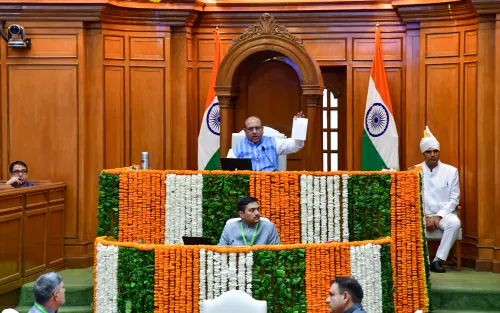
Chirag Paswan Hails Vande Mataram Bill Passed in Rajya Sabha

Synopsis
The Rajya Sabha passed the Vande Mataram Bill on 29 July 2026, with Union Minister Chirag Paswan and the LJP (Ram Vilas) calling it a historic step to protect India's national identity and cultural heritage. The National Song was adopted by the Constituent Assembly in 1950.
Key Takeaways
The Rajya Sabha passed the Vande Mataram Bill on 29 July 2026 .
Union Minister Chirag Paswan and the Lok Janshakti Party (Ram Vilas) formally welcomed the legislation.
Paswan described Vande Mataram as 'a symbol of the patriotism, sacrifice and inspiration of the freedom struggle for crores of Indians.' The Constituent Assembly had adopted Vande Mataram as India's National Song in 1950 , distinct from the National Anthem.
If Rajya Sabha passage requires Lok Sabha concurrence, further parliamentary proceedings will be the next key milestone.
A bill to legally protect and honour Vande Mataram — the song that stirred millions through India's freedom struggle — cleared the Rajya Sabha on Wednesday, 29 July 2026, and Union Food Processing Minister Chirag Paswan called it a historic step for India's national identity.
Posting on X with the tricolour emoji, Paswan wrote: 'वंदे मातरम्.... आज राज्यसभा में वंदे मातरम् विधेयक पारित होना भारत की राष्ट्रीय अस्मिता, स्वाभिमान और सांस्कृतिक विरासत के सम्मान की दिशा में एक ऐतिहासिक कदम है' — 'The passage of the Vande Mataram Bill in the Rajya Sabha today is a historic step towards honouring India's national identity, self-respect and cultural heritage.' He added that Vande Mataram is 'not merely a song, but a symbol of the patriotism, sacrifice and inspiration of the freedom struggle for crores of Indians,' and that he and his party, the Lok Janshakti Party (Ram Vilas), welcome the decision.
From Bankim's pen to Parliament's floor
The song's journey to legislative protection is long. Vande Mataram, composed by Bankim Chandra Chattopadhyay in his 1882 novel Anandamath, became a rallying cry of the independence movement before the Constituent Assembly adopted it as India's National Song in 1950 — alongside, but distinct from, the National Anthem. That distinction has kept the song in recurring political and judicial conversation ever since, with successive governments periodically advancing measures to reinforce respect for national symbols including the flag, the anthem, and the song itself.What the bill is meant to do
The legislation, as characterised by its supporters, aims to ensure the 'dignity and protection' of India's invaluable cultural heritage linked to national honour. If the bill originated in or was amended by the Rajya Sabha, it would typically require Lok Sabha concurrence before receiving Presidential assent — making the lower house's proceedings the next critical watch-point. State-level implementation and potential legal challenges on the scope of such a law are also likely to follow. For Paswan and the LJP (Ram Vilas), the welcome is both cultural and political — a moment to align the party firmly with the national-identity current that has defined much of India's legislative agenda in recent years. The kicker: a song that once moved a nation to march against colonial rule now moves Parliament to codify its place in the republic's soul.Point of View
Publicly welcoming the bill reinforces LJP (Ram Vilas)'s alignment with cultural-nationalist priorities at a moment when the party is keen to demonstrate ideological coherence within the NDA. The bill's route through the Rajya Sabha first is notable, given the upper house's historical role as a deliberative check; smooth passage there signals broad political consensus on the measure. Whether the legislation translates into enforceable ground-level change — or remains largely symbolic — will depend on the implementing rules and any constitutional scrutiny that follows.
NationPress
29 Jul 2026
Frequently Asked Questions
What is the Vande Mataram Bill passed in Rajya Sabha?
The Vande Mataram Bill, passed in the Rajya Sabha on 29 July 2026, is legislation aimed at legally protecting the dignity and honour of India's National Song, Vande Mataram. Its precise provisions are subject to the bill's text and any Lok Sabha proceedings that follow.
What did Chirag Paswan say about the Vande Mataram Bill?
Chirag Paswan called it a historic step for India's national identity, self-respect and cultural heritage, and said Vande Mataram is not merely a song but a symbol of the patriotism and sacrifice of the freedom struggle for crores of Indians.
When was Vande Mataram adopted as India's National Song?
The Constituent Assembly adopted Vande Mataram as India's National Song in 1950, alongside but distinct from the National Anthem, Jana Gana Mana.
What happens after the Vande Mataram Bill passes Rajya Sabha?
If the bill requires Lok Sabha concurrence, it must be passed by the lower house of Parliament before receiving Presidential assent and becoming law. State-level implementation and potential legal challenges are also expected to follow.
What is the Lok Janshakti Party (Ram Vilas)?
The Lok Janshakti Party (Ram Vilas) is a political party led by Chirag Paswan, Union Minister of Food Processing Industries. It is a constituent of the National Democratic Alliance (NDA).