Chirag Paswan Pays Tribute to Former PM VP Singh on Birth Anniversary
Synopsis
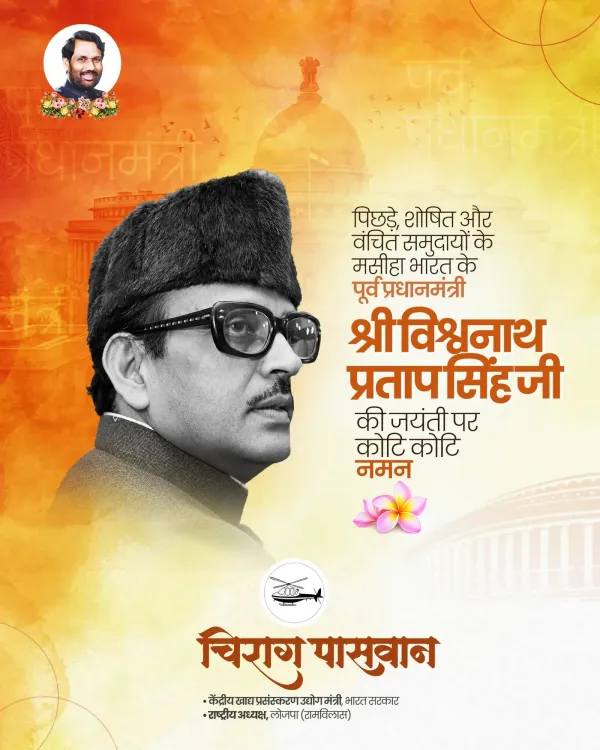
Union Food Processing Minister Chirag Paswan on 25 June 2026 paid homage to former Prime Minister Vishwanath Pratap Singh on his birth anniversary, saluting him as a champion of India's backward and marginalised communities and a defining force behind OBC reservations.
Key Takeaways
Union Food Processing Minister Chirag Paswan paid tribute to former PM Vishwanath Pratap Singh on his birth anniversary on 25 June 2026 .
VP Singh served as India's Prime Minister from 1989 to 1990 and is credited with implementing the Mandal Commission recommendations.
The Mandal Commission had recommended 27 per cent reservations for OBCs in central government jobs and educational institutions.
Chirag Paswan is the national president of Lok Janshakti Party (Ram Vilas) and continues his father Ram Vilas Paswan's focus on backward-caste politics.
The tribute comes amid ongoing national debate on caste census and OBC representation in government and education.
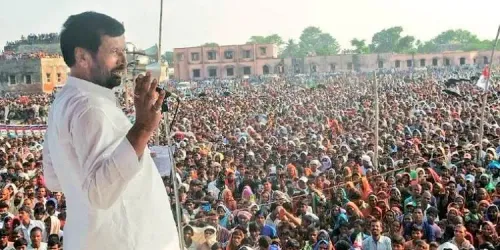
Union Food Processing Minister Chirag Paswan on Thursday, 25 June 2026, paid homage to former Prime Minister Vishwanath Pratap Singh on his birth anniversary, honouring him as a powerful voice for India's backward, exploited, and marginalised communities and a fierce champion of social justice.
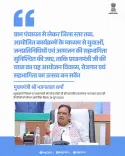
Posting on X, Paswan wrote — 'देश के पिछड़े, शोषित एवं वंचित वर्गों के अधिकारों की सशक्त आवाज़, सामाजिक न्याय के प्रखर समर्थक' — ('the powerful voice for the rights of the backward, exploited, and deprived sections of the country, a fierce advocate of social justice') — offering his 'koti-koti naman' (countless salutations) to the former Prime Minister.
Context
Vishwanath Pratap Singh served as India's seventh Prime Minister from 1989 to 1990, leading the Janata Dal-headed National Front government. His tenure, though brief, left a lasting imprint on Indian politics through his government's decision to implement the Mandal Commission recommendations, extending 27 per cent reservations in central government jobs and educational institutions to Other Backward Classes (OBCs). The move triggered nationwide debate and remains one of the most consequential policy decisions in post-independence India.
VP Singh is widely regarded as a defining figure in the politics of social justice, and his birth anniversary is observed each year by leaders across party lines who identify with backward-caste and Dalit political traditions.
Policy Backdrop
The Mandal Commission, constituted in 1980 under the chairmanship of B.P. Mandal, had recommended OBC reservations that remained unimplemented for nearly a decade. When VP Singh's government enforced the recommendations in 1990, it fundamentally reshaped the architecture of affirmative action in India. The decision energised OBC political mobilisation and gave rise to a new generation of social-justice-oriented parties and leaders.
Chirag Paswan's tribute carries particular political weight. As the national president of the Lok Janshakti Party (Ram Vilas) and son of the late Ram Vilas Paswan — himself a towering figure in Dalit and backward-caste politics — Chirag Paswan is seen as a custodian of the legacy that VP Singh helped shape. His ministry's work on food processing also intersects with rural and agrarian communities that overlap significantly with OBC and marginalised populations.
Stakeholders and Impact
Public tributes to VP Singh by leaders from backward-caste political backgrounds serve as a signal of ideological continuity with the Mandal era. OBC communities, which constitute a substantial share of India's population, closely watch such gestures as affirmations of political commitment to their interests. Social justice advocates and reservation proponents view these anniversaries as occasions to reinforce the moral and constitutional basis of affirmative action.
The tribute comes at a time when national debates around caste enumeration, the proposed caste census, and potential revisions to reservation quotas remain active across parliamentary and public discourse. Leaders who invoke VP Singh's legacy are broadly understood to be signalling support for expanding or protecting existing reservation frameworks.
What's Next
With the question of a nationwide caste census and its implications for reservation policy continuing to occupy political attention, tributes such as this one are likely to be read as positioning statements ahead of any legislative or executive action on OBC representation. Observers will watch whether Chirag Paswan's public messaging on social justice translates into concrete policy advocacy within the National Democratic Alliance government in the coming parliamentary sessions.
Point of View
Not merely a ceremonial gesture. As a leader whose party's core constituency is OBC and Dalit voters, invoking the architect of Mandal-era reservations reinforces his claim to that ideological inheritance. The tribute also arrives in a politically charged environment where the caste census debate has sharpened competition among parties for backward-caste allegiance. For Paswan, aligning publicly with VP Singh's legacy is a low-cost, high-visibility way to assert social-justice credentials within a ruling coalition that spans a wide ideological range.
NationPress
25 Jun 2026
Frequently Asked Questions
Who was Vishwanath Pratap Singh?
Vishwanath Pratap Singh was India's seventh Prime Minister, serving from 1989 to 1990. He is best known for implementing the Mandal Commission recommendations that granted 27 per cent reservations to Other Backward Classes in central government jobs and educational institutions.
Why did Chirag Paswan pay tribute to VP Singh?
Chirag Paswan paid tribute to VP Singh on his birth anniversary on 25 June 2026, honouring him as a champion of the rights of backward, exploited, and marginalised communities. As a leader with deep roots in OBC and Dalit politics, Paswan regularly signals continuity with the Mandal-era social justice tradition.
What is the Mandal Commission and why does it matter?
The Mandal Commission was constituted in 1980 to examine the conditions of socially and educationally backward classes. Its recommendation of 27 per cent OBC reservations in central government employment and education was implemented by VP Singh's government in 1990, fundamentally reshaping Indian affirmative action policy.
What is Chirag Paswan's political party?
Chirag Paswan is the national president of the Lok Janshakti Party (Ram Vilas), a party he leads in continuation of the legacy of his father, the late Ram Vilas Paswan, who was a prominent Dalit and backward-caste political leader.
What is VP Singh's birth anniversary date?
Vishwanath Pratap Singh was born on 25 June 1931. His birth anniversary is observed each year by political leaders, particularly those associated with OBC and social justice politics in India.