Shivraj Singh Chouhan pays tribute to Bipin Chandra Pal on birth anniversary
Synopsis
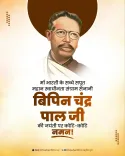
Union Agriculture Minister Shivraj Singh Chouhan paid tribute to revolutionary leader Bipin Chandra Pal on his birth anniversary, calling him a force who gave new direction to India's independence movement and whose ideals continue to inspire service to the nation.
Key Takeaways
Shivraj Singh Chouhan posted a tribute to Bipin Chandra Pal on his birth anniversary on 7 November 2026 .
Chouhan described Pal as a 'great revolutionary' who gave a new direction to the Indian independence movement.
Bipin Chandra Pal was the 'Pal' of the Lal-Bal-Pal triumvirate — one of the most prominent extremist nationalist groupings of early-20th-century India.
Pal was a central figure in the Swadeshi movement sparked by the 1905 partition of Bengal , advocating full Swaraj and a boycott of British goods.
BJP leaders routinely mark anniversaries of pre-Gandhian nationalist figures as part of a broader effort to highlight the assertive strand of India's freedom struggle.
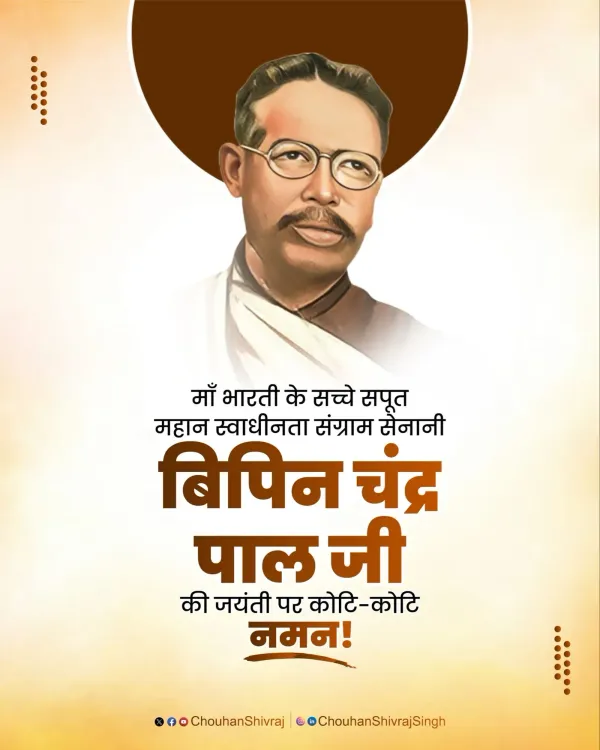
A freedom fighter who helped fracture the colonial order with words as sharp as any weapon — Union Agriculture Minister Shivraj Singh Chouhan marked the birth anniversary of Bipin Chandra Pal on Saturday, 7 November 2026, with a heartfelt tribute on X, honouring the revolutionary whose ideas gave the Indian independence movement its most militant edge.
In his post, Chouhan wrote: 'Bhartiya swatantrata andolan ko nai disha dene wale, mahan krantikari Bipin Chandra Pal ji ki jayanti par koti-koti naman karta hoon!' — 'I bow in reverence, countless times, to the great revolutionary Bipin Chandra Pal, who gave a new direction to the Indian independence movement.' He added that Pal's sharp ideas and exemplary life would continue to inspire all of them in the service of Mother India and the upliftment of society.
The revolutionary who made 'Swaraj' a battle cry
Bipin Chandra Pal stands as one of the towering figures of early-twentieth-century Indian nationalism — the 'Pal' in the celebrated Lal-Bal-Pal triumvirate alongside Lala Lajpat Rai and Bal Gangadhar Tilak. Where the moderate Congress of the era sought constitutional reform through petition, Pal demanded nothing less than complete Swaraj — self-rule — and was among the first nationalists to articulate that goal without apology or qualification.
He was a driving force of the Swadeshi movement, which erupted in response to the 1905 partition of Bengal ordered by Viceroy Lord Curzon. The movement called on Indians to boycott British goods and champion domestic production — a strategy that would later echo through Mahatma Gandhi's own campaigns. Pal's fiery oratory and journalism made him one of the most feared voices in British India, earning the 'extremist' label from both the colonial administration and the moderate wing of the Congress.
BJP's pattern of reclaiming the Swadeshi canon
BJP leaders have made a consistent practice of publicly commemorating pre-Gandhian nationalist figures like Pal, Tilak, and Lajpat Rai on their birth and death anniversaries. These tributes are part of a deliberate effort to spotlight the assertive, Swadeshi-era strand of the freedom struggle — one that emphasises civilisational pride, economic self-reliance, and direct confrontation with colonial power — alongside the more familiar moderate or Gandhian narrative.
For a minister who also holds the Rural Development portfolio, invoking Pal's legacy of Swadeshi carries a subtle resonance: the original Swadeshi impulse — build at home, buy at home — echoes in contemporary programmes aimed at rural self-sufficiency and domestic enterprise.
Point of View
Tilak, and Lajpat Rai who demanded Swaraj outright rather than seeking incremental colonial concessions. By consistently marking these anniversaries, BJP seeks to broaden the ideological genealogy it claims, positioning itself as the inheritor of an older, more confrontational patriotism. For a senior minister also steering rural development policy, invoking Pal's Swadeshi legacy adds a subtle civilisational framing to economic self-reliance programmes. These tributes, while ceremonial in form, function as quiet ideological signalling to a base that prizes assertive nationalism.
NationPress
7 Nov 2026
Frequently Asked Questions
Who was Bipin Chandra Pal?
Bipin Chandra Pal was a major Indian nationalist leader of the early 20th century, best known as the 'Pal' of the Lal-Bal-Pal triumvirate alongside Lala Lajpat Rai and Bal Gangadhar Tilak. He was a fiery orator, journalist, and advocate of complete Swaraj who played a central role in the Swadeshi movement against the 1905 partition of Bengal.
What is the Lal-Bal-Pal triumvirate?
Lal-Bal-Pal refers to the trio of Lala Lajpat Rai, Bal Gangadhar Tilak, and Bipin Chandra Pal — three of the most influential 'extremist' nationalist leaders in early-20th-century India who demanded complete self-rule and championed the Swadeshi movement.
What was Bipin Chandra Pal's role in the Swadeshi movement?
Bipin Chandra Pal was one of the leading voices of the Swadeshi movement, which erupted in opposition to the 1905 partition of Bengal. He advocated boycotting British goods and promoting Indian-made products, using his oratory and journalism to mobilise public sentiment against colonial rule.
Why do BJP leaders regularly pay tribute to Bipin Chandra Pal?
BJP leaders routinely mark the birth and death anniversaries of pre-Gandhian nationalist figures like Bipin Chandra Pal to highlight the assertive, Swadeshi-era strand of India's freedom struggle, which emphasises civilisational pride and economic self-reliance.
What did Shivraj Singh Chouhan say about Bipin Chandra Pal?
Chouhan described Bipin Chandra Pal as a 'great revolutionary' who gave a new direction to the Indian independence movement, saying his sharp ideas and exemplary life would continue to inspire service to Mother India and the upliftment of society.