Shivraj Singh Chouhan Pays Tribute to C.V. Raman on Birth Anniversary
Synopsis
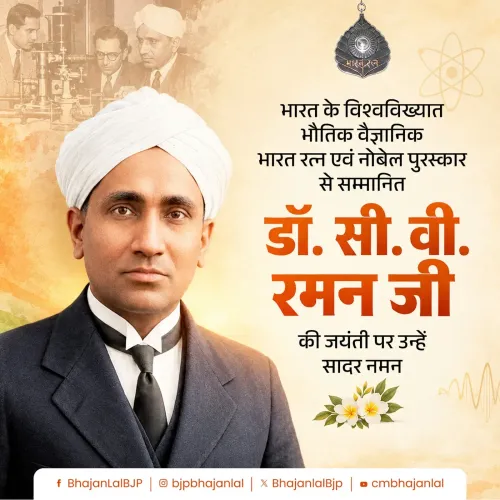
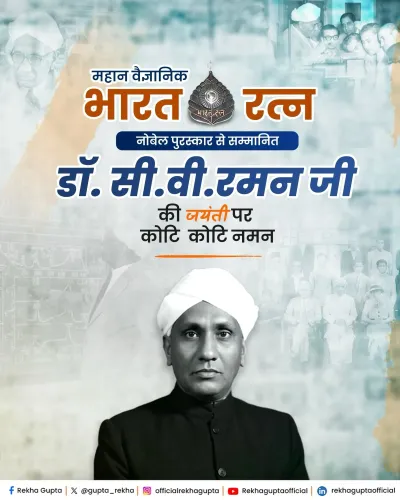
Union Agriculture Minister Shivraj Singh Chouhan marked the birth anniversary of Nobel laureate Sir C.V. Raman on 7 November, saluting the discoverer of the Raman Effect as an eternal inspiration for purposeful scientific service to the nation.
Key Takeaways
Shivraj Singh Chouhan paid tribute to Sir C.V.
Raman on his birth anniversary, 7 November 2026 .
Raman discovered the Raman Effect on 28 February 1928 , which earned him the Nobel Prize in Physics in 1930 .
He was the first Asian to win a Nobel Prize in science and the only Indian to win it for work done entirely in India.
Raman was awarded the Bharat Ratna in 1954 .
The Government of India declared 28 February as National Science Day in 1986 to commemorate the discovery.
Raman founded the Raman Research Institute in Bengaluru in 1948 , which remains active today.
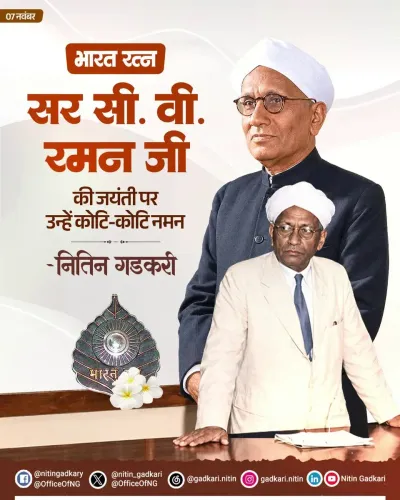
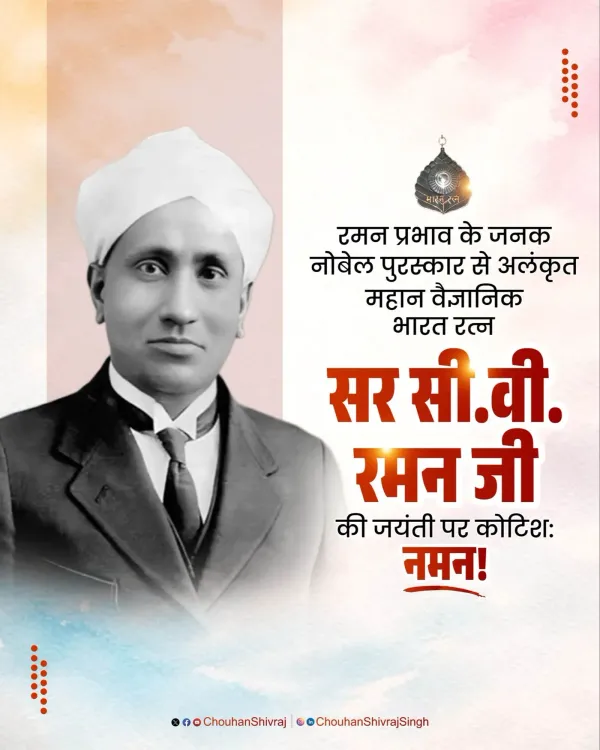
On the birth anniversary of Sir Chandrasekhara Venkata Raman, Union Agriculture Minister Shivraj Singh Chouhan offered a heartfelt tribute to the Nobel laureate and Bharat Ratna physicist, calling his service to the nation through science an example that will inspire generations to come.
Posting on Saturday, 7 November 2026, Chouhan wrote: 'कोटिश: नमन करता हूँ' — 'I bow in reverence a million times' — saluting the man he described as the father of the Raman Effect, a Nobel Prize recipient and a Bharat Ratna awardee. He added that Raman's 'unparalleled efforts to serve the nation through science will always inspire future generations to live a purposeful life.'Who was Sir C.V. Raman?
Sir C.V. Raman, born on 7 November 1888 in Tiruchirapalli, Tamil Nadu, fundamentally altered how the world understood light. His discovery of the Raman Effect — demonstrating that when light passes through a transparent material, a portion of it scatters at a different wavelength — earned him the Nobel Prize in Physics in 1930, making him the first Asian to win a Nobel in a science category. He remains the only Indian to have won the prize for work conducted entirely in India.
India's highest civilian honour, the Bharat Ratna, was conferred on him in 1954. The Government of India later institutionalised his greatest discovery as a national occasion: since 1986, 28 February — the date in 1928 when the Raman Effect was announced — has been observed as National Science Day across the country.
A tradition of remembering India's scientific giants
Chouhan's tribute reflects a consistent practice among Indian public figures of marking the anniversaries of pre-Independence era scientists as occasions to link national identity with intellectual achievement. For a minister whose portfolio spans agriculture and rural development, the salute to a physicist carries a pointed message: that science, in all its forms, sits at the foundation of India's national project.
Raman's legacy endures well beyond Nobel citations. The Raman Research Institute in Bengaluru, which he founded in 1948, remains an active centre for fundamental science. His belief that rigorous curiosity was itself a form of patriotism continues to resonate in India's science education discourse.
Point of View
' the minister subtly aligns scientific endeavour with the prevailing political vocabulary of rashtra seva. The anniversary also serves as a prelude to the National Science Day ecosystem on 28 February, when government science outreach programmes typically peak. For a minister overseeing agriculture — a sector increasingly dependent on scientific intervention — the tribute carries an implicit note on the centrality of research to rural transformation.
NationPress
7 Nov 2026
Frequently Asked Questions
When is C.V. Raman's birth anniversary?
Sir C.V. Raman was born on 7 November 1888 , and his birth anniversary is commemorated annually on that date.
What is the Raman Effect?
The Raman Effect is the phenomenon by which light scatters at a shifted wavelength when it passes through a transparent medium, discovered by Sir C.V. Raman and K.S. Krishnan on 28 February 1928 .
Why did C.V. Raman win the Nobel Prize?
Sir C.V. Raman received the Nobel Prize in Physics in 1930 for the discovery of the Raman Effect, becoming the first Asian scientist to win the prize in a science discipline.
What is National Science Day and why is it on 28 February?
National Science Day is observed every year on 28 February to mark the anniversary of the discovery of the Raman Effect in 1928; the Government of India instituted the observance in 1986 .
What awards did C.V. Raman receive from the Indian government?
Sir C.V. Raman was conferred the Bharat Ratna — India's highest civilian honour — in 1954 .