The Shutdown of CIRUS: A Turning Point in India's Nuclear Journey
Synopsis
In 2010, the Congress-led UPA government shut down the CIRUS reactor, pivotal in India's nuclear development, amid claims of external pressure. This controversial decision sparked debates about national security and international relations.
Key Takeaways
CIRUS reactor was crucial for India's nuclear development.
Decommissioned in December 2010 under allegations of US pressure.
The decision tied to the India-US civil nuclear agreement .
Significant implications for India's strategic autonomy .
Continues to spark debate in political circles.
New Delhi, March 2 (NationPress) The CIRUS (Canada-India Reactor US) reactor, which was pivotal in shaping India's initial nuclear program and enhancing its atomic research and fissile material production capabilities, was definitively decommissioned by the Congress-led UPA government in December 2010 amidst claims of succumbing to external influences.
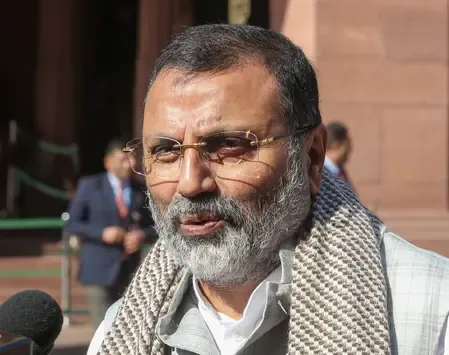
"An MP who excels in deception, the reactor from Canada, which enriched our nuclear status, was shut down by the Congress administration in 2010 under pressure from the US, infuriating the Canadian government. A cowardly and 'compromised' Congress," stated Nishikant Dubey, the BJP MP from Godda, Jharkhand.
Initially launched on July 10, 1960, under the leadership of then Prime Minister Jawaharlal Nehru, this 40-megawatt thermal heavy-water reactor achieved criticality thanks to collaborative efforts with Canada, which provided financial and design support, and the US, which supplied the heavy water.
During a Parliamentary response to a starred question on February 12, 1960, Nehru confirmed the reactor's operational status and detailed its initial activities: various systems were under testing, start-up experiments were underway, and power was progressively increased towards its rated capacity of 40,000 kilowatts.
Once fully functional, the reactor was designated for research in neutron physics and engineering, as well as isotope production for diverse applications in agriculture, industry, medicine, and scientific inquiry.
Over the years, CIRUS became vital to India's nuclear progression, generating considerable amounts of plutonium through the irradiation of natural uranium fuel.
It was instrumental in facilitating the 1974 "Smiling Buddha" peaceful nuclear explosion, although this event strained relationships with supplier nations Canada and the USA, resulting in reduced cooperation and the establishment of stricter international export regulations.
In the late 2000s, as part of the India-US civil nuclear agreement negotiated by then Prime Minister Manmohan Singh and US President George W. Bush, India agreed to decommission CIRUS by the close of 2010.
This decision was linked to obtaining a waiver from the Nuclear Suppliers Group (NSG), which permitted civilian nuclear trade with India despite its non-signatory status to the Nuclear Non-Proliferation Treaty.
The decision to separate civilian from military facilities positioned many under IAEA safeguards while maintaining strategic components unsafeguarded.
In a Lok Sabha unstarred question response on December 16, 2009, Prithviraj Chavan, Minister of State in the Prime Minister's Office, affirmed the Congress-led UPA government's intention to permanently shut down the CIRUS reactor at the Bhabha Atomic Research Centre (BARC) in Trombay by December 2010.
The shutdown was justified by the reactor nearing the end of its operational life after nearly 50 years, although critics argue that it was primarily due to US demands to restrict India's weapons-grade plutonium production.
The reactor was officially shut down on December 31, 2010, just before midnight.
Some analysts argue that the Congress government acted under US pressure to facilitate the nuclear agreement, compromising India's strategic autonomy and provoking Canada, which had long harbored grievances regarding the reactor's previous uses contrary to original peaceful intentions.
Supporters view the shutdown as a pragmatic move towards ending years of isolation in global nuclear commerce, facilitating fuel imports and technology access to enhance energy security.
This incident remains a contentious issue in political discussions, with accusations directed at the previous Congress-led UPA government for showing weakness in national security by prioritizing international agreements over homegrown capabilities, particularly those related to reactors like CIRUS, which played a significant role in establishing India's nuclear capabilities.
Point of View
Others criticize it as a compromise of India's strategic interests. This incident highlights the delicate balance between national sovereignty and global diplomatic relations.
NationPress
26 Sept 2026
Frequently Asked Questions
When was the CIRUS reactor shut down?
The CIRUS reactor was permanently shut down on December 31, 2010.
What was the role of the CIRUS reactor in India's nuclear program?
CIRUS was crucial in developing India's nuclear capabilities, particularly in producing plutonium for various applications.
Why did the Congress government shut down the reactor?
The shutdown was linked to international agreements, particularly the India-US civil nuclear deal, which required the reactor to be decommissioned as a condition for obtaining a waiver from the Nuclear Suppliers Group.
What impact did the shutdown have on India's nuclear capabilities?
Critics argue that the shutdown compromised India's ability to produce weapons-grade plutonium, while proponents see it as a step towards greater global nuclear integration.
How did Canada react to the CIRUS reactor's shutdown?
The shutdown reportedly angered the Canadian government, which had long-standing grievances regarding the reactor's historical use.