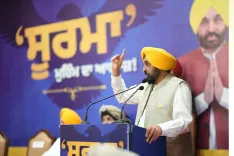
CM Bhagwant Mann Lays Foundation of Stadium in Samana, Cites 3,100 Sports Venues Plan

Synopsis
Chief Minister Bhagwant Mann laid the foundation stone of a sports stadium in Samana on 27 June 2026, announcing that Punjab is constructing 3,100 stadiums statewide to promote sporting culture and combat drug abuse among the youth.
Key Takeaways
Chief Minister Bhagwant Mann laid the foundation stone of a sports stadium in Samana , Patiala district, on 27 June 2026 .
The state government is constructing 3,100 stadiums across Punjab to promote sporting culture.
The infrastructure drive is explicitly linked to the government's anti-drug strategy targeting Punjab's youth.
Mann described sports promotion as 'the most effective tool' in the government's 'crusade against drugs'.
The AAP government has prioritised sports infrastructure since its March 2022 election victory.
Progress metrics — youth enrolment in sport and athlete performance at national events — will indicate real-world impact.
The Chief Minister's Office of Punjab announced on Saturday, 27 June 2026 that Chief Minister Bhagwant Mann laid the foundation stone of a sports stadium in Samana, reiterating the state government's plan to construct 3,100 stadiums across Punjab as part of its anti-drug strategy targeting the youth.
Context
Speaking at the foundation-stone ceremony in Samana, a town in Patiala district, Chief Minister Bhagwant Mann framed the stadium-building drive explicitly as a weapon against drug abuse. He stated, 'Promotion of sports culture can be the most effective tool in the state government's crusade against drugs.' The event marks a visible milestone in an infrastructure push that the Aam Aadmi Party government has championed since taking office in March 2022.
The Chief Minister's Office said the government is making 'unprecedented investments in sports infrastructure' to encourage youth participation, eradicate the drug menace, and prepare athletes to compete at national and international levels.
Policy Backdrop
Punjab has grappled with a persistent drug-abuse crisis among its young population for more than two decades. Successive state administrations have combined enforcement and de-addiction programmes with efforts to channel youth energy into sports, but the scale of physical infrastructure has historically lagged behind stated ambitions.
After its 2022 election victory, the AAP government listed sports-facility upgrades among its priority social-sector interventions. The current plan to build 3,100 stadiums — spanning village and block levels — represents the most expansive articulation of that commitment to date, aiming to make sporting venues accessible even in smaller towns and rural areas.
Stakeholders and Impact
The primary beneficiaries of the programme are Punjab's youth and aspiring athletes who currently lack access to quality training infrastructure close to home. Availability of local stadiums is expected to lower barriers to entry for sport, particularly in districts such as Patiala where grassroots talent has historically fed state and national teams.
Community organisations, local sports clubs, and coaches stand to gain training and competition venues, while the state's de-addiction ecosystem could see complementary benefits if youth engagement in organised sport increases. Critics and civil-society groups monitoring the drug crisis will likely track whether the infrastructure translates into measurable reductions in substance abuse among young people.
What's Next
Attention will now turn to the pace of construction and commissioning of the 3,100 stadiums, particularly whether timelines and budgetary allocations are formalised in forthcoming state budgets. Performance metrics — such as the number of youth enrolled in sport programmes and Punjab athletes qualifying for national events — will serve as indicators of whether the infrastructure investment achieves its stated social goals.
The Samana foundation-stone ceremony is likely to be followed by similar events in other districts as the government seeks to demonstrate momentum on the ground. How quickly the venues become operational, and whether local bodies are equipped to manage and maintain them, will determine the long-term impact of what Chief Minister Bhagwant Mann has positioned as a cornerstone of Punjab's anti-drug agenda.
Point of View
A framing that carries both political and policy weight in a state where drug abuse has been an electoral flashpoint for years. By anchoring the 3,100-stadium pledge to the anti-drug agenda rather than sporting achievement alone, the AAP administration is seeking to broaden the constituency for what is essentially a capital-expenditure programme. The approach mirrors tactics used by other state governments to securitise social spending, but Punjab's acute drug crisis gives the argument unusual urgency and resonance. Whether the strategy sustains public trust will hinge on visible, verifiable delivery of completed venues rather than foundation-stone ceremonies alone.
NationPress
27 Jun 2026
Frequently Asked Questions
How many stadiums is the Punjab government building?
The Punjab government, under Chief Minister Bhagwant Mann , has announced plans to construct 3,100 stadiums across the state to promote sports and combat drug abuse among youth.
Why is Punjab building so many sports stadiums?
The state government has linked the stadium-construction drive directly to its anti-drug strategy, arguing that providing youth with accessible sports infrastructure is one of the most effective ways to wean them away from substance abuse.
Where did CM Bhagwant Mann lay the foundation stone of a stadium?
Chief Minister Bhagwant Mann laid the foundation stone of a sports stadium in Samana , a town in Patiala district , Punjab, on 27 June 2026 .
What is the AAP government doing about drugs in Punjab?
Alongside enforcement and de-addiction programmes, the AAP government is investing in sports infrastructure — including a plan to build 3,100 stadiums — as a preventive measure to engage youth and reduce drug dependency.
What did Bhagwant Mann say about sports and drugs?
Chief Minister Bhagwant Mann stated that 'promotion of sports culture can be the most effective tool in the state government's crusade against drugs,' describing sports as the strongest weapon in the fight against the drug menace.