Tharoor backs Sonia Gandhi op-ed on India-Israel moral stand
Synopsis
Congress MP Dr. Shashi Tharoor backed a Sonia Gandhi op-ed on June 27, 2026, affirming India's security ties with Israel while insisting those ties cannot override India's moral convictions amid the humanitarian crisis in Gaza.
Key Takeaways
Shashi Tharoor publicly endorsed an op-ed by Smt Sonia Gandhi on June 27, 2026 , calling it a 'powerful call to our collective conscience.' Tharoor affirmed India's 'sound security and technology partnerships' with Israel while arguing they cannot justify 'abandoning our moral convictions.' India established full diplomatic relations with Israel in 1992 and has since built deep defence and technology cooperation.
The Congress party has historically supported Palestinian self-determination, including recognition of the PLO in the 1980s and advocacy for a two-state solution.
India's upcoming votes at the UN General Assembly and Human Rights Council on Gaza-related resolutions will be a key test of the government's position.
The intervention by two senior Congress leaders signals the India-Israel relationship and the Palestinian question will remain active domestic political issues.
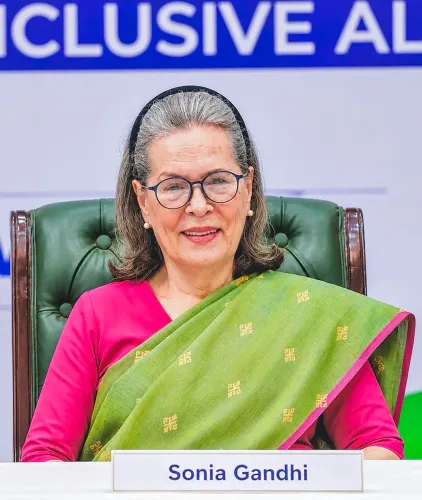
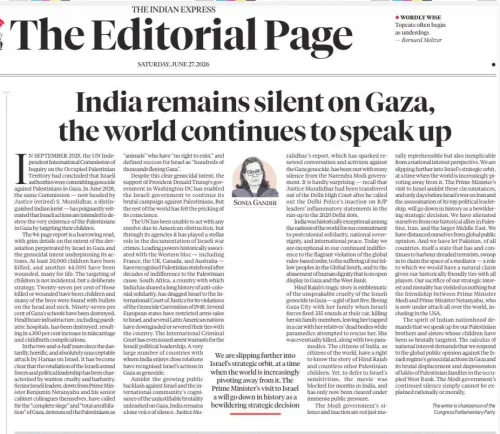
Congress MP Dr. Shashi Tharoor on Saturday, June 27, 2026, publicly endorsed an op-ed authored by senior Congress leader Smt Sonia Gandhi, calling it a 'powerful call to our collective conscience' on India's posture toward Israel amid the ongoing humanitarian crisis in Gaza.
Context
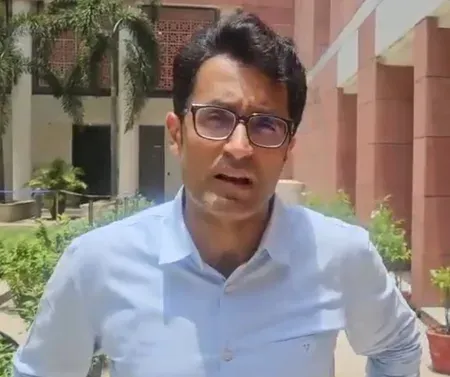
Tharoor's post amplified Sonia Gandhi's op-ed, which urged India to weigh its moral convictions against the backdrop of its strategic partnerships. Tharoor wrote that while India 'respects the sound security and technology partnerships India enjoys with Israel and values its support,' that relationship 'cannot mean abandoning our moral convictions in the face of the horrors.' The statement is notable for its dual acknowledgement — affirming the bilateral partnership while simultaneously invoking a humanitarian red line.
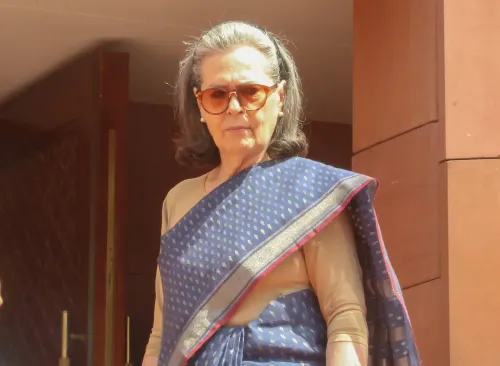
The op-ed by Sonia Gandhi, a former president of the Indian National Congress, represents a rare direct intervention by a senior party figure on a live foreign-policy question. Tharoor, a former UN Under-Secretary-General with deep expertise in international affairs, lent his voice to reinforce its reach and credibility.
Policy Backdrop
India established full diplomatic relations with Israel in 1992, and the two countries have since built one of South Asia's most consequential defence and technology partnerships, covering missile systems, surveillance equipment, and agricultural technology. At the same time, India has historically voted in support of Palestinian self-determination at the United Nations, a posture rooted in its non-alignment tradition and solidarity with decolonisation movements.
The Congress party has a particularly long record on this question — it backed recognition of the Palestine Liberation Organisation (PLO) in the 1980s and has consistently advocated for a two-state solution. The current statements by both Sonia Gandhi and Tharoor sit squarely within that tradition, though they arrive at a moment of heightened international scrutiny over the scale of civilian suffering in Gaza.
Indian foreign policy under successive governments has navigated a careful balance: deepening security cooperation with Israel while maintaining rhetorical support for Palestinian rights. Opposition parties have periodically invoked humanitarian concerns during escalations, creating a recurring domestic debate over the consistency between strategic interests and stated moral positions.
Stakeholders and Impact
The statement carries weight across multiple constituencies. For the Indian defence sector, any political pressure on the India-Israel relationship has procurement implications, given Israel's role as one of India's top arms suppliers. For Palestinian civilians, statements from prominent Indian political figures carry symbolic significance, as India holds considerable diplomatic weight in the Global South.
Domestically, the Congress party's vocal stance creates pressure on the ruling government to articulate its own position more clearly, particularly ahead of any upcoming votes at the UN General Assembly or the Human Rights Council on Gaza-related resolutions. Tharoor's profile as a former senior UN official gives the argument additional authority in multilateral diplomatic circles.
What's Next
India's votes on Gaza-related resolutions at the UN General Assembly and the Human Rights Council will be closely watched as a test of how the government reconciles its security partnership with Israel against the humanitarian pressure articulated by opposition voices. Any scheduled high-level defence or technology reviews with Israel will similarly attract scrutiny.
The intervention by two of the Congress party's most prominent figures signals that India-Israel ties and the Palestinian question will remain live political issues, with the opposition framing moral accountability as inseparable from strategic calculation.
Point of View
Since any defence of the partnership risks being cast as indifference to civilian suffering. The episode reflects a broader global pattern in which opposition parties in democracies with Israel ties are using the Gaza crisis to force a public reckoning on the limits of strategic partnerships.
NationPress
27 Jun 2026
Frequently Asked Questions
What did Shashi Tharoor say about India and Israel?
Tharoor said India's security and technology partnership with Israel is valuable, but that it cannot mean abandoning India's moral convictions in the face of the humanitarian horrors in Gaza. He made the statement while endorsing an op-ed by Sonia Gandhi.
What is Sonia Gandhi's op-ed about?
Sonia Gandhi's op-ed, endorsed by Tharoor on June 27, 2026, is described as a call to India's 'collective conscience' regarding the humanitarian situation in Gaza and India's moral responsibilities alongside its strategic partnerships.
What is India's relationship with Israel?
India established full diplomatic relations with Israel in 1992 and has since built one of its most significant defence and technology partnerships, covering missile systems, surveillance equipment, and agricultural technology. Israel is among India's top arms suppliers.
Has India historically supported Palestine?
Yes. India has historically voted in support of Palestinian self-determination at the United Nations. The Congress party backed recognition of the PLO in the 1980s and has long advocated for a two-state solution.
Why does India's vote at the UN on Gaza matter?
India's votes at the UN General Assembly and Human Rights Council on Gaza-related resolutions are seen as a direct indicator of how the government balances its strategic partnership with Israel against its stated commitment to Palestinian rights and humanitarian principles.