Priyanka Gandhi shares Sonia's attack on Modi's Gaza silence
Synopsis
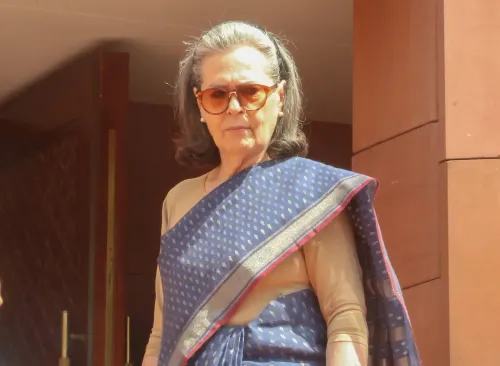
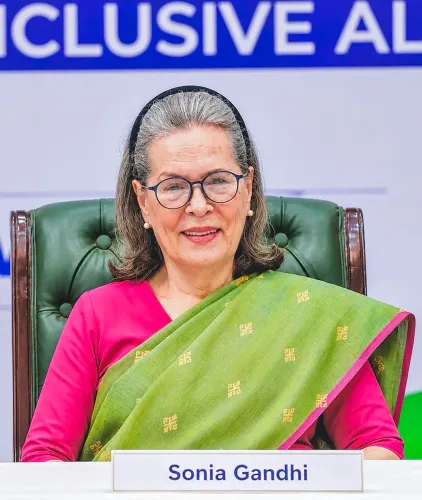
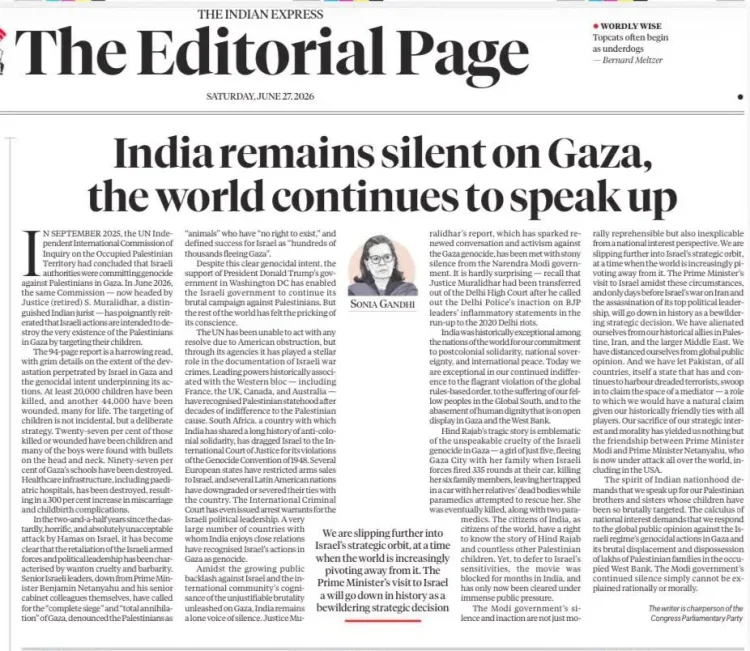
Congress Parliamentary Party Chairperson Sonia Gandhi has called the Modi government's silence on Israeli military actions in Gaza and Palestinian displacement in the West Bank inexplicable 'rationally or morally,' with Congress general secretary Priyanka Gandhi Vadra amplifying the statement on 27 June 2026.
Key Takeaways
Congress general secretary Priyanka Gandhi Vadra shared a statement by CPP Chairperson Sonia Gandhi on 27 June 2026 attacking the government's Gaza silence.
The statement says 'the calculus of national interest' demands India respond to global opinion against Israeli actions in Gaza and displacement of lakhs of Palestinian families in the occupied West Bank .
India recognised Palestinian statehood in 1988 and voted for Palestine's UNESCO membership in 2011 under a Congress-led government.
Since 2014 , the Modi government has deepened ties with Israel while maintaining rhetorical support for Palestinian rights at the UN .
Congress has a long record of advocating Palestinian self-determination, and the statement signals unified party messaging on the issue.
India's future votes at the UN General Assembly and Human Rights Council on Gaza-related resolutions will be closely watched.
Congress general secretary Priyanka Gandhi Vadra on Saturday, 27 June 2026 shared a statement by Congress Parliamentary Party Chairperson Sonia Gandhi sharply criticising the Modi government for its continued silence on Israeli military actions in Gaza and the displacement of Palestinian families in the occupied West Bank.
Context
The statement, attributed to Smt. Sonia Gandhi ji, CPP Chairperson, argues that 'the calculus of national interest demands that we respond to the global public opinion against the Israeli regime's genocidal actions in Gaza and its brutal displacement and dispossession of lakhs of Palestinian families in the occupied West Bank.' It concludes that 'the Modi government's continued silence simply cannot be explained rationally or morally.'
By amplifying the statement on her personal account, Priyanka Gandhi Vadra — Lok Sabha MP from Wayanad, Kerala and Congress general secretary in charge of Uttar Pradesh — extended its reach to her large social-media following, signalling unified party messaging on the issue.
Policy Backdrop
India recognised Palestinian statehood in 1988 and has long endorsed a two-state solution to the Israel-Palestine conflict. The Congress-led UPA government voted in favour of Palestine's full UNESCO membership in 2011, reflecting a consistent policy posture across decades.
Since 2014, under the BJP-led government of Prime Minister Narendra Modi, India has deepened defence, technology and strategic cooperation with Israel while simultaneously maintaining rhetorical support for Palestinian rights at the United Nations. This dual-track approach has drawn periodic criticism from opposition parties who argue it amounts to effective silence when Israeli military actions escalate.
Full diplomatic relations between India and Israel were established in 1992, and the bilateral relationship has expanded significantly in subsequent decades, particularly in the areas of defence procurement and agricultural technology.
Stakeholders and Impact
The Congress statement is directed at multiple audiences simultaneously: the foreign policy establishment, which manages India's balancing act between its Israel relationship and its Arab-world partnerships; and Muslim voters, a constituency that has historically been attentive to the party's stance on Palestinian rights.
Opposition parties have periodically faulted the government for avoiding public criticism of Israeli actions, citing both domestic electoral calculations and India's expanding strategic interests. The invocation of 'global public opinion' in the statement is a deliberate framing, positioning India's silence as an outlier in an international context where many governments have issued formal statements or recalled ambassadors.
Palestinian representatives and Arab-world interlocutors who engage with New Delhi diplomatically will also be watching whether this opposition pressure produces any shift in the government's public posture.
What's Next
Attention will now turn to India's voting record on any forthcoming UN General Assembly or Human Rights Council resolutions concerning Gaza, and to official statements during the next scheduled India-Israel strategic dialogue. The Congress party's renewed pressure could intensify if the government continues to withhold a formal public position. Any government response — or the absence of one — is likely to become a flashpoint in parliamentary proceedings.
Point of View
Using the moral language of 'genocide' and 'dispossession' to frame the government's posture not merely as a strategic choice but as an ethical failure. By routing the statement through Priyanka Gandhi Vadra's social-media platform, the party ensures maximum visibility while keeping the formal attribution with the senior CPP Chairperson. This dual-track communication mirrors the very balancing act Congress accuses the government of practising in its Israel-Palestine diplomacy. The pressure is calibrated to resonate with both domestic constituencies and India's diplomatic partners in the Arab world ahead of any UN vote on Gaza.
NationPress
25 Sept 2026
Frequently Asked Questions
What did Sonia Gandhi say about Modi and Gaza?
Sonia Gandhi, as CPP Chairperson, said the 'calculus of national interest' demands India respond to global opinion against Israeli actions in Gaza and Palestinian displacement in the West Bank, calling the Modi government's silence inexplicable 'rationally or morally.'
Why is Congress criticising India's stance on Gaza?
Congress argues that India's historical support for Palestinian statehood and its non-aligned foreign policy tradition oblige it to publicly oppose Israeli military actions in Gaza, and that silence undermines both India's credibility and its stated values.
What is India's official position on the Israel-Palestine conflict?
India has long supported a two-state solution and recognised Palestinian statehood in 1988. Since 2014, the Modi government has deepened ties with Israel while continuing rhetorical support for Palestinian rights at the United Nations.
Who is Sonia Gandhi in Indian politics?
Sonia Gandhi is the Chairperson of the Congress Parliamentary Party and a former president of the Indian National Congress, one of India's principal opposition parties.
What will India's next steps on Gaza be?
Key indicators to watch include India's vote on forthcoming UN General Assembly or Human Rights Council resolutions on Gaza, and any official statements made during the next India-Israel strategic dialogue.