Sonia Gandhi's 7 op-eds in 2 years: Three on Gaza, Iran spark debate

Synopsis
Sonia Gandhi has written seven opinion pieces in two years — three targeting India's stance on Gaza and Iran. Government sources say the record contradicts her 'silence' charge, citing Iran's own praise for Modi's diplomacy. Analysts argue the pattern looks less like foreign policy scrutiny and more like targeted electoral messaging.
Key Takeaways
Sonia Gandhi has authored seven op-eds in two years, with three focused on Gaza and Iran .
Gandhi accuses the Centre of 'silence' and 'abdication' on Gaza ; government sources reject the charge, citing consistent support for a two-state solution and humanitarian aid.
Iranian President Masoud Pezeshkian reportedly called India a 'trusted friend' and thanked PM Modi for advocacy on dialogue and de-escalation.
The Iranian Embassy in India publicly praised India's 'balanced diplomatic approach.' BJP leaders and political analysts question Gandhi's silence on the persecution of Hindus in Bangladesh , Afghan Sikhs, and Kashmiri Hindus.
Analysts argue the focus on West Asia is calibrated to appeal to Muslim voters ahead of future elections.
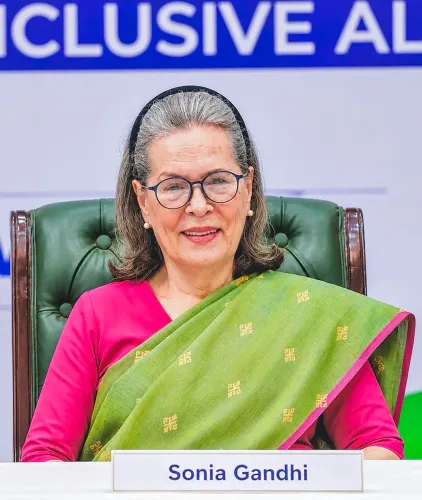
Congress leader Sonia Gandhi has authored seven opinion pieces over the past two years, with three of them centred on Gaza and Iran — a pattern that has ignited a fresh political debate in New Delhi over her foreign policy priorities and the intent behind her sustained criticism of the Prime Minister Narendra Modi-led government. The recurring focus on West Asia has prompted government sources and political observers to question whether the scrutiny reflects a genuine concern over India's diplomatic posture or a calculated appeal to domestic constituencies.
Gandhi's Charge and the Government's Rebuttal
In her latest op-ed, Gandhi accuses the Centre of maintaining 'silence' on Gaza and argues that India is drifting from its traditional foreign policy commitments. She describes the government's conduct as an 'abdication' of India's moral and diplomatic responsibilities in the region.
Government sources, however, firmly reject this characterisation. Officials point to New Delhi's repeated public support for a two-state solution, its humanitarian assistance to the Palestinian people, and its consistent advocacy for dialogue and de-escalation — positions maintained even while sustaining strong strategic ties with Israel.
Iran's Acknowledgement of India's Role
Government sources further note that India's diplomatic engagement has drawn international recognition. Earlier this year, Iranian President Masoud Pezeshkian reportedly described India as a 'trusted friend' during a conversation with Prime Minister Modi, thanking him for New Delhi's consistent push for dialogue and de-escalation amid heightened regional tensions. The Iranian Embassy in India also publicly commended India's humanitarian assistance and what it called a 'balanced diplomatic approach.'
Bharatiya Janata Party (BJP) leaders argue that this record directly contradicts Gandhi's framing. India has, they contend, neither abandoned Palestine nor uncritically aligned itself with Israel — instead maintaining a calibrated position that weighs humanitarian concerns, regional stability, energy security, and national interest.
The Pattern That Has Raised Questions
The concentration of Gandhi's writing on West Asia — three of seven op-eds over two years — has prompted government sources to raise what they describe as a legitimate political question: why do these issues attract repeated attention while humanitarian crises closer to India's immediate strategic neighbourhood receive comparatively little coverage in her writing?
Political analysts argue that Gandhi's repeated criticism over Gaza is calibrated to resonate with sections of Muslim voters ahead of future elections, rather than to advance a substantive foreign policy debate. They suggest the Congress leadership may be attempting to read India's external affairs through a domestic political lens.
Selective Outrage, Critics Say
Political observers have noted an apparent asymmetry in Gandhi's public interventions. They point out that she has not been equally vocal — at least not in op-ed form — on issues such as the reported persecution of Hindus in Bangladesh, the exodus of Afghan Sikhs following the Taliban's return to power, or the displacement of Kashmiri Hindus.
BJP leaders argue this 'selective' emphasis reflects political priorities rather than a consistent human rights perspective. Analysts add that a credible foreign policy critique would engage with the full spectrum of India's neighbourhood concerns, not a subset that aligns with particular electoral calculations.
As Gandhi's next op-ed is awaited, the debate over the line between principled dissent and political positioning in Indian foreign policy commentary looks set to sharpen further.
Point of View
But for what it consistently omits. A genuine human rights framework would engage with the full arc of India's neighbourhood — Bangladesh, Afghanistan, Kashmir — not only the issues with the clearest domestic electoral resonance. The government's diplomatic record on West Asia is more nuanced than the 'silence' framing allows: Iran's own acknowledgement of Modi's role is a detail that any serious foreign policy critique must reckon with. The deeper question is whether Indian opposition politics has the appetite for a foreign policy debate that is inconvenient on all sides — or whether op-eds will continue to function as targeted constituency messaging dressed in the language of principle.
NationPress
26 Sept 2026
Frequently Asked Questions
How many op-eds has Sonia Gandhi written in the past two years?
Sonia Gandhi has authored seven opinion pieces over the past two years, with three of them focused on Gaza or Iran, according to government sources who flagged the pattern as politically motivated.
What is Sonia Gandhi's main criticism of the Modi government on Gaza?
Gandhi accuses the Centre of maintaining 'silence' on Gaza and describes India's conduct as an 'abdication' of its moral and diplomatic responsibilities in West Asia, arguing that India is drifting from its traditional foreign policy.
How has the government responded to Gandhi's charge of silence on Gaza?
Government sources reject the charge, pointing to India's repeated support for a two-state solution, humanitarian assistance to Palestinians, and diplomatic engagement in the region — including acknowledgement from Iranian President Masoud Pezeshkian, who reportedly called India a 'trusted friend.'
Why do BJP leaders and analysts question Gandhi's foreign policy criticism?
Critics argue her focus is selective — she has not written op-eds on the reported persecution of Hindus in Bangladesh, the exodus of Afghan Sikhs after the Taliban's return, or the displacement of Kashmiri Hindus. BJP leaders contend this reflects political rather than principled priorities.
Is India's West Asia policy actually aligned with Israel against Palestine?
Analysts say no. India has maintained what officials describe as a calibrated position — supporting Palestinian humanitarian needs and a two-state solution while sustaining strategic ties with Israel. Iran's public praise for India's 'balanced diplomatic approach' is cited as evidence of this posture.