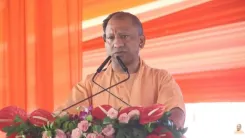
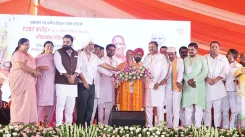
CM Bhajan Lal Reaffirms Push to Reach Last Person with Schemes
Synopsis
The Chief Minister's Office of Rajasthan, on 18 July 2026, reaffirmed CM Bhajan Lal Sharma's government commitment to delivering welfare scheme benefits to the last person and integrating villages into the development mainstream, under the campaign banner 'Aapno Agrni Rajasthan'.
Key Takeaways
The Chief Minister's Office of Rajasthan posted on 18 July 2026 reaffirming the government's objective of last-mile welfare delivery.
Chief Minister Bhajan Lal Sharma , who came to power after the December 2023 assembly elections, was directly tagged in the post.
The government stated it is 'continuously working' to connect villages to the mainstream of development.
The post carried the hashtag #आपणो_अग्रणी_राजस्थान ('Our Leading Rajasthan'), a recurring campaign identity of the current BJP administration.
No specific new scheme or financial outlay was announced; the post reflects ongoing administrative messaging on rural outreach.
Rajasthan's large rural and geographically dispersed population makes last-mile delivery a central governance challenge for successive state administrations.
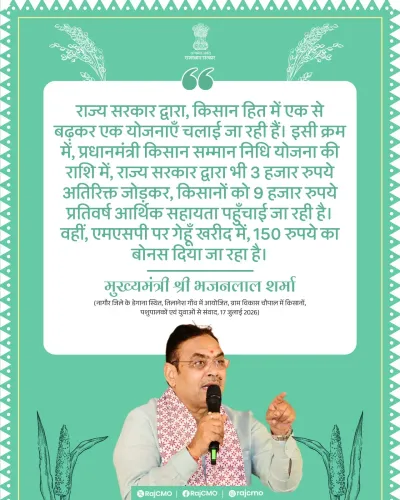
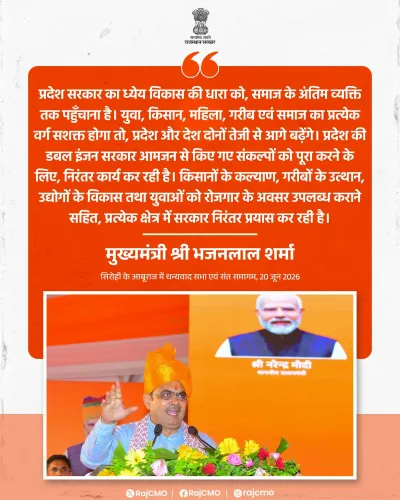
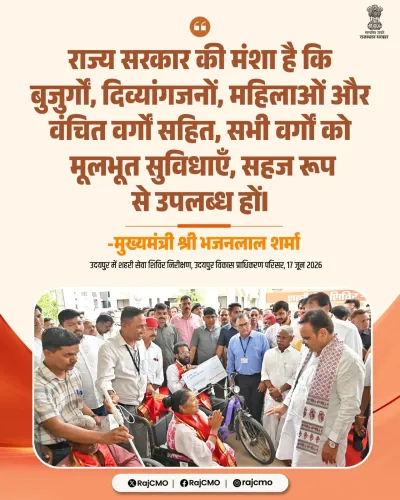
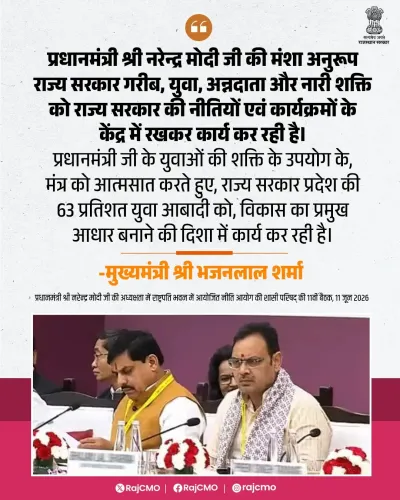
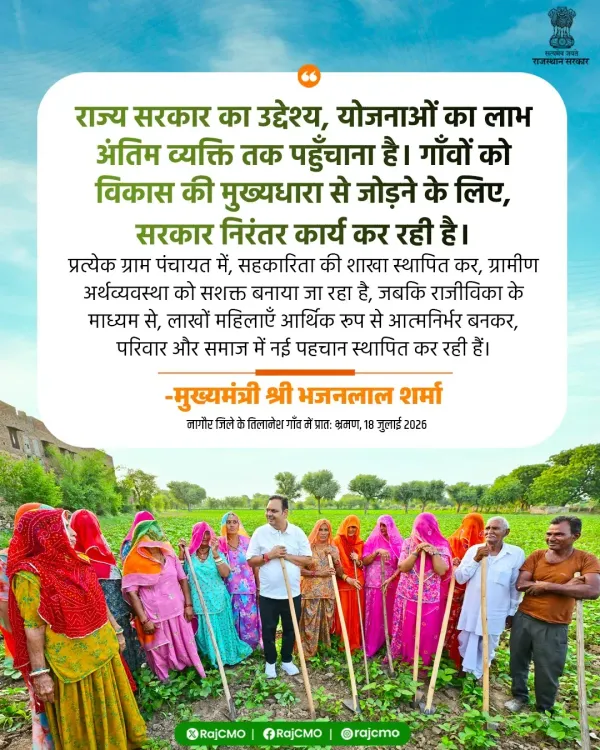
The Chief Minister's Office of Rajasthan reaffirmed on Saturday, 18 July 2026 that the state government's core objective is to deliver the benefits of welfare schemes to the last person in the queue, with a specific emphasis on connecting villages to the mainstream of development.
The post, attributed to the office of Chief Minister Bhajan Lal Sharma and tagged to his personal account @BhajanlalBjp, stated in Hindi: 'राज्य सरकार का उद्देश्य, योजनाओं का लाभ अंतिम व्यक्ति तक पहुँचाना है' ('The state government's objective is to deliver the benefits of schemes to the last person'). The message was accompanied by the hashtag #आपणो_अग्रणी_राजस्थान ('Our Leading Rajasthan'), a recurring campaign identity used by the current administration.
Context
Rajasthan is one of India's largest states by area and carries a substantial rural population spread across remote districts, making last-mile delivery of government schemes a persistent administrative challenge. The BJP government under Chief Minister Bhajan Lal Sharma, which came to power after the December 2023 state assembly elections, has consistently framed its governance priorities around rural outreach and welfare delivery.
The phrasing 'last person' echoes the Antyodaya philosophy — the principle of prioritising the most marginalised — which has been a touchstone of welfare policy discourse in India since the mid-2010s. The CMO's messaging reflects this vocabulary, positioning the administration as one focused on grassroots impact rather than headline-level announcements.
Policy Backdrop
Since assuming office, the Sharma government has stated rural connectivity and scheme penetration as twin pillars of its administrative agenda. Rajasthan's vast geography — encompassing desert terrain, tribal belts, and agrarian hinterlands — means that welfare entitlements such as housing, health coverage, and agricultural support often require active administrative effort to reach intended beneficiaries.
State governments across India have increasingly used digital outreach, gram sabha-level camps, and district-level review mechanisms to track scheme saturation. The CMO's post, while not announcing a specific new programme, signals a continued institutional emphasis on this delivery framework.
Stakeholders and Impact
The primary beneficiaries of this stated policy direction are rural villagers and welfare scheme recipients across Rajasthan's districts — particularly those in geographically remote or economically vulnerable communities. For these populations, the gap between scheme announcement and actual benefit receipt has historically been the critical point of failure in public delivery systems.
Local administrative bodies, gram panchayats, and district collectors are the key implementation nodes through which such commitments are operationalised. The CMO's public reiteration of this objective can also be read as a signal to the bureaucracy to maintain focus on ground-level execution.
What's Next
Concrete progress on this stated objective is likely to be assessed at upcoming Rajasthan budget sessions and district-level scheme review meetings, where the government may be expected to present quantified data on rural scheme coverage and beneficiary reach. The hashtag #आपणो_अग्रणी_राजस्थान suggests this messaging is part of a broader, ongoing communications campaign rather than a one-off statement.
Observers and opposition parties will watch for specific metrics — such as the number of villages newly brought under flagship schemes or the percentage of eligible beneficiaries enrolled — to evaluate whether the administration's stated commitment translates into measurable ground-level change.
Point of View
Now past its mid-term phase, such communications serve a dual purpose: reinforcing the BJP's pro-poor brand identity and signalling administrative seriousness to a bureaucracy that can become complacent without visible political pressure. The absence of specific scheme names or numbers, however, means the statement remains aspirational until backed by district-level data. The broader pattern suggests that the real test will come at the next budget or scheme-review cycle, when opposition parties and civil society will demand quantified proof of rural penetration.
NationPress
18 Jul 2026
Frequently Asked Questions
What did the Rajasthan CMO post on 18 July 2026?
The Chief Minister's Office of Rajasthan posted that the state government's objective is to deliver welfare scheme benefits to the last person, and that it is continuously working to connect villages to the mainstream of development.
Who is the Chief Minister of Rajasthan in 2026?
Bhajan Lal Sharma of the BJP is the Chief Minister of Rajasthan, having been sworn in after the December 2023 state assembly elections.
What does 'last-mile delivery' mean in the context of Indian welfare schemes?
Last-mile delivery refers to ensuring that government welfare benefits — such as housing, health coverage, or agricultural support — actually reach the most remote and marginalised beneficiaries, rather than being absorbed at intermediate administrative levels.
What is the meaning of the hashtag #आपणो_अग्रणी_राजस्थान?
The hashtag translates from Rajasthani/Hindi as 'Our Leading Rajasthan' and is a campaign identity used by the current BJP administration in Rajasthan to brand its governance and communications.
What is the Antyodaya principle and how does it relate to Rajasthan's governance?
Antyodaya — meaning 'rise of the last person' — is a welfare philosophy that prioritises the most marginalised citizens. The Rajasthan CMO's emphasis on reaching the 'last person' with scheme benefits directly echoes this principle, which has been a central plank of Indian welfare policy discourse since the mid-2010s.