CM Bhajan Lal Holds Key Meet on Rajasthan Semiconductor Push
Synopsis
Rajasthan CM Bhajan Lal Sharma and Union Minister Ashwini Vaishnaw met industry representatives on 23 May 2026 to advance semiconductor unit establishment and electronics manufacturing investment in the state, citing the ₹1,200 crore Bhiwadi facility as a milestone.
Key Takeaways
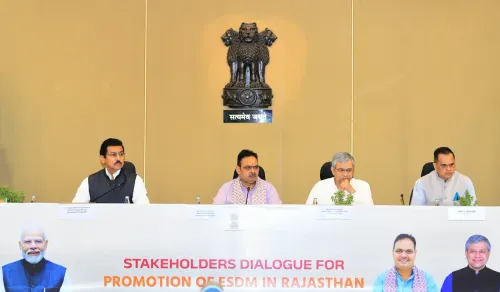
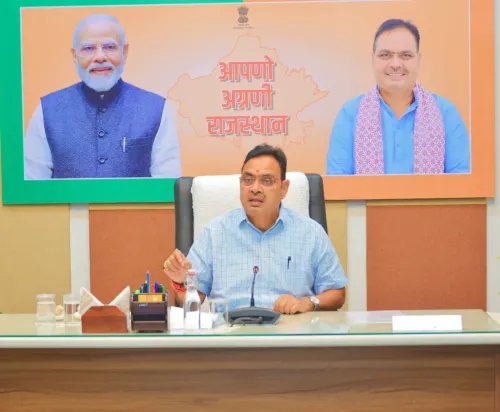
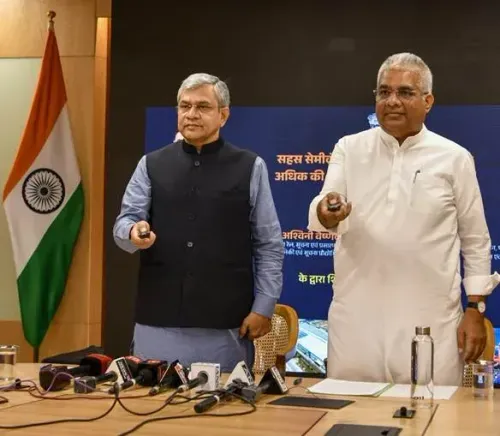
Rajasthan CM Bhajan Lal Sharma held a high-level meeting at the Chief Minister's Office on 23 May 2026 with Union Minister Ashwini Vaishnaw and electronics and semiconductor industry representatives.
Discussions covered the establishment of semiconductor units in Rajasthan, investment possibilities, and expansion of the electronics manufacturing sector.
Rajasthan's first semiconductor unit has been established in Bhiwadi at a cost of ₹1,200 crore .
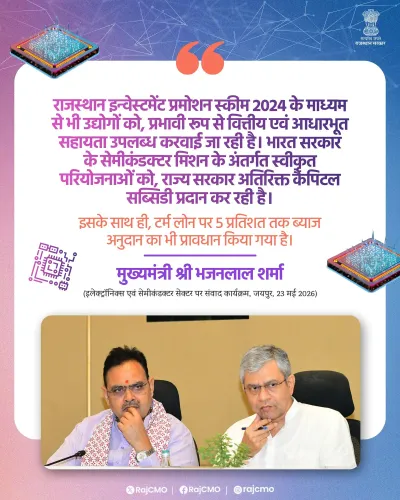
The state has introduced a dedicated Rajasthan Semiconductor Policy to attract investment through incentives and infrastructure support.
The state's push aligns with central programmes including Atmanirbhar Bharat , Digital India , and the India Semiconductor Mission launched in 2021.
The government has committed to ensuring ease of doing business and world-class infrastructure for semiconductor and electronics investors.
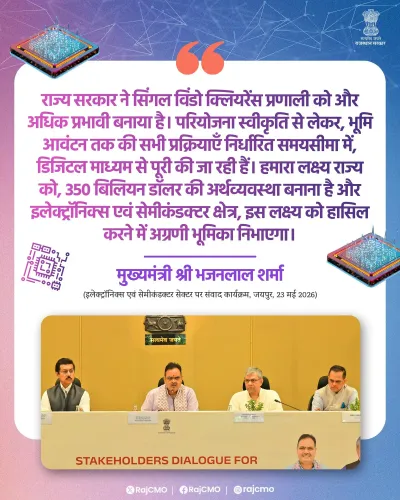
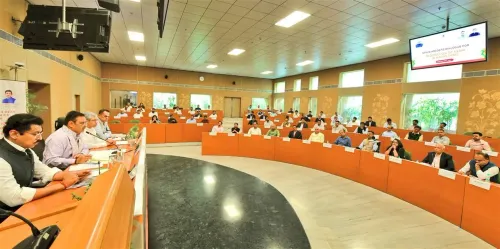
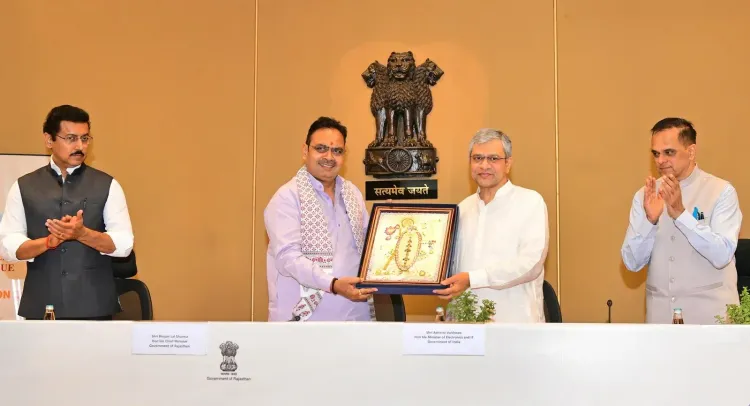
Rajasthan Chief Minister Bhajan Lal Sharma on Saturday, 23 May 2026, hosted a high-level meeting at the Chief Minister's Office in Jaipur with Union Minister Ashwini Vaishnaw and representatives from the electronics and semiconductor industry to explore investment opportunities and the expansion of electronics manufacturing in the state.
Context
The meeting brought together Union Minister for Railways, Information and Broadcasting, and Electronics and IT Ashwini Vaishnaw alongside industry stakeholders to discuss the establishment of semiconductor units in Rajasthan. CM Sharma described the discussions as wide-ranging, covering 'semikondaktar ikaiyon ki sthapna, nivesh ki sambhavnaon' — the setting up of semiconductor units and investment possibilities — as well as the broader expansion of the electronics manufacturing sector.
In his post, CM Sharma highlighted Bhiwadi as a symbol of Rajasthan's emerging semiconductor ambitions, pointing to the state's first semiconductor unit established there at a cost of ₹1,200 crore. He framed the development as evidence of the state's readiness to attract high-technology industry.
Policy Backdrop
Rajasthan's push is anchored in a dedicated Rajasthan Semiconductor Policy, which the state government has introduced to attract fabrication, assembly, and electronics manufacturing investments through incentives, infrastructure support, and an ease-of-doing-business framework. CM Sharma stated that the government is 'fully committed to ensuring every necessary facility for the establishment and expansion of industries in the state.'
At the national level, the India Semiconductor Mission, launched in 2021, and the Production Linked Incentive (PLI) scheme for large-scale electronics manufacturing have provided the policy scaffolding that state-level initiatives like Rajasthan's are designed to complement. The broader Atmanirbhar Bharat programme, launched in 2020, and the Digital India initiative — running since 2015 — explicitly identify semiconductor and electronics manufacturing as strategic national priorities. CM Sharma invoked both programmes, crediting Prime Minister Narendra Modi's 'visionary leadership' for positioning Rajasthan as an emerging hub.
Several Indian states have introduced dedicated semiconductor or electronics policies in recent years, competing to attract investment from global and domestic firms. Rajasthan's steps align with a national effort to distribute manufacturing capacity beyond traditional IT corridors.
Stakeholders and Impact
The primary beneficiaries of any expansion would be semiconductor investors, electronics manufacturers, and the broader industrial ecosystem in Rajasthan's existing manufacturing belts, including Bhiwadi in the Alwar district — already part of the Delhi-Mumbai Industrial Corridor. A successful scale-up could generate skilled employment and deepen the state's integration into national and global electronics supply chains.
Industry representatives present at the meeting signal that private-sector interest is being actively cultivated at the state level, with the government positioning itself as a facilitator through transparent processes and world-class infrastructure, as stated by the Chief Minister.
What's Next
Attention will now turn to whether the discussions translate into formal memoranda of understanding or investment commitments under the Rajasthan Semiconductor Policy. The central approval timeline for any new units proposed during the meeting, and the operational progress of the ₹1,200 crore Bhiwadi facility, will be key indicators of how quickly the state's semiconductor ambitions move from policy to production. Rajasthan's ability to convert high-level political engagement into on-ground investment will determine its standing in the increasingly competitive race among Indian states for semiconductor manufacturing capacity.
Point of View
Hosting Union Minister Vaishnaw alongside industry at the Chief Minister's Office is as much a political signal as a policy one, reinforcing the BJP government's narrative of economic transformation ahead of future electoral cycles. The ₹1,200 crore Bhiwadi unit gives the state a concrete anchor for its pitch, distinguishing it from states still at the aspiration stage. Whether this translates into a pipeline of new units will depend on how quickly land, power, and water commitments can be formalised under the state's semiconductor policy.
NationPress
7 Oct 2026
Frequently Asked Questions
What was discussed in the Rajasthan semiconductor meeting on 23 May 2026?
The meeting at the Chief Minister's Office in Jaipur, attended by CM Bhajan Lal Sharma, Union Minister Ashwini Vaishnaw, and industry representatives, focused on establishing semiconductor units in Rajasthan, exploring investment possibilities, and expanding the electronics manufacturing sector.
What is the Bhiwadi semiconductor unit and how much did it cost?
The Bhiwadi semiconductor unit is Rajasthan's first semiconductor manufacturing facility, established at a reported cost of ₹1,200 crore. It is cited by the state government as proof of Rajasthan's emergence as a high-technology investment destination.
What is the Rajasthan Semiconductor Policy?
The Rajasthan Semiconductor Policy is a state-level framework introduced to attract semiconductor fabrication, assembly, and electronics manufacturing investments by offering incentives, world-class infrastructure, and an ease-of-doing-business environment.
How does Rajasthan's semiconductor push connect to central government schemes?
Rajasthan's efforts align with the central government's India Semiconductor Mission (2021), the PLI scheme for electronics manufacturing, the Atmanirbhar Bharat programme (2020), and the Digital India initiative (2015), all of which prioritise domestic semiconductor and electronics production.
Who is Ashwini Vaishnaw and why was he at the Rajasthan CM's office?
Ashwini Vaishnaw is the Union Minister holding the portfolios of Railways, Information and Broadcasting, and Electronics and IT. He attended the meeting to discuss semiconductor investment opportunities and electronics manufacturing expansion in Rajasthan alongside CM Bhajan Lal Sharma and industry representatives.