Rajasthan launches first semiconductor cluster in Bhiwadi, targets global chip supply chain
Synopsis
Rajasthan has quietly become India's most ambitious semiconductor newcomer. The Bhiwadi cluster — India's first SME-focused chip facility — already has ₹900 crore invested and 2,700 jobs running, with capacity set to grow tenfold. Backed by a dedicated state policy and national mission funding, this is Rajasthan's clearest bet yet on moving beyond textiles and tourism.
Key Takeaways
Rajasthan's first semiconductor cluster launched in Bhiwadi on 19 May 2025 , jointly developed by 20 companies .
The facility is also India's first SME-focused semiconductor cluster , located in the Salarpur-Khushkhera region.
Investment proposals exceed ₹1,200 crore ; 11 companies are operational with ₹900 crore invested and 2,700 jobs created.
Annual semiconductor packaging capacity is currently 60 million units , targeted to reach 400–600 million units within two to three years.
The Rajasthan Semiconductor Policy-2026 , announced in March 2026 , underpins the push with Single Window clearances and dedicated semiconductor corridors.
The Union Budget 2026–27 has allocated ₹1,000 crore for India Semiconductor Mission 2.0 , which the state's plans align with.
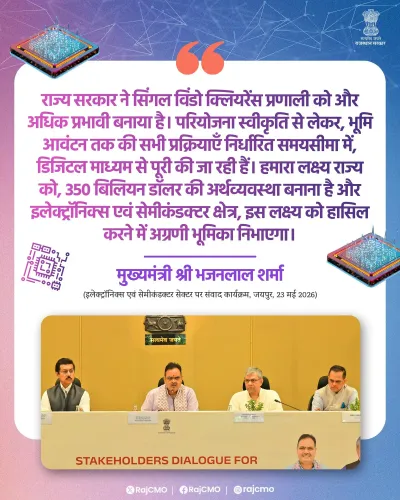
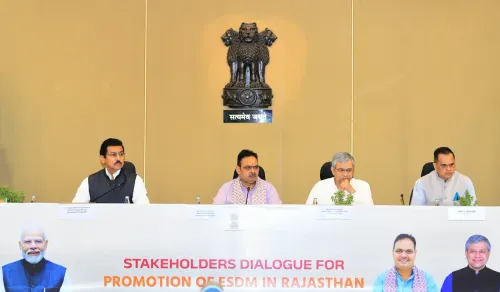
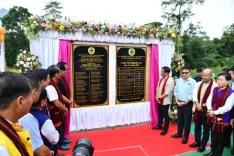
Rajasthan has taken a decisive step toward becoming India's next major semiconductor manufacturing hub, with the Bharatiya Janata Party (BJP)-led state government on Tuesday, 19 May formally unveiling the state's first semiconductor cluster in Bhiwadi. The move signals a structural shift from Rajasthan's traditional industrial base toward a high-technology economy anchored in the vision of 'Viksit Rajasthan-2047'.
The cluster, a greenfield electronics manufacturing facility established in the Salarpur-Khushkhera region of Bhiwadi, is being jointly developed by 20 companies and carries the distinction of being not only Rajasthan's first semiconductor cluster but also India's first semiconductor facility focused on Small and Medium Enterprises (SMEs).
Investment and Operations So Far
The project has already drawn investment proposals worth more than ₹1,200 crore. Of these, 11 companies have commenced operations with cumulative investments of approximately ₹900 crore, generating employment for nearly 2,700 people.
The cluster currently hosts industries engaged in semiconductor packaging, electronic components, Radio Frequency Identification (RFID) products, Electric Vehicle (EV) components, and air-conditioner manufacturing. Its annual semiconductor packaging capacity stands at nearly 60 million units, with plans to scale this to between 400 million and 600 million units within the next two to three years.
Plans are also underway to manufacture products using advanced packaging technologies, alongside SSDs, DRAMs, and other data-storage solutions.
The Policy Framework Driving the Push
State officials say the Rajasthan Semiconductor Policy-2026, announced in March 2026, is central to positioning the state as a preferred investment destination for chip and electronics manufacturers. Under the policy, the state is developing semiconductor corridors in regions including Jodhpur-Pali-Marwar and the Kankani Industrial Area.
Industries are being offered faster land allotment, infrastructure support, uninterrupted electricity and water supply, improved connectivity, and Single Window clearances to facilitate rapid industrial growth. The policy specifically targets investment in Outsourced Semiconductor Assembly and Test (OSAT), Assembly, Testing, Marking and Packaging (ATMP), sensors, and advanced electronics manufacturing.
Alignment with the National Semiconductor Mission
Rajasthan's push dovetails with India's broader ambitions in chip manufacturing. The India Semiconductor Mission, launched in 2021, marked the country's first concerted effort toward technological self-reliance in semiconductors. The Union Budget 2026–27 has further allocated ₹1,000 crore for India Semiconductor Mission 2.0, with a focus on industry-led research, training centres, and workforce development.
Officials say Rajasthan's expansion aligns closely with the national mission and will help India strengthen its role across the full semiconductor value chain — spanning chip design, packaging, research, equipment manufacturing, and global supply networks. This comes amid intensifying global competition for semiconductor self-sufficiency, with the United States, China, Taiwan, and South Korea having long dominated the ecosystem.
Employment and Skill Development Outlook
Beyond the factory floor, the semiconductor push is expected to create opportunities in electronics engineering, chip design, robotics, machine automation, artificial intelligence, quality control, and advanced manufacturing. The state government is simultaneously running skill development programmes to ensure Rajasthan's youth are equipped for careers in these emerging sectors.
Officials say the long-term vision extends beyond attracting global capital — the goal is to establish Rajasthan as a centre for innovation, entrepreneurship, and advanced electronics manufacturing, with Bhiwadi's new cluster as the first proof point.
Point of View
But the real test lies in execution depth. India's chip ambitions have historically stumbled at the transition from policy announcement to operational fab — the Bhiwadi cluster's SME focus is a pragmatic workaround, but OSAT and packaging are the lower rungs of the value chain. The state's ability to move upstream into chip design and advanced packaging will determine whether this is a genuine industrial transformation or another investment-proposal headline. With China aggressively expanding its own packaging capacity and Taiwan defending its fab dominance, Rajasthan has a narrow but real window to carve a niche — if skill pipelines and infrastructure commitments hold.
NationPress
7 Oct 2026
Frequently Asked Questions
What is the Rajasthan semiconductor cluster in Bhiwadi?
It is a greenfield electronics manufacturing cluster in the Salarpur-Khushkhera region of Bhiwadi, jointly developed by 20 companies. It is Rajasthan's first semiconductor cluster and India's first semiconductor facility focused on Small and Medium Enterprises (SMEs), with investment proposals exceeding ₹1,200 crore.
How many jobs has the Bhiwadi semiconductor cluster created so far?
As of the launch on 19 May 2025, 11 companies have commenced operations with investments of around ₹900 crore, generating employment for nearly 2,700 people. The cluster is expected to create significantly more jobs as capacity scales.
What is the Rajasthan Semiconductor Policy-2026?
Announced in March 2026, it is the state government's framework to attract semiconductor and electronics investment by offering faster land allotment, Single Window clearances, uninterrupted utilities, and dedicated semiconductor corridors in regions such as Jodhpur-Pali-Marwar and Kankani Industrial Area. It targets OSAT, ATMP, sensors, and advanced electronics manufacturing.
How does Rajasthan's semiconductor push connect to the national India Semiconductor Mission?
India's Semiconductor Mission was launched in 2021 to reduce the country's dependence on foreign chip supply chains. The Union Budget 2026–27 allocated ₹1,000 crore for India Semiconductor Mission 2.0. Rajasthan officials say the state's cluster and policy align directly with this national framework, covering chip design, packaging, and supply chain integration.
What products will the Bhiwadi cluster manufacture?
The cluster currently houses industries making semiconductor packages, electronic components, RFID products, EV components, and air conditioners. Future plans include advanced packaging technologies, SSDs, DRAMs, and other data-storage solutions, with packaging capacity expected to grow from 60 million to 400–600 million units annually.