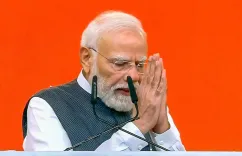
CM Bhajanlal Hosts Electronics & Semiconductor Dialogue in Jaipur
Synopsis
Chief Minister Bhajanlal Sharma and Union Minister Ashwini Vaishnaw addressed industry leaders at a semiconductor and electronics dialogue in Jaipur on 23 May 2026, spotlighting Rajasthan's Semiconductor Policy, the Bhiwadi cluster launch, and investor incentives under the double-engine government framework.
Key Takeaways
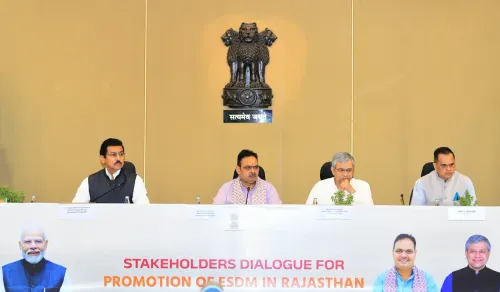
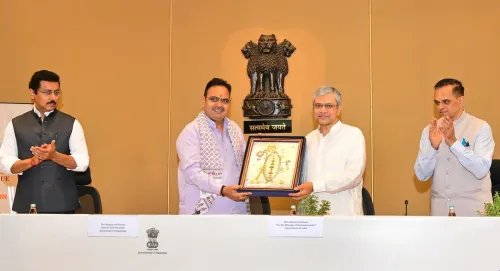
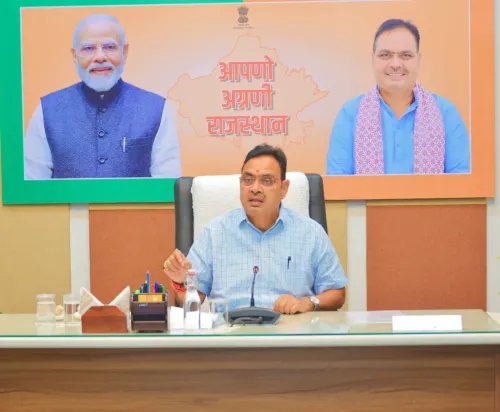
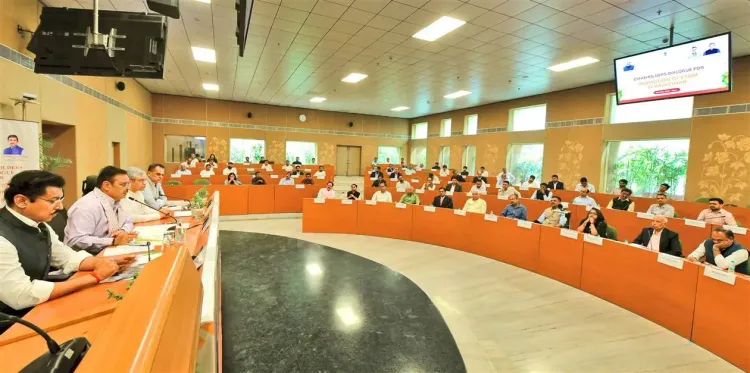
Chief Minister Bhajanlal Sharma hosted an Electronics and Semiconductor Sector Dialogue at the Chief Minister's Office in Jaipur on 23 May 2026 .
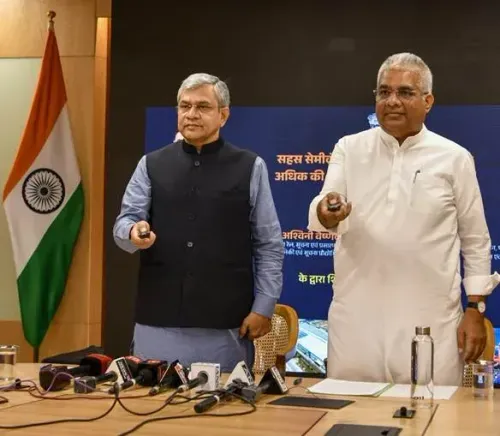
Union Minister Ashwini Vaishnaw stated that Rajasthan holds immense potential in electronics manufacturing and pledged full central government support.
The Rajasthan Semiconductor Policy has been implemented to build a dedicated ecosystem for semiconductor investment in the state.
Rajasthan's first semiconductor cluster has been launched in Bhiwadi , Alwar district.
Investors are being offered infrastructure support, a Digital Single Window System , and state incentive schemes.
The initiative aligns with the Centre's India Semiconductor Mission , backed by a ₹76,000 crore outlay announced in 2021.
The Chief Minister's Office of Rajasthan announced on Saturday, 23 May 2026 that Chief Minister Bhajanlal Sharma engaged with industry representatives, investors, and experts at an Electronics and Semiconductor Sector Dialogue held at the Chief Minister's Office in Jaipur, with Union Minister Ashwini Vaishnaw also addressing the gathering.
Context
The dialogue brought together stakeholders from the electronics manufacturing and semiconductor investment ecosystem. Union Minister Vaishnaw stated that Rajasthan holds 'apar sambhavnaein' ('immense possibilities') in electronics manufacturing, and that the 'double-engine government' — referring to aligned BJP governments at the Centre and in the state — would provide full support for industry establishment.
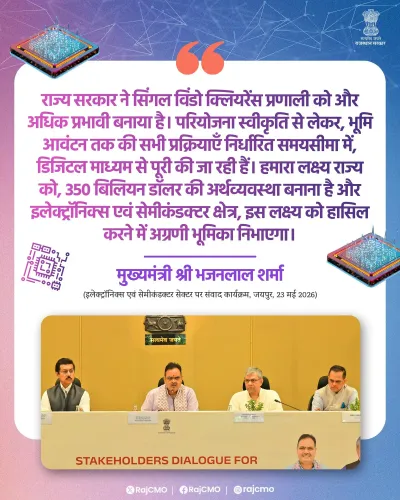
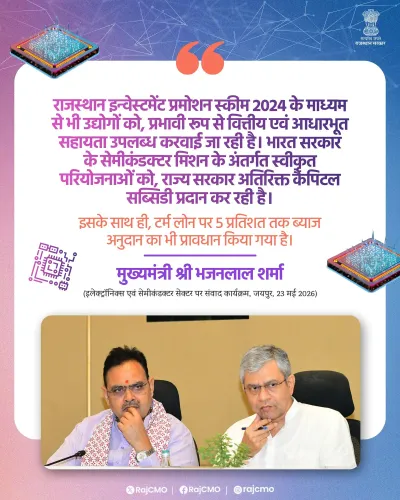
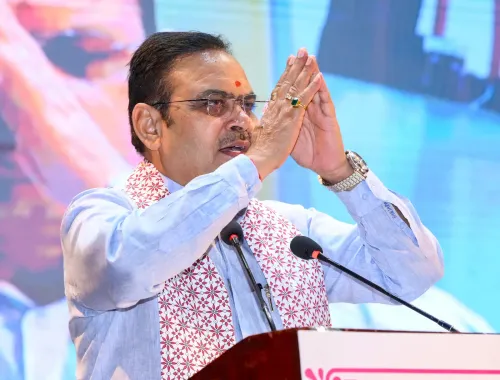
Chief Minister Bhajanlal Sharma highlighted that the state government has implemented the Rajasthan Semiconductor Policy to develop a stronger ecosystem for the sector, and that investors in the state are being offered infrastructure support, a Digital Single Window System, and the benefits of various incentive schemes.
Policy Backdrop
The event builds on the India Semiconductor Mission, launched by the Government of India in 2021 with an outlay of ₹76,000 crore, aimed at developing domestic semiconductor design and manufacturing capabilities and reducing the country's dependence on imports. Rajasthan's state-level semiconductor policy is positioned as a complementary layer to this national framework.
The Chief Minister specifically noted that Bhiwadi, an industrial hub in Alwar district, has seen the launch of the state's first semiconductor cluster — a significant milestone in translating policy into physical infrastructure. Similar cluster-based approaches have been adopted by states such as Gujarat and Tamil Nadu under the central mission.
Stakeholders and Impact
Electronics manufacturers, semiconductor investors, and technology experts participated in the dialogue, signalling the state's intent to position itself as a serious destination for high-technology investment. The Digital Single Window System is designed to ease regulatory clearances, a persistent concern cited by investors in the sector.
Coordinated central-state action — with the Union Minister personally present — is being presented as a guarantee of faster land, power, and regulatory support for prospective investors. The Bhiwadi cluster, once fully operational, is expected to serve as a nucleus for ancillary electronics supply-chain activity in the region.
What's Next
Attention will now turn to the pace of investment proposals and infrastructure rollout at the Bhiwadi semiconductor cluster, as well as the operationalisation of the incentive schemes outlined under the Rajasthan Semiconductor Policy. Future investor conclaves or formal project announcements from the state government will be key indicators of how quickly this dialogue translates into ground-level activity.
As India races to carve out a meaningful share of the global semiconductor supply chain, Rajasthan's ability to convert policy intent and ministerial-level signalling into tangible investment commitments will determine whether the state emerges as a credible electronics manufacturing hub alongside more established industrial states.
Point of View
Which has historically been the gap between intent and execution in Indian industrial strategy. Rajasthan enters this race later than Gujarat and Tamil Nadu, meaning the quality of its single-window implementation and incentive delivery — not just ministerial optics — will be the real differentiator. The event fits a broader national pattern where state governments are increasingly competing on policy sophistication, not just land and labour costs, to attract semiconductor and electronics capital.
NationPress
7 Oct 2026
Frequently Asked Questions
What is the Rajasthan Semiconductor Policy?
The Rajasthan Semiconductor Policy is a state-level framework introduced by the Bhajanlal Sharma government to build an ecosystem for semiconductor manufacturing and attract investment, offering infrastructure support, a Digital Single Window System, and financial incentives to investors.
Where is Rajasthan's first semiconductor cluster located?
Rajasthan's first semiconductor cluster has been launched in Bhiwadi , an industrial hub in Alwar district , as announced by Chief Minister Bhajanlal Sharma at the 23 May 2026 dialogue.
What is the India Semiconductor Mission and how does it relate to Rajasthan?
The India Semiconductor Mission was launched by the Government of India in 2021 with a ₹76,000 crore outlay to develop domestic semiconductor manufacturing and design. Rajasthan's state-level semiconductor policy is designed to complement this national mission by creating enabling infrastructure at the state level.
What did Ashwini Vaishnaw say about Rajasthan's electronics sector?
Union Minister Ashwini Vaishnaw said that Rajasthan holds immense possibilities in electronics manufacturing and that the double-engine government — aligned BJP governments at the Centre and in the state — would provide full support for industry establishment.
What facilities is Rajasthan offering to semiconductor investors?
Rajasthan is offering investors basic infrastructure, a Digital Single Window System for regulatory clearances, and the benefits of various state incentive schemes under the Rajasthan Semiconductor Policy.