Rajasthan Offers Extra Capital Subsidy for India Semiconductor Mission Projects
Synopsis
The Rajasthan Chief Minister's Office announced on 24 May 2026 that the state government is extending additional capital subsidies to projects approved under the Union government's India Semiconductor Mission, reinforcing Rajasthan's push to attract chip and electronics manufacturing investment.
Key Takeaways
The Rajasthan state government is offering additional capital subsidies over and above central support for projects approved under the India Semiconductor Mission .
The announcement was made by the Chief Minister's Office of Rajasthan on 24 May 2026 and attributed to CM Bhajanlal Sharma .
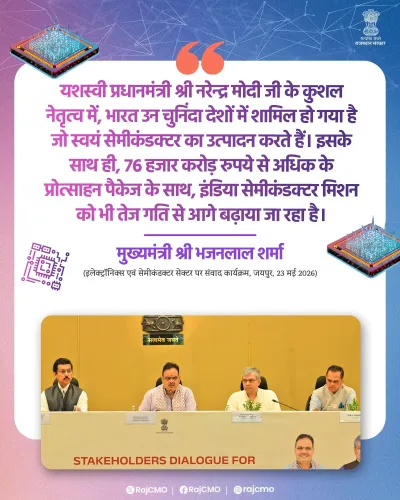
The India Semiconductor Mission carries a central outlay of Rs 76,000 crore and is administered by MeitY .
The policy targets semiconductor manufacturers and electronics investors whose projects have already cleared the central approval process.
Rajasthan joins several other states competing to attract ISM-approved projects by layering state-level fiscal incentives on top of central support.
Specific subsidy amounts and approved projects in Rajasthan have not yet been officially detailed.
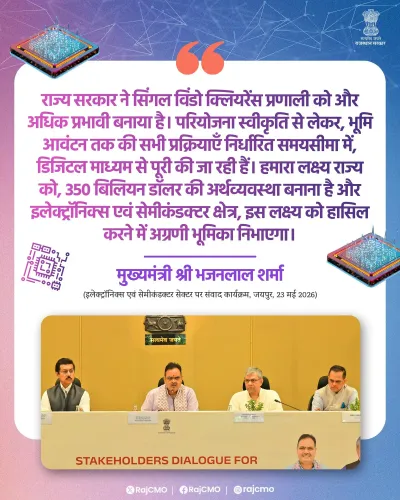
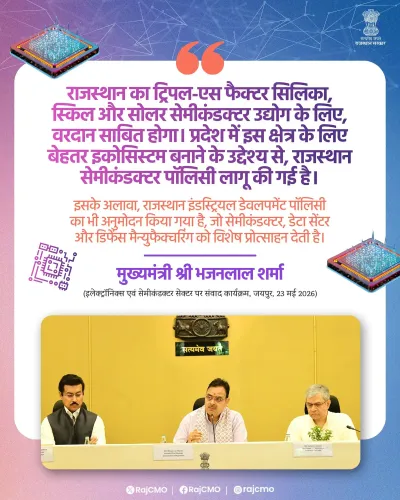
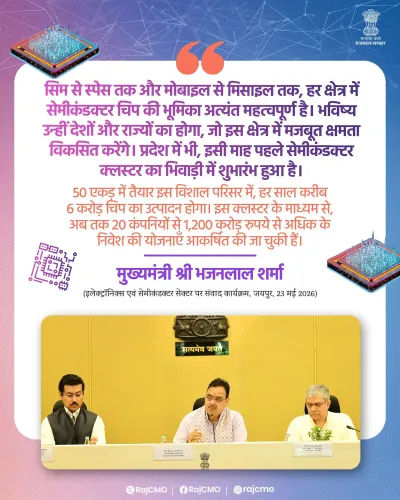
The Chief Minister's Office of Rajasthan announced on Sunday, 24 May 2026 that the state government is providing additional capital subsidies to projects approved under the India Semiconductor Mission, the Union government's flagship programme to build a domestic chip manufacturing ecosystem. The announcement, attributed to Chief Minister Bhajanlal Sharma, signals Rajasthan's intent to position itself as a preferred destination for high-value electronics investment.
Context
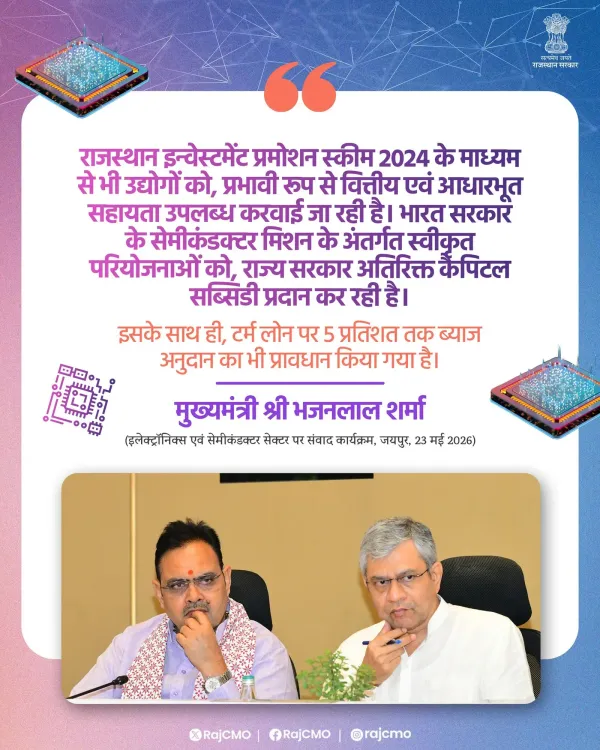
The post, shared from the official Rajasthan CMO handle, states in Hindi: 'Bharat Sarkar ke Semiconductor Mission ke antargat sweekriit pariyojanaon ko, rajya sarkar atirikt capital subsidy pradan kar rahi hai' — meaning, 'The state government is providing additional capital subsidy to projects approved under the Government of India's Semiconductor Mission.' The message was tagged to Chief Minister Bhajanlal Sharma's personal handle and carried the hashtag #AapnoAgraniRajasthan ('Our Pioneering Rajasthan'), a branding phrase used by the current BJP state administration.
Policy Backdrop
The India Semiconductor Mission (ISM) was approved by the Union Cabinet in 2021 under the Ministry of Electronics and Information Technology (MeitY), with a total outlay of Rs 76,000 crore. The mission aims to reduce India's near-total dependence on imported semiconductors by catalysing the creation of fabrication units, display fabs, and compound semiconductor facilities on Indian soil. Projects cleared under ISM are eligible for central government capital support, and states are encouraged to layer additional incentives on top.
Rajasthan's announcement of a state-level top-up capital subsidy follows a competitive pattern seen across several Indian states, each seeking to attract ISM-approved investors by sweetening the central incentive with their own fiscal support. This approach fits within the broader Atmanirbhar Bharat framework, which since 2020 has pushed for self-reliance in strategic technologies, including semiconductors, which are critical to everything from consumer electronics to defence systems.
Stakeholders and Impact
The primary beneficiaries of this policy are semiconductor manufacturers and electronics industry investors whose projects have already received approval under the central mission. For them, an additional state capital subsidy directly reduces the upfront investment burden, improving the financial viability of setting up capital-intensive fabrication or packaging units in Rajasthan. The state's industrial sector stands to gain from the downstream employment and ancillary ecosystem that semiconductor units typically generate.
The Government of Rajasthan, led by Chief Minister Bhajanlal Sharma since December 2023, has been actively working to attract investment in high-technology sectors. Supplementary capital subsidies of this nature are a standard tool in state industrial policy, used to make a state's offer more competitive relative to peers such as Gujarat, Tamil Nadu, and Telangana, which have also been aggressively courting semiconductor and electronics investments.
What's Next
Observers will watch for formal notifications from the Rajasthan Bureau of Investment Promotion or the state budget detailing the exact subsidy rates, eligible project categories, and disbursal timelines attached to this announcement. Investment summits and MoU signings with ISM-approved entities would be the next tangible milestones confirming the depth of the state's commitment. The broader question for India's semiconductor ambitions is whether state-level fiscal competition accelerates project execution or merely shifts geography without adding net capacity.
Point of View
In office since December 2023, is using fiscal incentives to signal industrial ambition and differentiate Rajasthan from rival states. This fits a well-established pattern in Indian industrial policy where central missions create the framework and states compete on the margin, but the real test will be whether Rajasthan can convert announcements into signed projects and operational units. The effectiveness of this approach will ultimately depend on the state's ability to back the subsidy pledge with land, infrastructure, and single-window clearances that semiconductor investors demand.
NationPress
10 Oct 2026
Frequently Asked Questions
What is the India Semiconductor Mission and why is it important?
The India Semiconductor Mission is a Government of India initiative approved in 2021 with an outlay of Rs 76,000 crore, designed to build domestic semiconductor and display manufacturing capacity and reduce India's dependence on imported chips.
What additional subsidy is Rajasthan offering for semiconductor projects?
The Rajasthan government is providing additional capital subsidies to projects already approved under the India Semiconductor Mission, though the exact subsidy rates and eligible categories have not yet been officially detailed.
Who is the Chief Minister of Rajasthan announcing this policy?
Chief Minister Bhajanlal Sharma of the BJP, who took office in December 2023, is the head of the Rajasthan government behind this semiconductor subsidy announcement.
Which ministry runs the India Semiconductor Mission?
The India Semiconductor Mission is administered by the Ministry of Electronics and Information Technology (MeitY) under the Government of India.
How does Rajasthan's semiconductor subsidy compare to other states?
Multiple Indian states including Gujarat, Tamil Nadu, and Telangana offer state-level capital incentives to attract semiconductor investment; Rajasthan's top-up subsidy places it within this competitive field, though specific comparative figures are not yet public.