CM Bhajanlal flags Rajasthan's Triple-S edge for semiconductors
Synopsis
The Chief Minister's Office of Rajasthan on 24 May 2026 promoted the state's 'Triple-S factor' — silica deposits, solar capacity exceeding 15 GW, and a skilled workforce — as a competitive edge for attracting semiconductor manufacturers under India's Rs 76,000-crore national chip mission.
Key Takeaways
The Chief Minister's Office of Rajasthan on 24 May 2026 coined the 'Triple-S factor' — silica, skill, and solar — as Rajasthan's pitch to semiconductor investors.
Rajasthan holds significant quartz and silica sand deposits, which are essential raw materials for semiconductor-grade silicon.
The state's installed solar capacity exceeds 15 GW , offering reliable low-carbon power for energy-intensive chip fabrication.
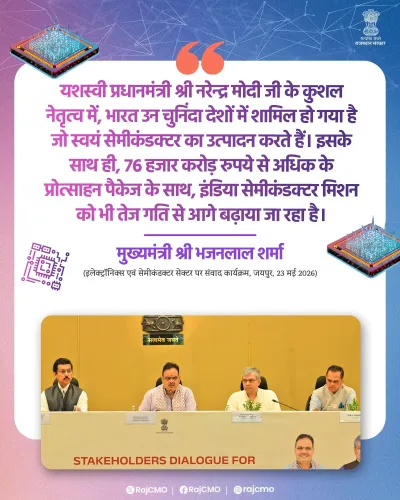
The India Semiconductor Mission , launched in 2021 with an outlay of Rs 76,000 crore , is the national framework underpinning this state-level competition.
Rajasthan's Electronics System Design and Manufacturing Policy (2022) already offers capital subsidies and single-window clearances for electronics manufacturers.
The state competes with Gujarat, Tamil Nadu, and Karnataka for semiconductor plant locations under the national mission.
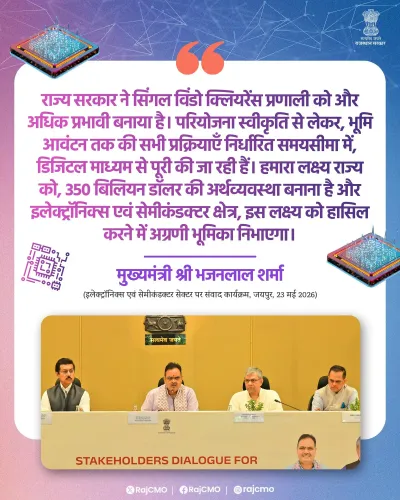
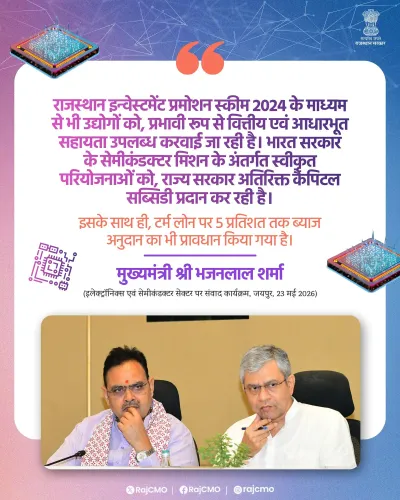
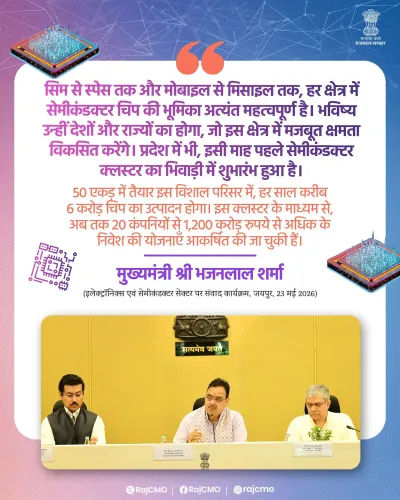
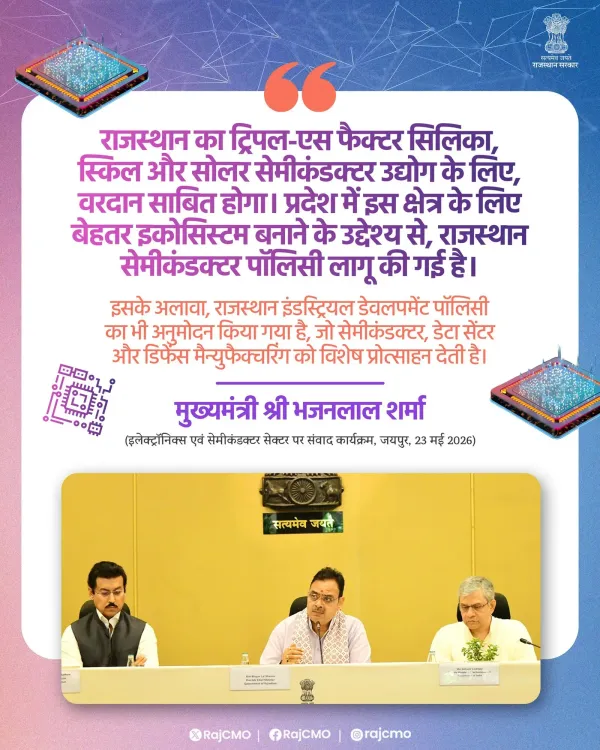
The Chief Minister's Office of Rajasthan on Sunday, 24 May 2026 highlighted the state's 'Triple-S factor' — silica, skill, and solar — as a defining competitive advantage for attracting semiconductor industry investment, in a post attributed to Chief Minister Bhajanlal Sharma.
The post, shared under the hashtag #आपणो_अग्रणी_राजस्थान ('Our Leading Rajasthan'), declared: 'Rajasthan's Triple-S factor — silica, skill, and solar — will prove to be a boon for the semiconductor industry.' The framing is a deliberate pitch to chip manufacturers and assembly units scouting locations within India's expanding domestic semiconductor ecosystem.
Context
India's semiconductor push gained formal momentum when the Government of India launched the India Semiconductor Mission in 2021 with a financial outlay of Rs 76,000 crore. The mission provides capital support, infrastructure incentives, and single-window clearances to attract fabrication, display, and chip-packaging units to the country. Multiple states have since raced to position themselves as preferred destinations for this capital-intensive sector.
Rajasthan entered this competition with its Electronics System Design and Manufacturing Policy of 2022, which offered capital subsidies and simplified approvals for electronics and component manufacturers. The latest communication from CM Bhajanlal Sharma's office signals a sharper, sector-specific pitch built around three locally abundant resources.
Policy Backdrop
Silica and quartz sand — essential raw materials in semiconductor-grade silicon production — are found in significant deposits across Rajasthan. The state also records among the highest solar irradiance levels in the country, and its installed solar capacity has crossed 15 GW, providing a foundation for the reliable, low-carbon power that energy-intensive chip fabrication plants require.
The third pillar, skill, points to the state government's ongoing emphasis on technical and vocational training for youth. Semiconductor manufacturing requires a trained workforce across design, fabrication, and testing functions — an area where state-level skilling programmes are expected to play a supporting role under the national mission's framework.
Stakeholders and Impact
The primary audience for this messaging is domestic and international semiconductor manufacturers evaluating plant locations under the India Semiconductor Mission and the broader Production Linked Incentive (PLI) framework. Rajasthan is competing directly with Gujarat, Tamil Nadu, and Karnataka, all of which have made active bids for chip-sector investment backed by industrial land banks and power infrastructure.
For Rajasthan's skilled youth, a successful semiconductor cluster would represent high-quality manufacturing employment — a key political and economic priority for the Bhajanlal Sharma government, which took office in December 2023. Supply-chain linkages could also benefit ancillary industries in chemicals, logistics, and precision engineering.
What's Next
Attention will now turn to whether the state government follows this positioning with concrete announcements — dedicated semiconductor clusters, memoranda of understanding with chip firms, or targeted incentives beyond the existing electronics policy. Upcoming investor summits and central government allocation decisions under the India Semiconductor Mission will be key milestones to watch. A formal cluster notification or an MoU with a fabrication or assembly partner would convert this narrative into verifiable policy action.
Point of View
Verifiable assets — silica geology, solar infrastructure, and workforce — rather than generic incentive packages, the state is signalling policy maturity to sophisticated industrial investors. This fits a broader pattern of BJP-governed states actively leveraging the Centre's semiconductor mission as a vehicle for economic diversification beyond traditional sectors. The real test, however, will be whether this narrative translates into binding investment commitments at upcoming summits or cluster notifications from the state industries department.
NationPress
7 Oct 2026
Frequently Asked Questions
What is Rajasthan's Triple-S factor for semiconductors?
The Triple-S factor refers to three competitive advantages Rajasthan is promoting for semiconductor manufacturing: silica deposits (a key raw material), a skilled workforce, and high solar energy capacity exceeding 15 GW for reliable power supply.
What is the India Semiconductor Mission?
The India Semiconductor Mission was launched by the Government of India in 2021 with a financial outlay of Rs 76,000 crore to build a domestic semiconductor ecosystem by attracting fabrication, display, and chip-packaging units to the country.
Why is Rajasthan promoting itself for semiconductor manufacturing?
Rajasthan is competing with states like Gujarat, Tamil Nadu, and Karnataka to attract semiconductor plants under the India Semiconductor Mission, using its silica reserves, solar infrastructure, and skilling programmes as key selling points.
What is Rajasthan's electronics manufacturing policy?
Rajasthan introduced its Electronics System Design and Manufacturing Policy in 2022, offering capital subsidies and single-window clearances to electronics and component manufacturers setting up in the state.
Who is the Chief Minister of Rajasthan in 2026?
Bhajanlal Sharma has served as Chief Minister of Rajasthan since December 2023, and his office made the Triple-S semiconductor pitch on 24 May 2026.